 Writers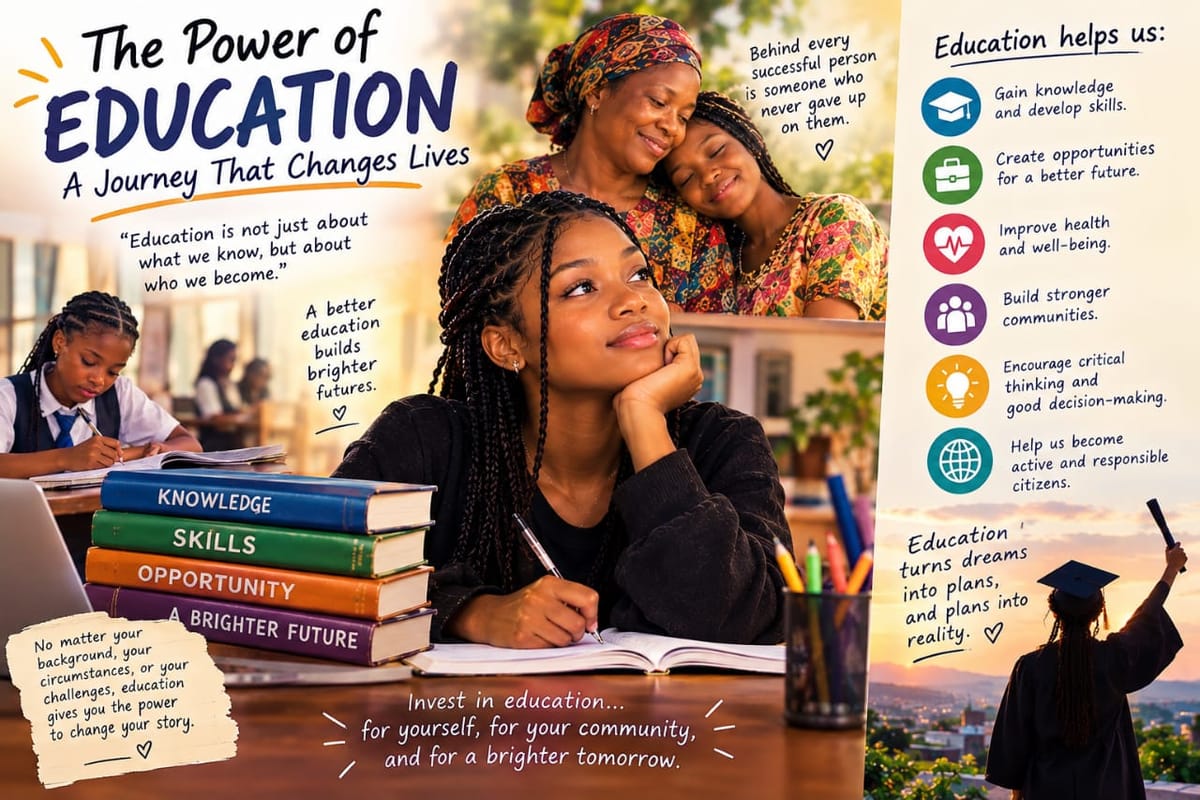
Education is one of the most powerful tools a person can possess. It is more than sitting in a classroom, writing examinations, or receiving a certificate. Education is the process of learning, understanding the world, developing skills, and gaining the ability to make informed decisions.
A person can be educated in many ways. Some lessons come from books and teachers, while others come from personal experiences, mistakes, and interactions with different people. True education does not only teach us what to think; it also teaches us how to think, how to ask questions, and how to understand the world around us.
However, not everyone has equal access to education. Some children attend well-equipped schools, while others struggle to find classrooms, textbooks, and qualified teachers. Despite these challenges, education remains a powerful opportunity for individuals and communities to build a better future.
1. Education Opens the Door to Opportunities
Imagine two young people growing up in the same community. Both have dreams of becoming successful, but their circumstances are different.
One has access to books, supportive teachers, and a school with good facilities. The other has to walk a long distance to school, share textbooks with classmates, and study without electricity at night.
Although their opportunities are different, both young people can benefit from education.
Education helps people develop knowledge and skills that can prepare them for employment, entrepreneurship, and other opportunities. It can help someone become a teacher, doctor, engineer, journalist, farmer, or business owner.
However, education does not guarantee success automatically. A certificate alone cannot replace discipline, practical experience, creativity, or hard work. People must learn how to apply their knowledge to real-life situations.
For example, a student studying business management can use that knowledge to plan a small business, manage money, understand customers, and make better financial decisions.
In this way, education becomes more than information stored in the mind. It becomes a practical tool for improving life.
2. The Importance of Education in Society
Education benefits individuals, but its importance extends to the entire society.
An educated population can contribute to economic development, improved public health, technological advancement, and responsible citizenship.
For instance, education helps people understand health information, recognise the importance of hygiene, and make informed decisions about their well-being. It can also help communities understand environmental problems and develop solutions to challenges such as waste management and pollution.
Furthermore, education encourages people to understand their rights and responsibilities. Citizens who understand how their society operates are better equipped to participate in community discussions, question harmful practices, and make informed choices.
Education can also challenge discrimination and harmful stereotypes. When people learn about different cultures, histories, and experiences, they have more opportunities to question prejudice and develop respect for others.
A society that values education invests not only in schools but also in the future of its people.
3. Challenges Facing Students Today
Although education is important, many students face difficulties that affect their academic performance.
In Nigeria, some students struggle with the cost of school fees, transportation, accommodation, textbooks, and feeding. Others attend schools with overcrowded classrooms or limited learning materials.
These difficulties can make it challenging for students to concentrate on their studies.
Financial pressure can also affect students' emotional well-being. A student who attends lectures while worrying about how to pay school fees may find it difficult to focus fully on academic work.
Another challenge is the misuse of technology. Although mobile phones and the internet provide access to educational resources, they can also become sources of distraction when students spend too much time on social media or unrelated activities.
Peer pressure is another concern. Some students may feel pressured to abandon their goals, engage in dishonest academic practices, or measure their worth by comparing themselves with others.
Addressing these challenges requires cooperation among governments, schools, parents, communities, and students themselves. Governments must work toward improving educational facilities and access, schools should provide supportive learning environments, and students should be encouraged to develop responsible study habits.
Most importantly, students experiencing difficulties should understand that asking for help is not a sign of weakness. Speaking with a trusted teacher, school counsellor, family member, or mentor can help them identify possible solutions.
4. The Role of Teachers and Parents
Teachers and parents play important roles in a child's educational journey.
A teacher does more than explain lessons. A good teacher encourages curiosity, corrects mistakes constructively, recognises students' abilities, and helps them develop confidence in learning.
Sometimes, a few encouraging words from a teacher can change how a student sees their future.
Consider a student who struggles with mathematics. If the teacher constantly calls the student unintelligent, the student may begin to believe that improvement is impossible.
However, if the teacher identifies the student's difficulties, explains the concepts patiently, and encourages regular practice, the student may gradually improve.
Parents also contribute to education by providing support, encouragement, and guidance. They do not necessarily need to know every subject in their children's curriculum to be involved.
Asking about school activities, providing time for study, encouraging honesty, and communicating with teachers can make a meaningful difference.
When teachers and parents work together, students are more likely to receive the guidance they need to develop academically and personally.
5. Education Beyond the Classroom
One important truth is that learning should not stop when a person leaves school.
The world continues to change. New technologies emerge, workplaces develop new expectations, and societies encounter unfamiliar challenges.
For this reason, people need to remain willing to learn throughout their lives.
Reading books, learning a language, attending workshops, taking online courses, asking questions, and learning practical skills are all ways to continue developing knowledge.
For example, a university graduate who learns digital communication, financial management, or computer skills may discover additional ways to apply their existing qualifications.
Likewise, a person who did not have the opportunity to complete formal education can still develop valuable skills through vocational training, apprenticeships, and other learning opportunities.
Formal education is important, but learning can happen in many environments.
The most important qualities are curiosity, patience, and a willingness to improve.
6. The Relationship Between Education and Character
Education should not focus only on academic achievement. It should also encourage honesty, responsibility, respect, empathy, and critical thinking.
A person may possess several certificates but still make harmful decisions if they lack integrity and consideration for others.
For example, a student who cheats during examinations may receive a high score without understanding the subject properly. Although the result may appear successful, the student loses an opportunity to learn and develop personal responsibility.
In contrast, a student who admits a mistake, studies harder, and improves through honest effort develops knowledge and character together.
Education should help people recognise that success is not only about reaching personal goals. It is also about how they treat others and contribute to their communities.
A truly educated person should be willing to listen, examine evidence, admit when they are wrong, and continue learning.
7. What Students Can Do to Improve Their Education
Students can take practical steps to make their learning more effective.
First, they should develop a realistic study timetable. Organising time helps students balance academic responsibilities with rest and other activities.
Second, they should learn to ask questions. When a topic is unclear, seeking an explanation is more useful than pretending to understand.
Third, students should practise what they learn. Reading alone may not be enough for subjects that require problem-solving, writing, speaking, or practical application.
Fourth, they should choose their friends wisely. Friends who encourage learning, honesty, and responsible behaviour can positively influence academic progress.
Finally, students should avoid judging their abilities entirely by one examination result. Poor performance can reveal areas that need improvement, but it does not determine a person's entire future.
The important thing is to understand what went wrong, seek guidance when necessary, and develop a better approach.
Progress often comes through consistent effort rather than sudden changes.
Conclusion
Education is one of the foundations upon which individuals and societies can build a better future. It develops knowledge, improves skills, encourages critical thinking, and creates opportunities for personal and social development.
Nevertheless, education is not limited to obtaining certificates or achieving high examination scores. It also involves learning how to make responsible decisions, understand other people, solve problems, and contribute positively to society.
Although many students face financial difficulties, inadequate facilities, and other challenges, their educational journeys can be supported through cooperation, practical assistance, and encouragement.
Governments must continue working to improve access to quality education, teachers must guide students with patience, parents should provide support where possible, and students must take responsibility for their learning.
Above all, we must understand that learning is a lifelong process. There will always be something new to discover, a skill to develop, or an idea to understand more deeply.
Education may not remove every obstacle from our path, but it can help us understand those obstacles, discover possible solutions, and make better decisions about our future.
A society that invests in education invests in human potential. And when people are given opportunities to learn, they are better equipped to improve their lives and contribute to the world around them.