 Writers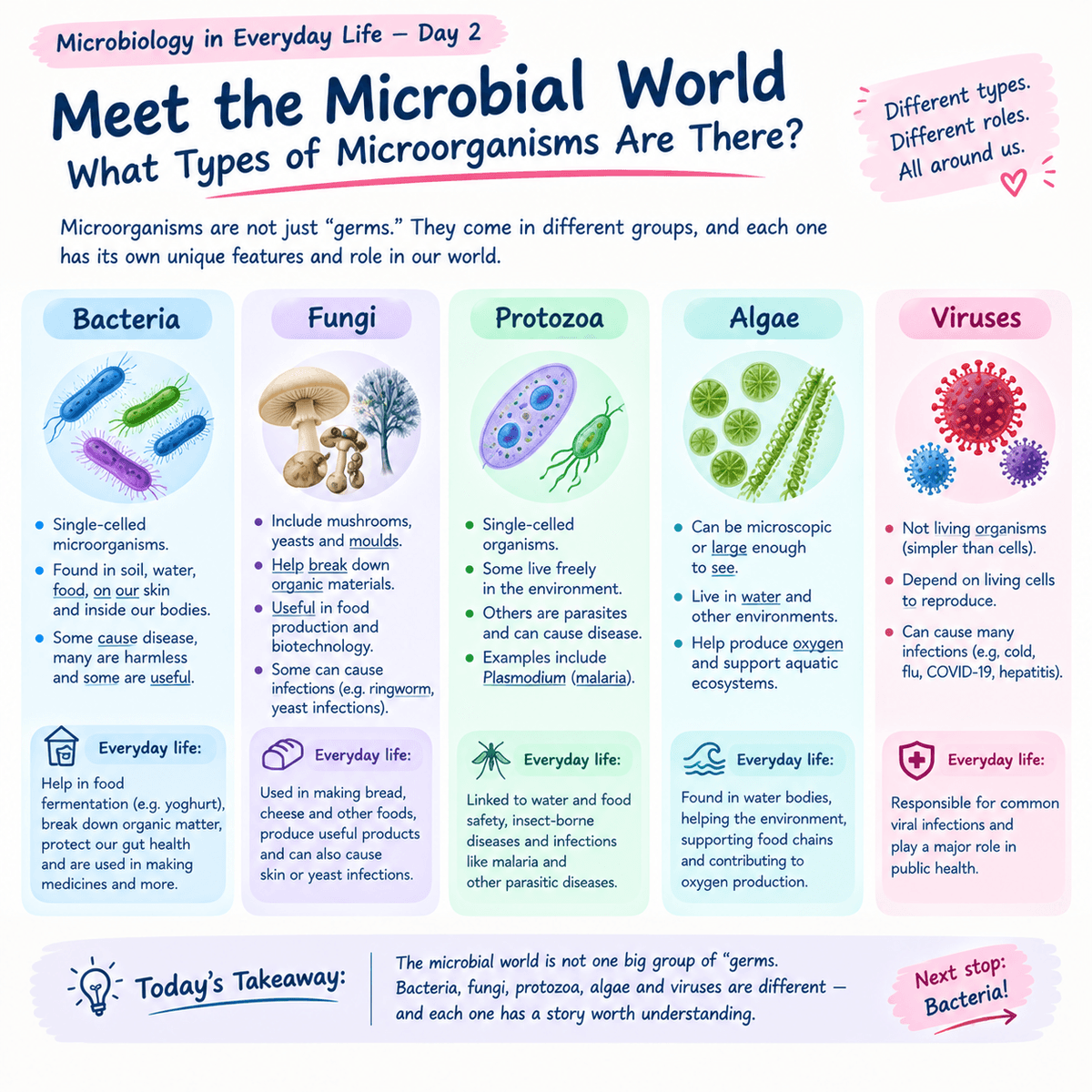
MICROBIOLOGY IN EVERYDAY LIFE — DAY 2
Meet the Microbial World: What Types of Microorganisms Are There?
Yesterday, we took our first step into microbiology.
We talked about something very simple but important: the microbial world is much bigger than the word “germs.”
Today, let's go a little deeper.
If microorganisms are everywhere around us, what exactly are they?
Are they all bacteria?
No.
The microbial world contains different groups of organisms and infectious agents, and each group has its own characteristics.
Let's meet some of them.
1. Bacteria 🦠
You've probably heard this word more than any other.
Bacteria are single-celled microorganisms found in places such as soil, water, food, on our skin and inside our bodies.
But here's something people often get wrong:
Not all bacteria are harmful.
Some bacteria can cause disease, but many others live alongside us without causing illness, and some perform useful functions.
Bacteria are also involved in processes we encounter every day, including food fermentation and the breakdown of organic matter.
So the next time you hear “bacteria,” don't immediately think “disease.”
There is a much bigger story.
We'll dedicate our next article entirely to bacteria.
2. Fungi 🍄
Fungi are another fascinating group.
When you hear “fungus,” you might immediately picture mushrooms.
And yes, mushrooms are fungi.
But fungi are much more diverse than the mushrooms we see.
Some are microscopic, including yeasts and moulds.
Fungi are important in nature because they help break down organic materials. They are also useful in food production and biotechnology.
At the same time, some fungi can cause infections such as ringworm and certain yeast infections.
So again, we have both sides:
Some fungi are useful. Some can cause disease.
3. Protozoa 🔬
Now let's meet a group many people may not have heard much about outside a biology classroom.
Protozoa are microscopic, single-celled organisms.
Some live freely in the environment, while others can live as parasites.
For example, Plasmodium, the parasite responsible for malaria, belongs to this broad group.
Other protozoa can be associated with contaminated food or water or transmitted by insects and other vectors, depending on the organism.
This is where microbiology begins to connect very clearly with everyday life:
the water we drink, the food we eat and the insects around us can all have microbiological significance.
4. Algae 🌿
Yes, algae also have a place in the microscopic world.
Some algae are microscopic and live in water.
They can contribute to aquatic ecosystems and produce oxygen through photosynthesis.
Not every alga is microscopic, though. Some are large enough to see easily.
So when we talk about microorganisms, we are not saying that every member of a group is necessarily invisible to the naked eye.
We're talking about organisms that include microscopic forms.
5. Viruses 🧬
Then we have viruses.
Viruses are a little different from the cellular microorganisms we've mentioned.
They are extremely small infectious agents that depend on living host cells to reproduce.
You've probably encountered viruses without even thinking about microbiology:
the common cold, influenza, COVID-19, hepatitis and many other infections involve viruses.
Viruses are therefore a major part of what microbiologists study.
So, why should you care about all these names?
Because these organisms are not living in some distant laboratory.
They are around us.
They are in soil.
In water.
In food.
On surfaces.
In our environment.
And some live on and inside our bodies.
Some help us.
Some are harmless.
Some spoil food.
Some help produce food and useful products.
And some cause disease.
Understanding these differences is one of the reasons microbiology matters.
You don't need to become a microbiologist to benefit from knowing this.
The next time someone says, “It's just bacteria,” you should know enough to ask:
Which bacteria?
And when someone says, “All microbes are dangerous,” you'll know that isn't the whole story.
TODAY'S MICROBIOLOGY TAKEAWAY
The microbial world is not one big group of “germs.”
Bacteria, fungi, protozoa, algae and viruses are different and each has a story worth understanding.
And we're going to take them one at a time.
Next : BACTERIA.
