 Writers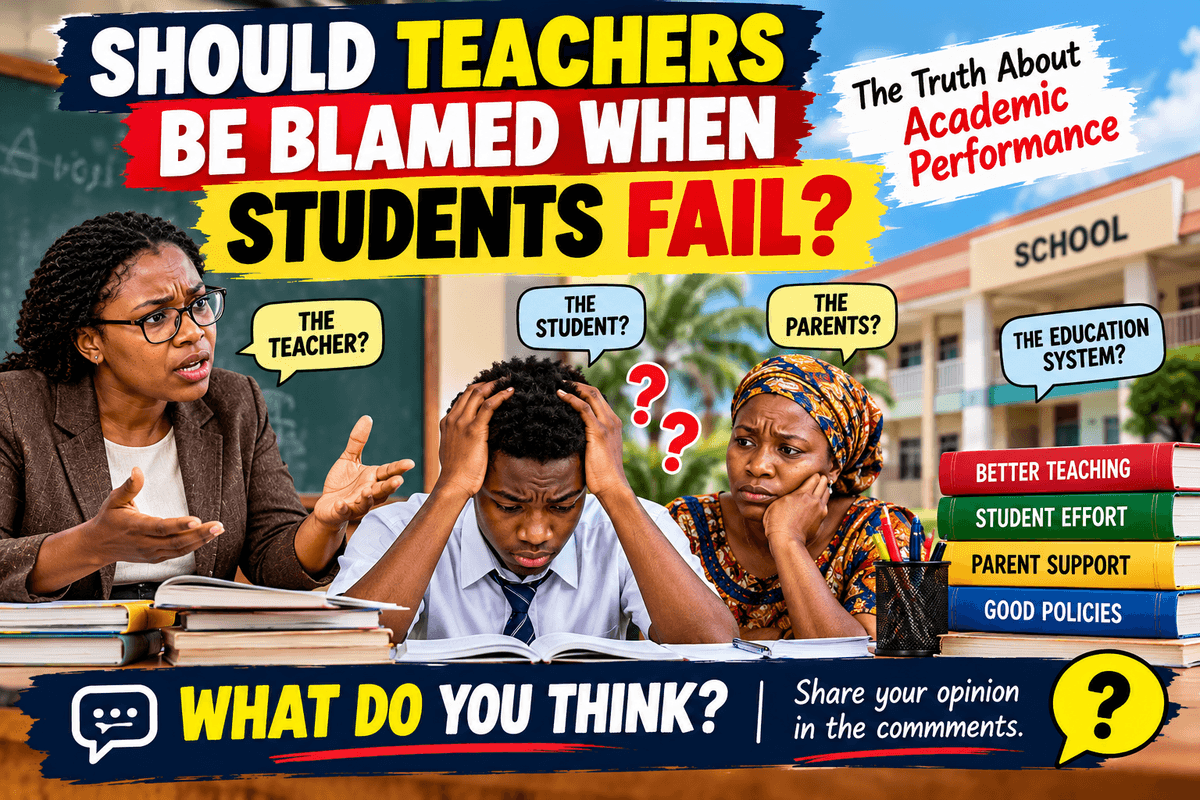
Imagine a student who consistently performs poorly in school. The parents blame the teachers, the teachers blame the student's lack of seriousness, and the student complains that the lessons are difficult to understand.
Everyone has someone to blame, but nobody seems interested in finding a solution.
This situation raises an important question: When students fail their examinations, who should take responsibility—the teachers, the students, the parents, or the education system?
Academic failure is a serious concern for students, parents, teachers and educational institutions. However, understanding its causes requires looking beyond examination results.
Are Teachers Responsible for Students' Failure?
Teachers play an important role in the learning process. They explain concepts, provide guidance, assess students' understanding and help learners develop the knowledge and skills they need.
A teacher who prepares lessons carefully, explains difficult topics clearly and encourages students to ask questions can make learning easier.
However, when teaching methods are ineffective, lessons are poorly delivered or students receive little support when they struggle, their academic performance may suffer.
Teachers should therefore be willing to evaluate their teaching methods and identify areas that need improvement.
Nevertheless, it would be unfair to blame teachers for every student who fails an examination.
Even an excellent teacher cannot guarantee that every student will achieve the same result.
Do Students Also Have a Responsibility?
Absolutely.
Education requires participation from both teachers and learners.
Students are expected to attend classes, pay attention, complete assignments, ask questions and study independently.
A student who spends most of their time on entertainment, neglects assignments and begins preparing for examinations only a few days before the examination may struggle academically.
Similarly, some students are afraid to ask questions when they do not understand a topic. They remain silent in class and discover their difficulties only when examinations approach.
Students must understand that teachers can provide knowledge and guidance, but they also have to make an effort to learn.
You cannot expect someone else to do all the work required for your success.
What Role Do Parents Play?
Parents and guardians also influence children's academic development.
A supportive home environment can encourage children to take their education seriously. Parents can monitor school attendance, provide reasonable study time, communicate with teachers and encourage children when they encounter difficulties.
However, not every parent has the same financial resources, educational background or amount of free time.
Some parents work long hours to provide basic necessities, while others may struggle to afford textbooks, school fees, transportation or internet access.
These circumstances can affect a child's learning experience.
Therefore, parents should be encouraged to support their children's education without assuming that academic difficulties always result from laziness or poor parenting.
What About the Education System?
Sometimes, the problem goes beyond individual teachers, students and parents.
Overcrowded classrooms, inadequate learning materials, limited access to technology and insufficient support for students with learning difficulties can create serious educational challenges.
A student who cannot hear the teacher clearly in an overcrowded classroom may struggle regardless of how determined they are to learn.
Similarly, a teacher managing an excessive number of students may find it difficult to give each learner individual attention.
This is why improving education requires cooperation among students, teachers, parents, school administrators and government institutions.
Blaming one person without examining the circumstances may prevent the real problem from being addressed.
So, Who Should Take Responsibility?
The truth is that academic performance is influenced by several factors.
Teachers are responsible for effective instruction. Students must make a genuine effort to learn. Parents should provide reasonable support, while school administrators and policymakers must work to create an environment where learning is possible.
When a student fails, the first question should not always be, "Who is responsible?"
A more productive question might be, "What caused the failure, and what can we do differently to improve the next result?"
Failure should be taken seriously, but it should also provide an opportunity to identify weaknesses, improve teaching methods and help students develop better learning habits.
THE BIG QUESTION
When a student fails an examination, who do you think should take the greatest responsibility: the teacher, the student, the parents or the education system?
If a class of 40 students is taught by one teacher and 30 students fail the same subject, would you blame the teacher, or would you investigate other possible causes first?
Share your opinion in the comments. Let's have a meaningful discussion!
