 Writers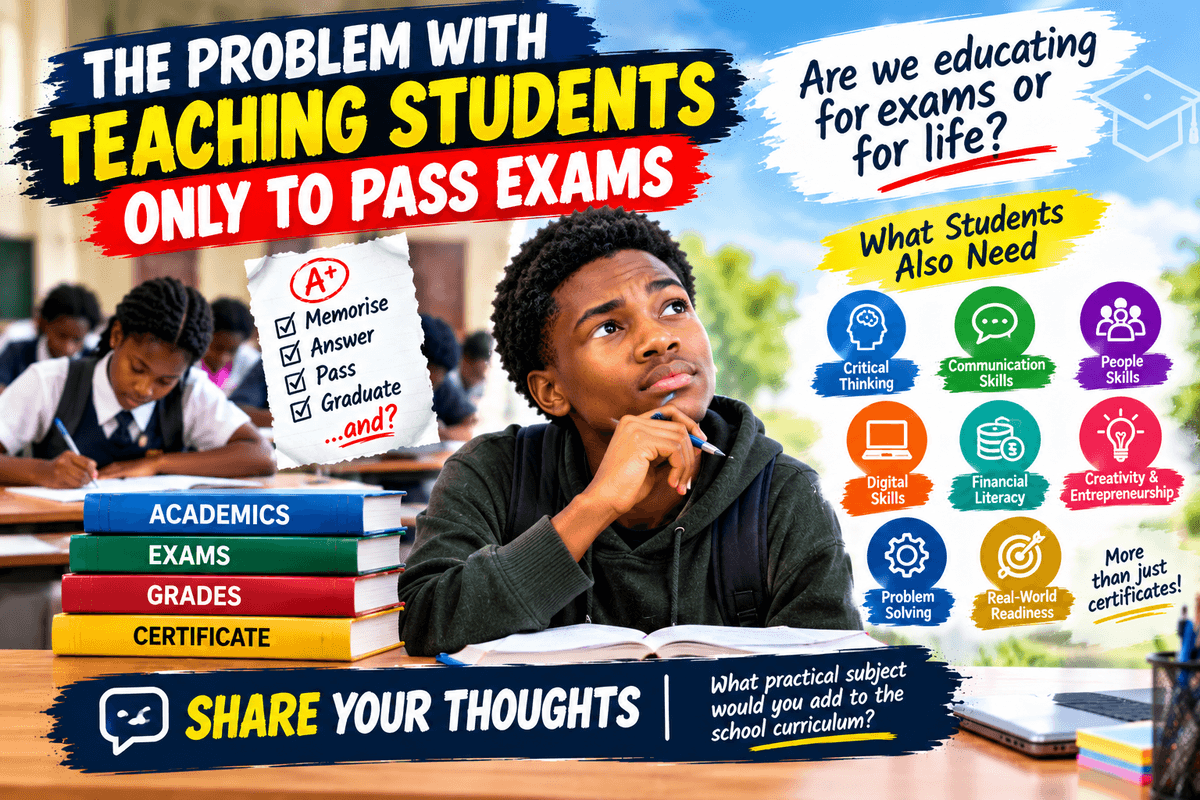
Education is often measured by examination results.
A student gets good grades, receives praise from parents and teachers, gains admission into a higher institution and eventually graduates. But after spending many years in school, an important question remains:
Does passing examinations mean that a student is truly prepared for life?
Examinations are important. They help schools assess whether students understand what they have been taught. Good academic performance can also open doors to higher education and employment.
However, education should be more than memorising information, answering examination questions and collecting certificates.
When Students Learn Only to Pass
One of the challenges in education is that some students become more interested in passing examinations than understanding what they are learning.
A student may memorise an entire textbook before an examination and perform excellently, but forget most of the information shortly afterwards.
Another student may know how to answer theoretical questions but struggle to communicate effectively, solve practical problems, manage money, work with others or make independent decisions.
This raises an important question:
Are we educating students for examinations or preparing them for life?
The Skills Students Need
Modern education should help students develop practical skills alongside academic knowledge.
Students need to learn how to think critically, communicate clearly, solve problems and work with people from different backgrounds.
They also need digital skills because technology has become an important part of education, employment and business.
Financial literacy is another important area. A student may graduate with excellent academic results but have little understanding of budgeting, saving, responsible borrowing, investment or managing personal income.
Similarly, students should have opportunities to develop creativity and entrepreneurship.
Not every graduate will immediately find a conventional office job. Some may become entrepreneurs, freelancers, researchers, teachers, content creators, designers, technicians or professionals in other fields.
Education should therefore help students understand that there are multiple legitimate ways to build a meaningful career.
What About Teachers?
This does not mean teachers should stop preparing students for examinations.
Examinations remain important, particularly when students need academic qualifications for further education or employment.
The problem arises when examination success becomes the only measure of educational success.
Teachers can combine academic instruction with practical activities, discussions, group projects, problem-solving exercises and real-life examples.
Instead of simply asking students to memorise a definition, teachers can ask them to explain how that concept applies to a situation they may encounter outside the classroom.
That approach can make learning more meaningful.
Parents Also Have a Role
Parents sometimes place enormous pressure on children to obtain the highest grades.
While encouraging academic excellence is positive, children should also be encouraged to develop their talents, interests and practical abilities.
A child who struggles in one subject may be exceptionally talented in another area.
Not every successful person will follow exactly the same educational or career path.
The goal should therefore not be to produce children who can only pass examinations, but young people who can think, adapt, communicate and contribute positively to society.
Education Should Prepare Students for the Real World
A certificate can open a door, but skills, character, knowledge and adaptability can determine what happens after the door is opened.
The ideal education system should therefore balance academic knowledge with practical skills.
Students should leave school not only knowing how to answer questions on an examination paper but also knowing how to approach problems, make responsible decisions, communicate with others and continue learning.
THE BIG QUESTION
Do you think schools today are preparing students for real life, or are they mainly preparing them to pass examinations?
If you could add one practical subject to the secondary-school curriculum, what would it be—financial literacy, entrepreneurship, digital skills, communication, vocational training, or something else?
Share your opinion in the comments.
