 Writers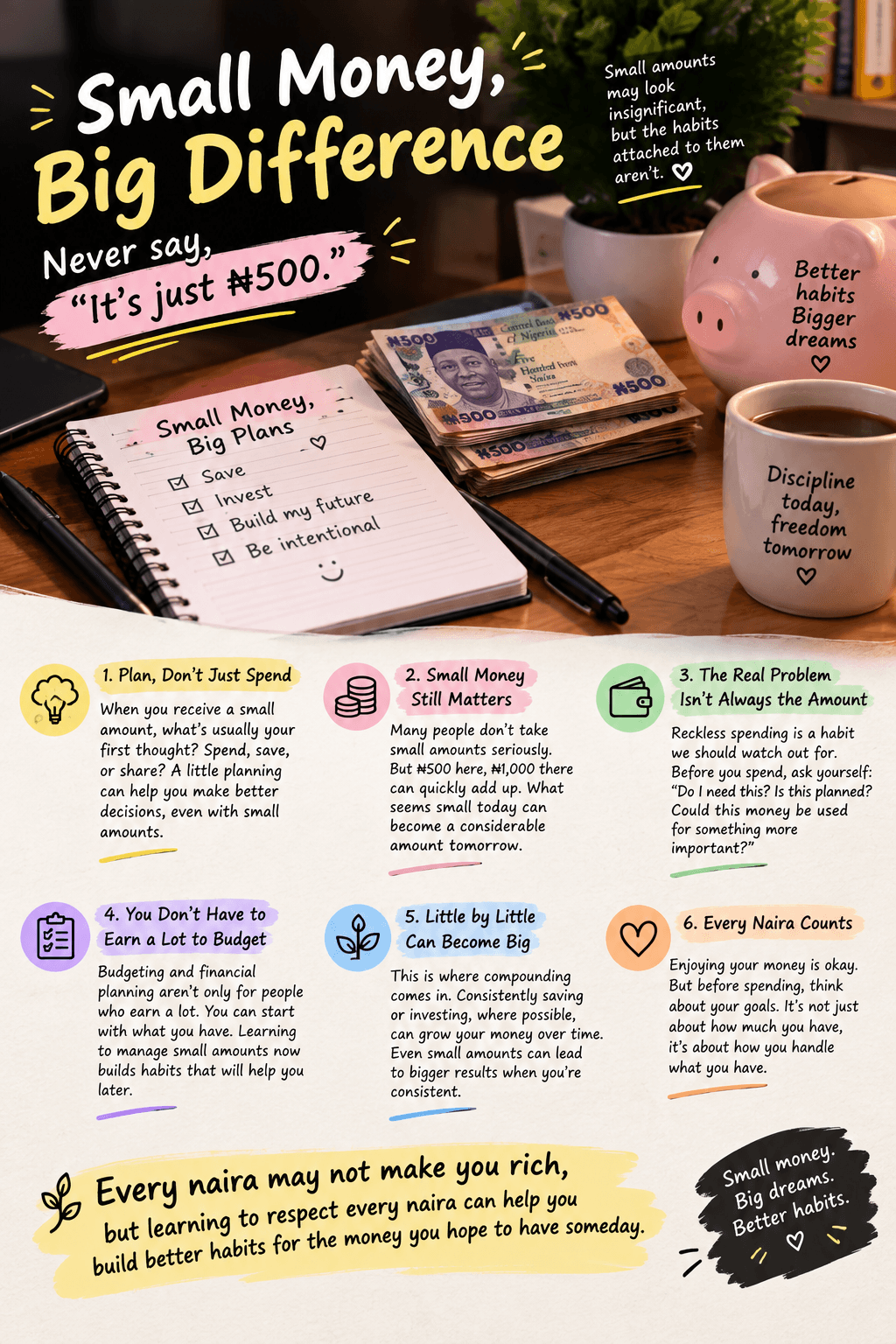
Have you ever had a small amount of money and thought, “It’s just ₦500, what difference can it really make?”
I think many of us have had that mindset at one point.
When the amount is small, it can feel like it doesn't matter much. Spending ₦500 on something unnecessary may not seem like a serious financial decision.
But what if we stopped looking at each amount separately and started looking at the habit behind the spending?
Small Money Still Matters
Whenever I receive money, one of the first things I usually think about is what I can do with it.
I don't think every small amount needs to be saved. Sometimes you genuinely need to spend money, and that's completely normal.
The problem is when we develop the habit of spending without thinking simply because the amount seems too small to matter.
₦500 today.
₦1,000 tomorrow.
Another ₦500 on something you didn't really need.
Then another small purchase.
Individually, each one may seem insignificant. But together, they can become a considerable amount.
The Real Problem Isn't Always the Amount
I think reckless spending is one of the habits we should pay more attention to.
Someone might say, “It's only ₦500.”
But the question shouldn't only be how much are you spending?
It should also be:
“Why am I spending it?”
Did you actually need the item?
Did you plan for the expense?
Could that money have been used for something more important?
Learning to ask these questions doesn't mean you have to become extremely strict with your money.
It simply means you're becoming intentional.
You Don't Have to Earn a Lot Before You Start Managing Money
Another misconception is that budgeting and financial planning are only for people who earn a lot.
I don't agree.
You don't need to be wealthy before you start learning how to manage money.
In fact, learning to manage small amounts can help you develop habits that become useful when you eventually have more.
If someone receives a small amount and immediately spends everything without thinking, earning more money doesn't automatically solve that habit.
The amount may increase, but so can the spending.
That's why financial discipline isn't only about how much you have.
It's also about how you handle what you have.
Little by Little Can Become Something Big
This is where the idea of compounding becomes interesting.
The principle behind compounding is that growth can build on previous growth over time. So consistently saving or investing, where appropriate, can potentially produce results that are much larger than the individual amounts you started with.
Of course, simply putting money aside doesn't magically make it grow. The actual result depends on where the money is saved or invested, the return, fees, time and other factors.
But the bigger lesson remains:
Small, consistent actions can become significant over time.
The same thing can happen with spending.
If we repeatedly waste small amounts because we believe they don't matter, those small decisions can gradually become a bigger financial problem.
Every Naira Counts
I'm not saying you should feel guilty every time you spend ₦500.
Enjoying your money is also part of having a healthy relationship with it.
But before spending, it's worth developing the habit of thinking.
Do I need this?
Is this planned?
What else could I do with this money?
Sometimes you'll still decide to spend it.
That's fine.
The difference is that you're making a conscious decision instead of spending simply because “it's just ₦500.”
Start With What You Have
You don't have to wait until you start earning millions before you become financially responsible.
Start with what you have.
Learn to plan.
Learn to save when you can.
Think before spending.
And don't underestimate small amounts simply because they are small.
Because money habits are built through repeated decisions.
Every naira may not make you rich, but learning to respect every naira can help you build better habits for the money you hope to have someday.