Writers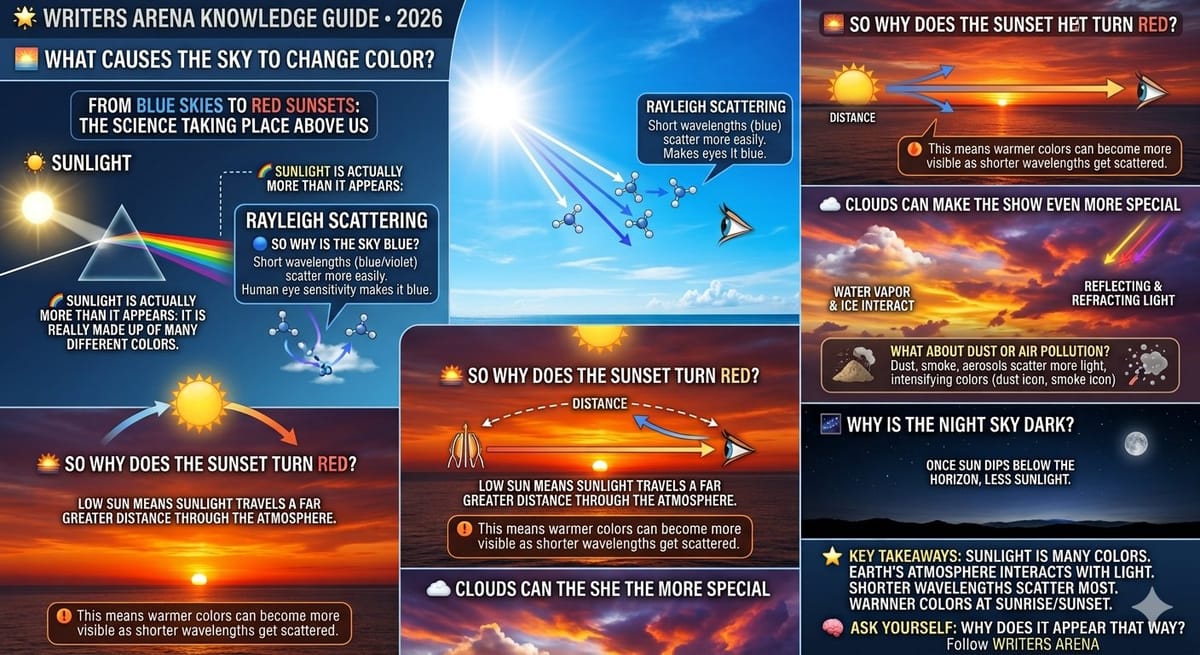
From Blue Skies to Red Sunsets: The Science Taking Place Above Us
🔥 LOOK UP—THERE'S MORE GOING ON THAN YOU REALIZE
On a bright summer afternoon, the sky can look like a lovely shade of blue
yet a few hours later, that same sky might take on orange, pink, or red tones. When night arrives, the sky grows dark and stars can come into view. But does the sky truly change colors? Let's find out! The story really starts with something you know very well:
☀️ SUNLIGHT
🌈 SUNLIGHT IS ACTUALLY MORE THAN IT APPEARS
Although sunlight looks white to our eyes, it is really made up of many different colors. When light travels through certain materials, various colors can emerge and separate, as they do in a rainbow. The atmosphere also influences sunlight. As sunlight moves through the atmosphere, it meets molecules and particles in the air, which causes it to scatter.
🔵 SO WHY IS THE SKY BLUE?
Nitrogen, oxygen, and other tiny molecules in the atmosphere are what cause sunlight to scatter. How the light scatters depends on the wavelength of each color. Wavelengths of blue and violet visible light scatter more easily than those of red light do. The sensitivity of the human eye is another factor to consider. Our eyes respond more strongly to blue light than to violet light, and sunlight's visible spectrum also contains more blue light than violet light. So when you gaze at a blue sky, what you're really seeing are the results of sunlight that has been scattered.
🌅 SO WHY DOES THE SUNSET TURN RED?
This is where things get especially interesting. When the sun sits high in the sky, its light has a fairly short distance to cover before it reaches your eyes. Around sunrise or sunset, the sun hangs low on the horizon, which means the sunlight must travel a far greater distance through the atmosphere to reach your eyes. Because of this scattering process, the amount of blue light that reaches you can drop dramatically, letting the leftover, unscattered light look more yellow, orange, or red.
☁️ CLOUDS CAN MAKE THE SHOW EVEN MORE SPECIAL
Clouds, too, can add their own distinctive touches to the display. When the sun's rays move through clouds, water vapor and ice can interact with the light, reflecting and refracting it to create some striking effects. Thanks to this, we get to see stunning golden and crimson shades of orange, pink, red, and purple spread across the sky. The final result depends on a range of atmospheric conditions, cloud formations, particles, humidity, and the sun's position, which is why no two sunsets ever look exactly alike.
🌫️ WHAT ABOUT DUST OR AIR POLLUTION?
Tiny particles floating in the atmosphere can also play a role in shaping the effect. Dust, smoke, aerosols, volcanic grit, and other substances can all have an impact. A vivid red or orange sky does not automatically signal a specific kind of pollution. Atmospheric effects are intricate, and numerous factors contribute to producing the effect.
🌌 WHY IS THE NIGHT SKY DARK?
Once the sun dips below the horizon, the atmosphere overhead no longer holds the same amount of sunlight it did during the day. Consequently, the sky looks dark and the stars come into view (that is, if you are not in a city where artificial light can scatter into the atmosphere and brighten the night sky) .
💡 THE INTERESTING PART
Colors serve as a reminder that what we observe is not always what we see.
A red sunset does not require the sun to change color—the atmosphere can affect the light's journey before it reaches our eyes.
❓ QUESTIONS YOU MAY HAVE
Q: Is the sky actually blue?
A: The atmosphere is not truly blue the way paint is. What you are seeing as blue is really sunlight being scattered by molecules in the atmosphere.
Q: Why isn't the sky always blue?
A: A mix of atmospheric conditions, clouds, particles, the sun's position, and other factors can shape how light reaches our eyes and alter the apparent color of the sky.
Q: Why can sunsets look different every day?
A: The quantity and types of clouds and particles present in the atmosphere differ, which affects how the sun's light is scattered and transmitted. Conditions are able to shift from one day to the next.
Q: What makes some sunsets so intensely red?
A: Traveling a longer distance through the atmosphere, along with particular particles, can eliminate or scatter a greater share of the shorter wavelengths. This enables more light of longer wavelengths to reach your eyes. Furthermore, where the sun sits in the sky can also influence how intense the color becomes.
⭐ KEY TAKEAWAYS
☀️ Sunlight really is made up of many colors that we can see.
🌍 The Earth's atmosphere is able to interact with sunlight.
🔵 It is the shorter wavelengths of light that get scattered the most.
🌅 Around sunrise and sunset, sunlight must travel a greater distance through the atmosphere
🟠 This means warmer colors can become more visible
☁️ Clouds and particles within the atmosphere strongly shape how light is scattered and transmitted across the sky
🤝 AN ETHICAL PERSPECTIVE
Science offers us a valuable lesson here: seeing something isn't the same as understanding it. A lovely sunset might appear to hold no great mystery, yet there are in fact important scientific principles that make it happen. Isn't it wonderful when a curious mind turns seemingly ordinary things into something far more fascinating?
🏁 CONCLUSION
The next time you glance up at a vivid blue sky or catch a stunning sunset and marvel at how lovely it is, remember that what you're witnessing is far more intriguing than you'd probably imagine! In reality, these interactions amount to a kind of experiment happening right above you.
Whenever you next see a blue sky or a dazzling sunset, keep this in mind:
It's truly a little science lesson unfolding right over your head!
📢 CALL TO ACTION
When you next gaze at the sky, don't just leave it at asking, "What color is it?" Ask yourself,
🧠 "Why does it appear that way?"
A single question can turn something ordinary into something extraordinary.
Source: NASA - Why Is the Sky Blue?
NASA Science: Why Is the Sky Blue?
🌟 Follow Writers Arena for more captivating guides that unpack the science, technology, society, and ideas shaping the world around us.