 Writers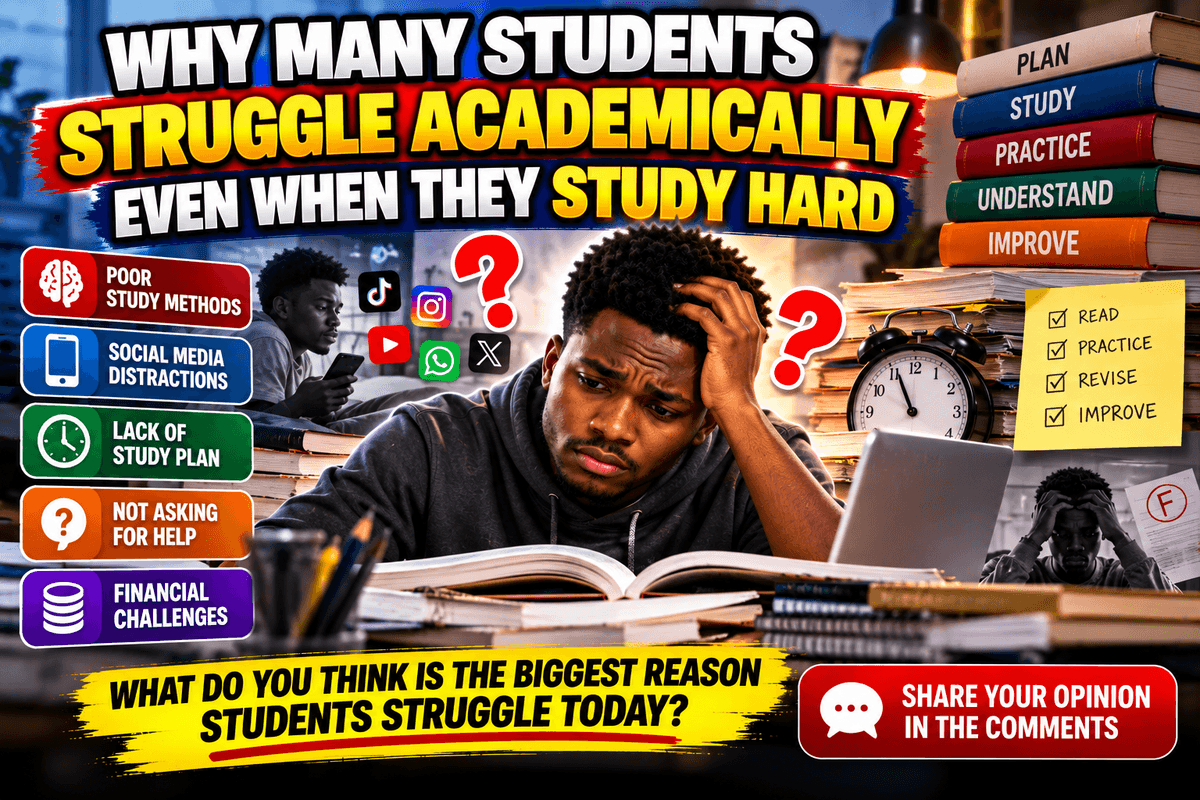
Education is often presented as a simple formula: attend classes, read your books, practise past questions and prepare for examinations. However, many students discover that studying hard does not always produce the results they expect.
A student may spend several hours reading every day and still perform poorly in examinations. Another student may appear to study less but consistently achieve better results. Why does this happen?
The answer is that effective learning is not always about the number of hours spent studying. It is also about how those hours are used.
Studying Without Understanding
One common problem among students is memorising information without actually understanding it.
A student may memorise definitions, formulas or answers simply because they want to reproduce them during an examination. While memorisation has its place in education, understanding allows students to apply knowledge to different questions and real-life situations.
For example, a student who understands a mathematical formula is more likely to solve a new problem than someone who only memorised the formula.
Poor Study Methods
Not every study method works equally well for everyone.
Some students spend hours reading the same textbook repeatedly without testing whether they can remember or explain what they have read. Others study only when examinations are approaching, creating unnecessary pressure.
Effective studying can involve different approaches, such as making concise notes, practising questions, explaining concepts in one's own words, using past examination questions and regularly reviewing previously learned materials.
Distractions and Digital Devices
Technology has become an important part of modern education, but it can also become a major source of distraction.
A student may sit down intending to study for two hours but spend much of that time checking social media, responding to messages, watching videos or browsing unrelated content.
The problem is not necessarily the phone itself. Smartphones can provide access to educational materials, online courses, dictionaries, tutorials and research resources. The important issue is how the student uses the device.
Lack of a Study Plan
Studying without a plan can also make learning difficult.
A student who simply opens a textbook and reads whatever comes to mind may eventually realise that important topics have been neglected. Having a realistic study timetable can help students divide their subjects into manageable sections.
A good study plan should also include breaks. Studying continuously for many hours without rest can make concentration more difficult.
The Importance of Asking for Help
Some students are afraid to admit that they do not understand a particular topic. They may remain silent in class because they are worried that their classmates or teacher will think they are not intelligent.
However, asking questions is an important part of learning.
Students can ask teachers, classmates, lecturers or other knowledgeable people for clarification. They can also use reliable educational resources to improve their understanding.
There is nothing embarrassing about not understanding something immediately. The real problem is refusing to seek help when it is needed.
Education Is More Than Examination Results
Academic performance is important, but education should not be reduced entirely to examination scores. Education is also about developing critical thinking, communication skills, problem-solving abilities, creativity and the ability to apply knowledge.
A student who learns how to think, investigate and solve problems may benefit from education long after leaving the classroom.
Conclusion
If a student is struggling academically, the solution may not always be to study for more hours. Sometimes, the student needs to change the way they study, reduce distractions, create a better timetable, ask questions and focus more on understanding than memorisation.
What do you think is the biggest reason students struggle academically today: poor study habits, social media, lack of motivation, difficult teachers, financial challenges, or something else?
