 Writers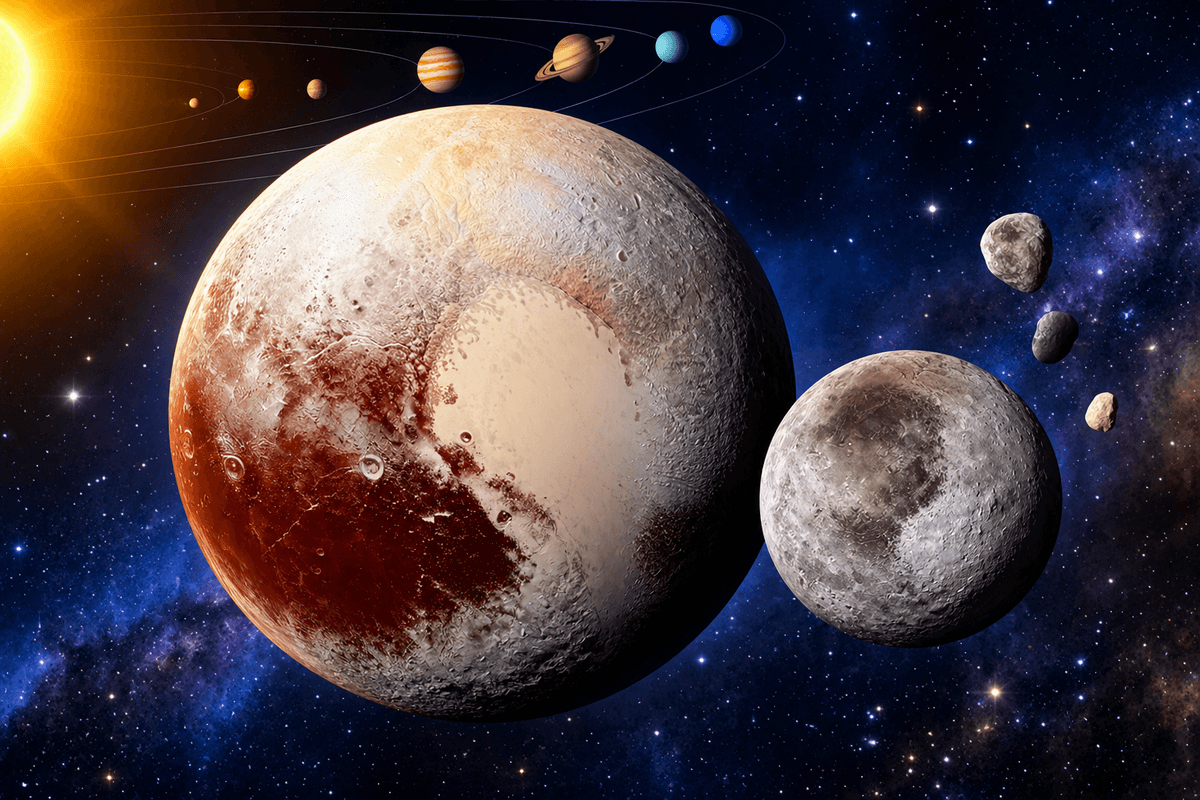
One of the solar system's most fascinating and enigmatic items is Pluto. Far beyond Neptune lies a tiny, chilly planet. Pluto was considered the ninth planet in the solar system for a long time. However, scientists later altered its classification and now refer to it as a dwarf planet. Pluto is still drawing interest from space enthusiasts and scientists throughout the globe, even with its little size.
American astronomer Clyde Tombaugh found Pluto in 1930. At the time, scientists believed there was a second large planet besides Neptune. As a result, Pluto was embraced as the ninth planet. For more than 75 years, it remained in that position.
The International Astronomical Union altered the definition of a planet in 2006. In accordance with the updated definition, a planet must orbit the Sun, have enough gravity to be virtually spherical, and remove the majority of other items from its orbital route. The first two criteria are satisfied by Pluto, but the third one isn't. It was therefore downgraded to a dwarf planet.
Pluto is very far from the Sun. Sunlight that reaches Pluto is significantly less powerful than the sunlight we experience on Earth due to this enormous distance. Pluto is also extremely cold, with temperatures that can approach -230 degrees Celsius. Its surface is composed of frozen substances such as nitrogen, methane, and carbon monoxide.
Despite its diminutive size, Pluto has a surface that is surprisingly intricate. Mountains, valleys, plains, and regions covered in ice were visible in images acquired by NASA's New Horizons spacecraft in 2015. The tombaugh region, a big, bright, heart-shaped region, is one of its most well-known features. Because of this feature, Pluto grew in popularity worldwide.
Additionally, Pluto has multiple satellites. About half the size of Pluto, Charon is the largest of these. Since Charon is so much bigger than Pluto, the two things are occasionally called a "double system." Styx, Nix, Kerberos, and Hydra are the four other moons that are known to exist around Pluto.
On Pluto, a year is quite long. A trip around the Sun takes Pluto roughly 248 Earth years. However, its day is substantially shorter, lasting approximately six and a half Earth days. Pluto also has a tilted axis, which causes it to have strange seasonal shifts.
Our understanding of Pluto was substantially improved by the New Horizons mission. On July 14, 2015, the spacecraft flew by Pluto after traveling for almost ten years. It provided thorough photos and scientific data regarding its surface, atmosphere, and satellites. Pluto isn't just a frigid, lifeless rock; the mission demonstrated that it is a fascinating and energetic planet.
Pluto serves as a reminder that there is still a great deal to learn about space. Even if it isn't formally recognized as a planet any longer, it still plays a significant role in our understanding of the solar system. Its distant location, icy surface, and odd landscape make it a fascinating and unique dwarf planet. Size does not determine importance, and even the smallest worlds can contain amazing mysteries, according to Pluto.
