Writers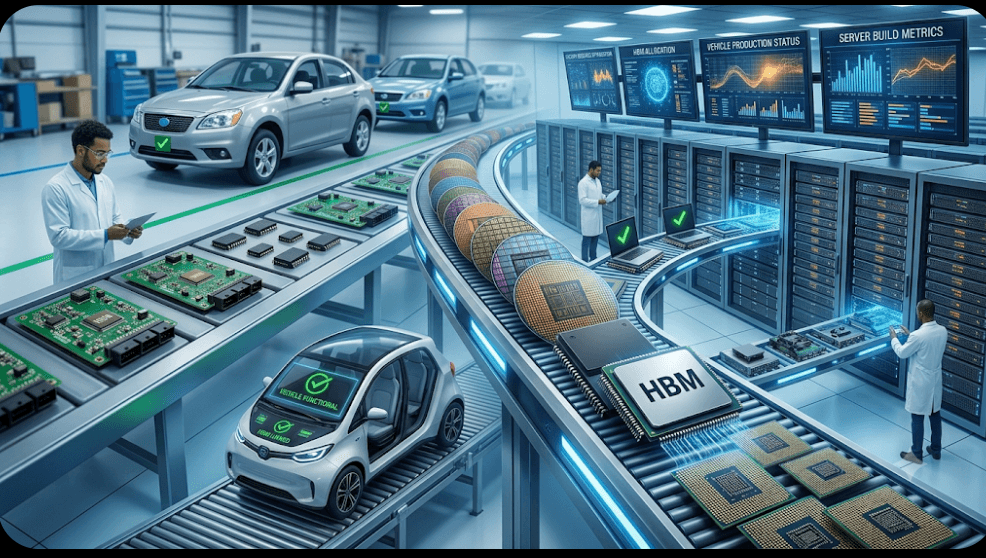
If you remember waiting months for a car or a game console, you might assume those days are behind us. In one sense they are. But a different kind of chip squeeze is taking shape, and it is already showing up in prices, contracts, and product planning.
The Pandemic Shortage Really Did End
The shortage that began in 2020 was a genuine crisis, and it has passed. The auto industry's pandemic-era chip shortage lasted into 2023. At its worst, it cut automotive production by more than 10 million units in 2021 alone, according to S&P.
That crisis had specific causes. Supply problems in 2021 came mostly from pandemic-related shipping disruptions, natural disasters, and underused factories making older, mature-node chips. Once those pressures eased, supply recovered.
Why a New Squeeze Is Forming
The new pressure comes from a different place: artificial intelligence. AI data centers need enormous amounts of memory, especially high-bandwidth memory (HBM). Major memory makers are shifting production capacity toward HBM to serve companies like Google, Meta, and Amazon. The profits are better there than in most other markets.
That leaves everyone else competing for what remains. Demand and profitability in AI data centers are far higher than in automotive, which makes carmakers more vulnerable to a supply crunch. The same logic applies to phones, laptops, medical devices, and telecom gear.
Supply can't respond quickly. S&P notes that memory makers did not foresee this surge in demand, and that building a new wafer fab takes years even though capacity investment has jumped since 2023. SK Hynix has said its entire 2026 output is already sold out.
What It Looks Like Right Now
So far, the effect shows up more in prices than in empty shelves.
Spot prices have spiked. A Kearney report claims spot prices for DRAM chips rose roughly 450 percent between September 2025 and January 2026. Spot prices are a volatile, short-term measure, so treat that figure as a sign of stress rather than what most companies pay.
Contract prices are climbing too. S&P Global estimates that new-contract DRAM prices could rise 70% to 100% in 2026 compared with 2025.
Big manufacturers are adjusting budgets. General Motors expects rising DRAM costs, currency swings, and higher material prices to add $1 billion to $1.5 billion in expenses this year, while Ford projects about $1 billion in higher commodity costs, driven partly by DRAM and inflation.
The impact reaches beyond cars. Automakers, retailers, electronics firms, and telecom groups have all reported that the shortage is raising costs and threatening supply chains. For car shoppers specifically, the near-term risk is that vehicles loaded with premium trims, tech packages, and driver-assistance features get more expensive to build and harder to source.
How This Differs From 2021
The distinction matters because the fixes are different. In 2021, factories and logistics couldn't keep up with a sudden shock. Today, the chips exist, but their makers are choosing to sell them to higher-paying customers.
Edward Wilford, an automotive research director at Omdia, described the change this way: 2021 was a one-time event that hit everyone, while 2026 is a lasting shift in the market, and he doesn't expect a quick resolution.
Not everyone is alarmed. Volkswagen has said its memory-chip supply chains are intact, and many automakers credit risk-management systems built after the pandemic shortage. That is a fair counterpoint. Preparation can cushion the blow, but it doesn't remove the cause.
What Comes Next
Analysts see a staged timeline. S&P Global Mobility describes 2026-2027 as a period of price-elastic supply with anecdotal shortages, meaning chips are available if you pay more, with occasional gaps. The longer-term concern is older technology. Supply of older-generation DRAM may dry up rapidly starting around 2028, regardless of price, forcing redesigns of cockpit and driver-assistance systems.
Stockpiling only helps so much. Buffer inventory can delay the impact, but it can't fix a structural imbalance, and memory chips aren't easily swapped across vehicle systems. The auto industry mostly uses older DDR4 and LPDDR4 chips, while AI relies on newer DDR5, so automakers may eventually have to migrate.
Practical Steps for Different Readers
If you run a business that buys or builds hardware:
Budget for higher memory costs through at least 2027 rather than assuming a rebound.
Ask suppliers which memory types your products use and whether those parts are being phased out.
Where possible, lock in longer-term contracts or line up a qualified alternate source.
If you design products:
Check now whether your designs depend on older memory generations. A redesign started in 2026 is far easier than one forced in 2028.
If you're a consumer:
Expect higher prices, or fewer options, on memory-heavy devices and feature-packed vehicles. Buying only when you need to, rather than in a rush, gives you more control.
The chip shortage that stalled factories in 2021 is over, but the supply chain hasn't returned to normal. Chipmakers are directing their most valuable capacity toward AI, and everyone else is adjusting. The likely result isn't a dramatic shutdown but a steady squeeze: higher costs, occasional gaps, and pressure to redesign products around newer parts.
The businesses that handle it best will treat this as a lasting change rather than a temporary disruption. Start with a simple question: which chips does your product or budget depend on, and what is your plan if their price stays high?