Writers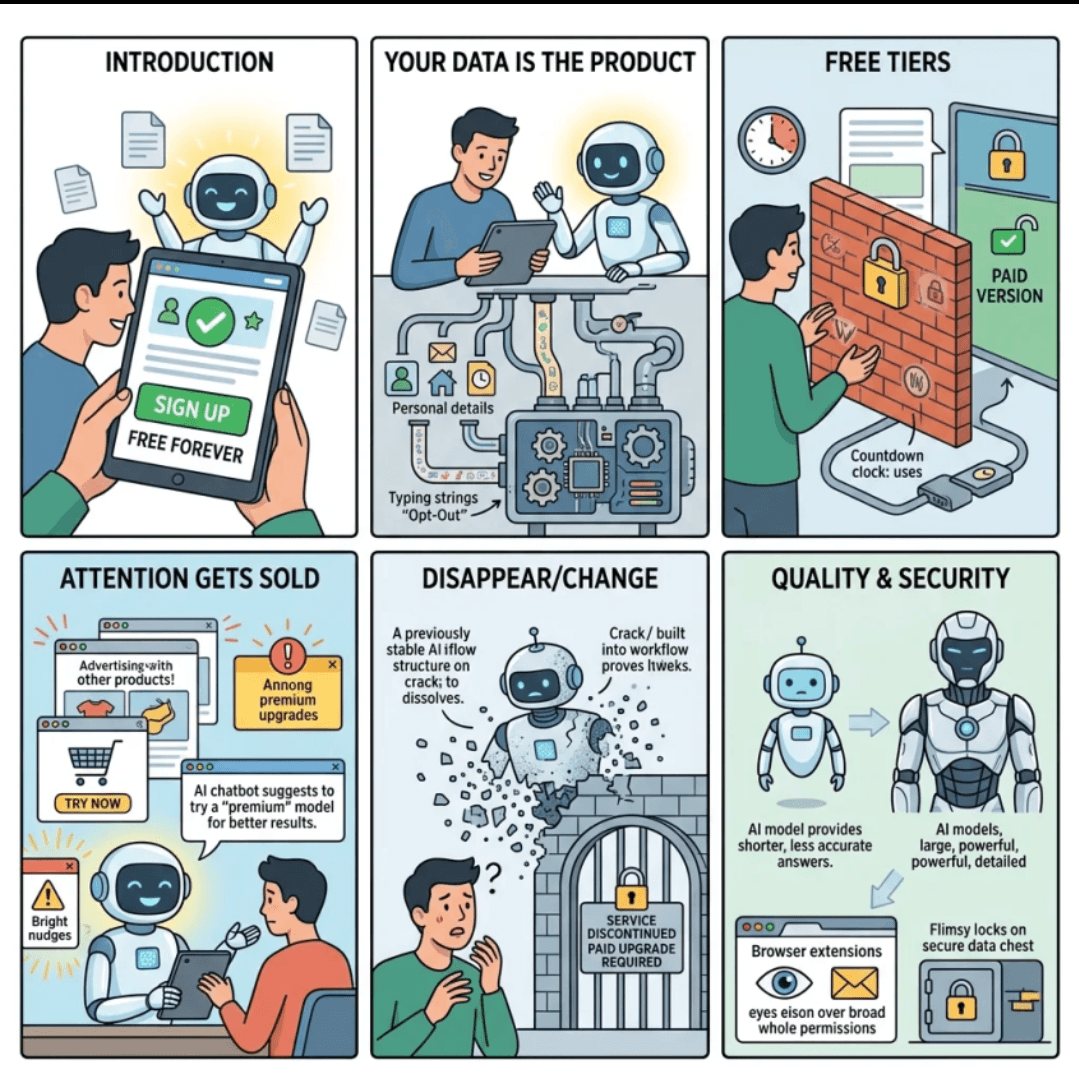
You open an app, it says "free forever," and you sign up without a second thought. No credit card, no fine print, just an email address and you're in. That's the deal with most AI tools today. Chatbots, image generators, writing assistants, resume builders — all "free."
But nothing that costs real money to build and run is actually free. Someone is paying for the servers, the electricity, the engineers. If you're not paying with money, you're paying with something else. Usually it's your data, your attention, or your future flexibility. And most people never stop to think about what that trade actually looks like.
This isn't about scaring you off free tools. Many of them are genuinely useful and fine to use. It's about understanding what you're giving up so you can make that choice on purpose, instead of by accident.
Your Data Is the Product, Not the App
This is the most talked-about cost, and for good reason. When you use a free AI chatbot or writing tool, whatever you type often gets used to train the next version of the model. That includes your drafts, your questions, sometimes personal details you didn't think twice about sharing.
Say you paste a work email into a free grammar checker to fix a typo. That email might contain your client's name, a project detail, maybe a number that shouldn't be public. Once it's in the system, you generally can't pull it back out. Most companies do let you turn off data training in your account settings, but the setting is often buried, and it's off by default in the sense that most people never find it.
The practical fix here isn't to avoid every free tool. It's to check the settings before you use one for anything sensitive. A quick search of "[tool name] + data training opt out" takes two minutes and tells you exactly where that toggle lives.
Free Tiers Are Built to Get You to Pay
Free AI tools aren't charities. They're funnels. The free version usually gives you just enough to see the value, then puts a wall in front of the thing you actually need.
Think about free versions of AI writing tools. You get maybe ten generations a day, or the outputs are shorter, or you can't export without a watermark. That's not an accident, it's the business model. The company needs some percentage of free users to convert to paying customers, so the free tier is designed to be almost good enough, not actually good enough.
There's nothing wrong with this. It's how a lot of software has worked for years. The cost here isn't hidden in a sneaky way, it's just easy to underestimate. You start using a tool for a small task, get used to it, and three months later you realize you're either paying for the upgrade or working around annoying limits every single day. Before committing time to learning a free tool for real work, it's worth checking what the paid tier costs and asking if you'd be okay paying that later.
Your Attention Gets Sold Somewhere
A lot of free AI apps make money through ads, or by nudging you toward other products the same company sells. This shows up in small ways: a chatbot that keeps suggesting you try the "premium" model for better answers, or an image generator that shows you sponsored templates before your own.
It's not always obvious because it's mixed into the product experience instead of sitting in a clearly marked ad banner. A free AI photo editor might recommend a specific stock photo service or print shop as part of its export flow, and you don't always know if that recommendation is there because it's genuinely useful or because there's a deal behind it.
This one's harder to spot than the data issue, but the rule of thumb still works: if you're not sure why a free product is suggesting something, assume there's a business reason behind it, not just helpfulness.
Free Tools Can Disappear or Change Without Warning
This is the cost people notice too late. A company launches a free AI tool, gets a lot of users, then either shuts it down, starts charging, or quietly makes it worse.
This has happened repeatedly in the AI tool space. A startup releases a genuinely useful free feature, it gets popular, and a few months later either the feature gets locked behind a paywall or the whole product gets discontinued because it wasn't making money. If you built a workflow around that free tool, you're now scrambling to replace it.
The lesson isn't to never use free tools for real work. It's to avoid building anything important entirely on top of one company's free product, especially a newer or smaller company. If a free AI tool becomes something you genuinely depend on, that's usually a sign it's time to either pay for it or have a backup plan ready.
Quality Isn't Always What It Looks Like
Free AI tools often run on older or smaller versions of the underlying model compared to what paying customers get. This isn't always disclosed clearly. You might be using "GPT" or "an AI model" without knowing it's a scaled-down version that gives shorter, less accurate, or more generic answers than the flagship version the company advertises.
This matters more than people think. If you're using a free AI tool to summarize a legal document or check facts for a report, and it's running on a lighter model, you might be getting answers that sound confident but are less reliable. The tool doesn't announce "I'm the cheap version", it just answers, and you assume it's doing its best.
A simple habit helps here: for anything where accuracy actually matters, medical questions, legal wording, financial numbers,don't treat any free AI answer as final. Double-check it against another source, free or not. This is good practice with any AI tool, but it matters more with the free version, which usually has more limitations baked in.
Security Is Often an Afterthought
Smaller or newer companies building free AI tools don't always have the same security budget as bigger, established players. That doesn't mean every free tool is unsafe, plenty are fine but it does mean the odds of something going wrong are higher with a small, free product than with a paid tool from a company that has more at stake if it messes up.
A practical example: browser extensions that add AI features, like summarizing web pages or rewriting emails inside Gmail. These extensions often need broad permissions to read what's on your screen. A free one from an unknown developer asking for full access to your browsing activity is a bigger risk than a paid tool from a company you can actually hold accountable.
Before installing a free AI browser extension or app, it's worth spending thirty seconds checking who made it, how long it's been around, and what permissions it's asking for. If a simple grammar tool wants access to your entire browsing history, that's worth questioning.
So Should You Avoid Free AI Tools?
No. Free AI tools are useful, and for a lot of everyday tasks, they're genuinely enough. Brainstorming ideas, drafting a quick email, generating a simple image, checking grammar, none of that needs the premium tier of anything.
The point isn't to distrust every free product. It's to ask a few quick questions before you rely on one:
What happens to the data I put in?
What am I actually getting in the free version, and is it enough for what I need?
Is this something I'd be upset about losing if the company shut it down or started charging?
Does the accuracy of this task actually matter, or is "good enough" fine here?
These questions take a minute to think through, and they turn "free" from something you accept blindly into something you actually chose.
"Free" doesn't mean "no cost." It means the cost isn't in your wallet. Sometimes that trade is completely fine — a free tool that uses your data to improve a chatbot you use for casual writing isn't a big deal for most people. Other times, the trade is worse than it looks, especially when sensitive information, real accuracy, or long-term dependency is involved.
The people who get the most out of free AI tools aren't the ones who avoid them out of suspicion. They're the ones who know exactly what they're trading, and decide that trade is worth it for that specific task. That's really all this comes down to — not fear, just a bit of awareness before you hit "accept."