Writers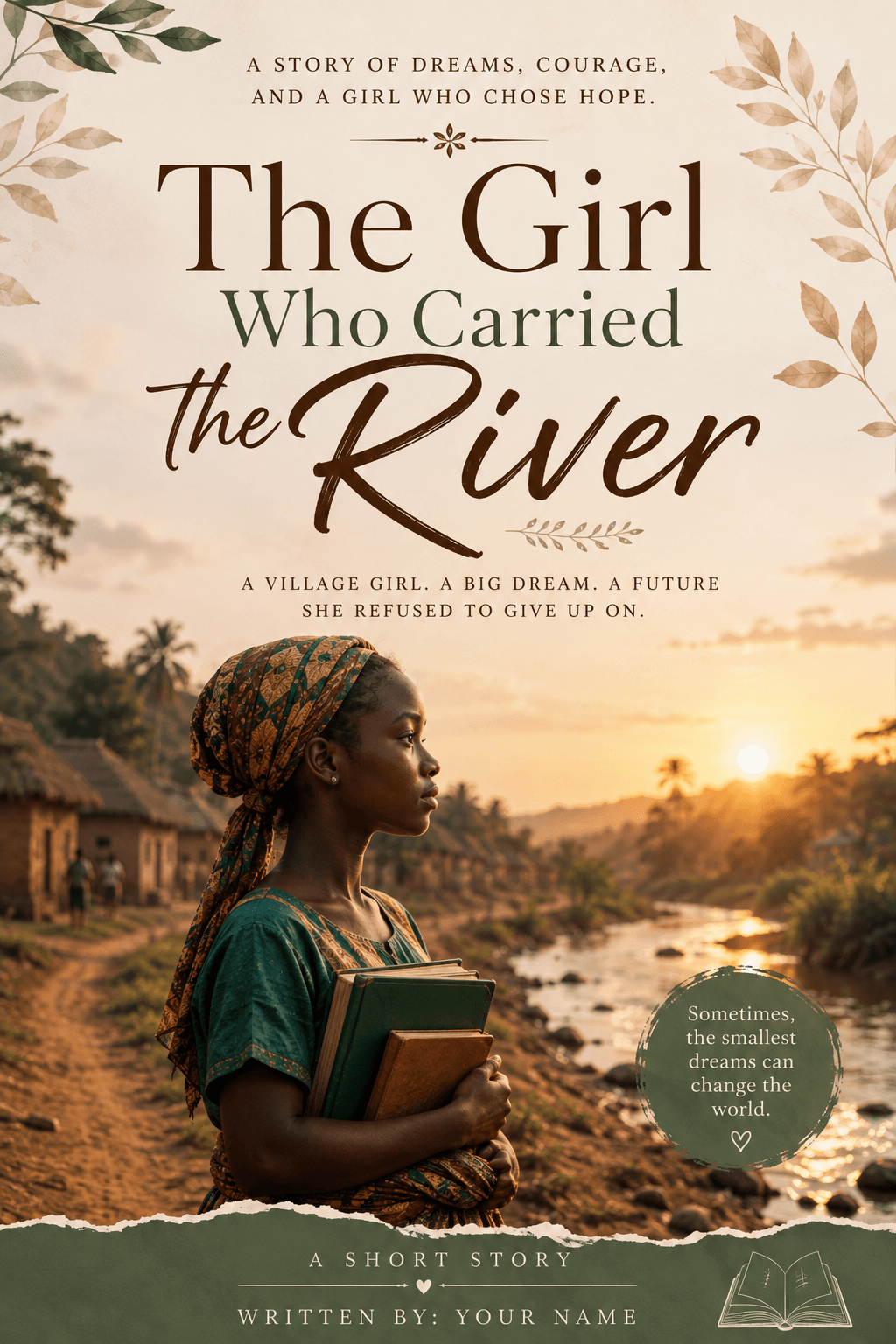
In the small village of Amaniko, where red earth roads curled between mud houses and palm trees whispered in the wind, lived a girl named Amara.
Amara was sixteen years old, with curious eyes and dreams far bigger than her village.
Every morning before the sun rose, she carried a clay pot on her head and walked to the river.
The journey was long.
While other girls complained about the distance, Amara walked quietly, watching the sky change from darkness to gold.
But she was not thinking about water.
She was thinking about books.
Amara loved books.
Her father was a farmer, and her mother sold vegetables in the village market. They did not have much money, but Amara's mother always told her:
“A poor person may have an empty pocket, but never let your mind become empty too.”
Those words stayed with Amara.
At school, she was known as the girl who always asked questions.
“Why does the rain fall?”
“How do birds know where to travel?”
“Why do some people leave the village and never return?”
Her teacher, Mr. Daniel, would often smile.
“One day, Amara,” he told her, “you will find the answers yourself.”
But dreams were not always easy to carry.
One evening, Amara returned from the river and found her parents sitting silently outside their house.
Her mother was holding an envelope.
“What happened?” Amara asked.
Her father looked away.
“The school sent this,” her mother said.
Amara opened the letter.
It was a reminder about her unpaid school fees.
Her heart sank.
Her father cleared his throat.
“The harvest was poor this year.”
Amara stared at the paper.
For the first time, her dream felt heavy.
That night, she lay awake listening to the sounds of insects outside.
Perhaps, she thought, it was time to stop dreaming.
Perhaps school was not meant for girls like her.
The following morning, Amara did not go to school.
Instead, she followed her mother to the market.
She spent the day arranging tomatoes, calling customers, and carrying baskets.
Days became weeks.
Whenever she saw children in their uniforms walking along the dusty road, she looked away.
Then, one afternoon, something unexpected happened.
An old woman came to her mother's stall.
She was known in the village as Mama Ebi, a quiet woman who had once worked as a teacher in the city before returning home.
She watched Amara carefully.
“Why aren't you in school?” she asked.
Amara remained silent.
Her mother sighed and explained everything.
Mama Ebi nodded slowly.
The next day, she returned.
But this time, she carried a small wooden box.
Inside were books.
Old books.
Some had torn covers. Others had yellow pages.
But to Amara, they looked like treasure.
“I cannot pay for all your problems,” Mama Ebi said. “But I can give you something.”
Amara touched one of the books.
“What?”
“A reason not to give up.”
From that day, Amara began studying again.
In the morning, she went to the river.
During the day, she helped her mother.
At night, she read beside a small lamp.
She read about distant countries, great scientists, writers, history, and people who had once started with almost nothing.
And slowly, something changed inside her.
Amara stopped seeing the village as a cage.
Instead, she began to see it as the beginning of her story.
Months later, the village announced a scholarship competition. Students from nearby communities were invited to write an essay titled:
“What Can I Do for My Community?”
Amara's hands trembled when she received the form.
She had not returned to school regularly.
She had no expensive clothes.
She had no private tutor.
But she had something else.
She had a story.
For three nights, Amara wrote.
She wrote about the long walk to the river.
She wrote about children who struggled to stay in school.
She wrote about mothers who worked from morning until night.
And she wrote about her dream.
One day, she wanted to return to Amaniko and build a small library.
A place where children could read without worrying about whether they could afford a book.
When the day of the competition arrived, Amara stood before people from different villages.
Her knees shook.
Then she remembered her mother's words.
Never let your mind become empty.
Amara took a deep breath.
And she began.
When she finished reading, the room was silent.
For a moment, she thought she had failed.
Then someone started clapping.
Another person joined.
Soon, the entire room was filled with applause.
Three days later, a motorcycle stopped in front of Amara's house.
A man stepped down and handed her father an envelope.
Amara watched as her father opened it.
His hands began to shake.
“What is it?” she asked.
He looked at her.
For the first time in weeks, he smiled.
“You won.”
Amara covered her mouth.
Inside the envelope was a scholarship that would allow her to return to school.
Her mother cried.
Her father laughed.
And Amara stood beneath the afternoon sun, holding the letter against her chest.
Years later, people would know Amara as a writer and teacher.
She would travel beyond Amaniko.
She would see cities she had once only read about.
But she never forgot the dusty road.
She never forgot the river.
And she never forgot the old woman who gave her a box of books.
Eventually, Amara returned to her village.
On a piece of land near the old market, she built a small library.
Above the entrance were written the words:
“Every great journey begins somewhere.”
And every morning, children came.
Some arrived barefoot.
Some carried books.
Some carried dreams they had not yet found the courage to speak aloud.
Amara welcomed every one of them.
Because she knew something they were only beginning to understand:
A village girl could carry water on her head and still carry an entire future inside her heart.