Writers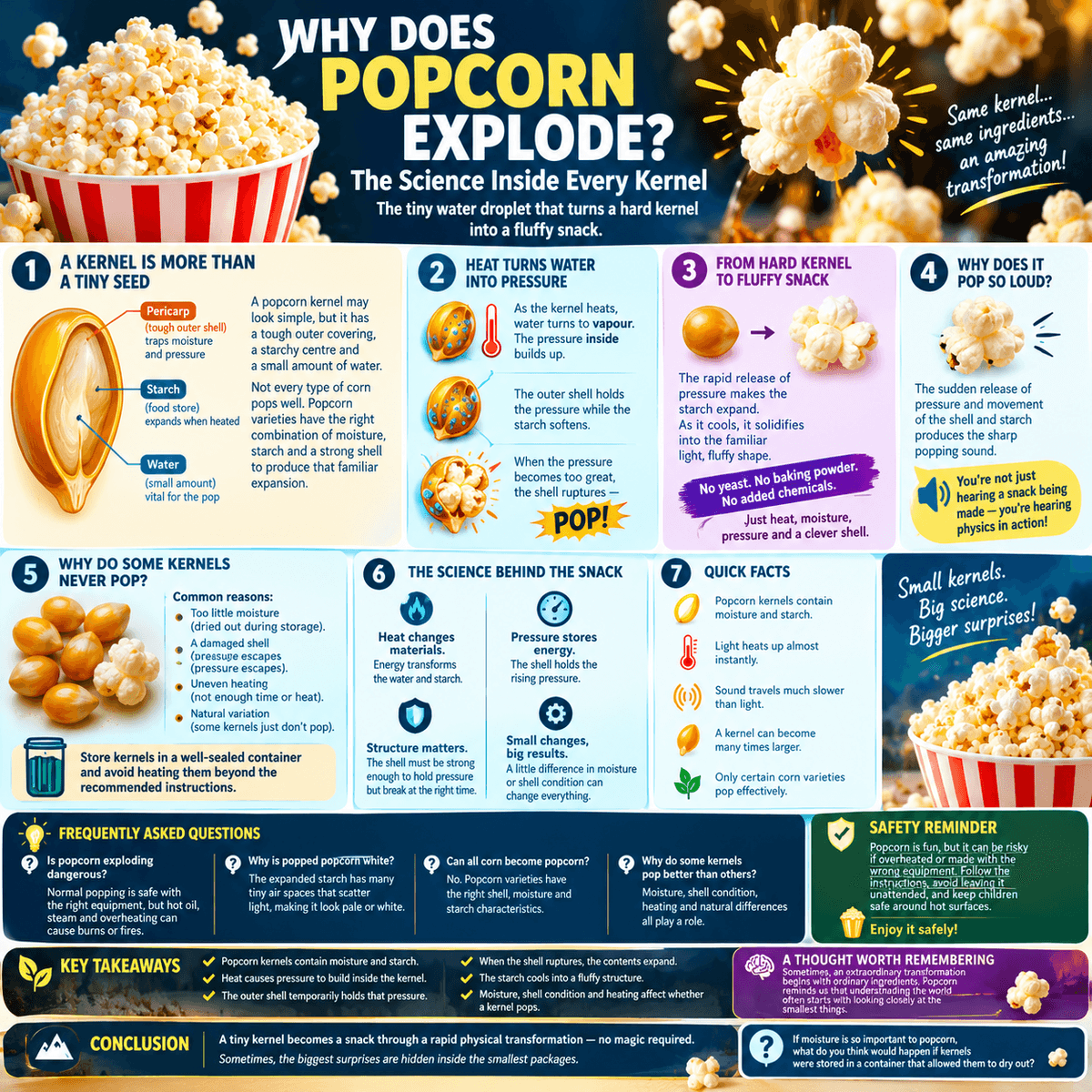
The Tiny Water Droplet That Turns a Hard Kernel Into a Fluffy Snack
You pour a handful of hard, yellow kernels into a hot pot. A few moments later, the kernels begin to jump, crack, and explode into fluffy white pieces.
Some shoot across the pot. Others pop so loudly that you can hear them from another room.
But here's the remarkable part: popcorn doesn't need yeast, baking powder, or an added chemical to make it expand.
Each kernel already contains the ingredients needed for its own little explosion.
The secret is a combination of water, heat, pressure, and a special kind of outer shell.
🌽 A Kernel Is More Than a Tiny Seed
A popcorn kernel may look simple, but it has several important parts.
Inside is a starchy centre containing a small amount of water. Around it is a tough outer covering called the pericarp.
That outer shell is important because it helps trap moisture and pressure as the kernel heats up.
Not every type of corn pops well. Popcorn varieties have the right combination of moisture, starch, and a strong outer shell to produce that familiar expansion.
Think of each kernel as a tiny natural pressure chamber.
💧 Water Is the Hidden Ingredient
The most surprising part of popcorn is that it contains water even when it looks completely dry.
As the kernel heats, the water inside becomes hotter. Eventually, much of it turns into water vapour.
Under ordinary conditions, water boils at around 100°C, but the situation inside a sealed, heating popcorn kernel is different. As pressure rises, the water can remain liquid at a higher temperature before rapidly turning into vapour when the kernel bursts.
That trapped moisture is essential.
If a kernel has lost too much water during storage, it may fail to pop properly. It might heat up, scorch, or remain hard instead of expanding into a fluffy piece.
No suitable moisture, no satisfying pop.
🔥 Pressure Builds Inside
As heating continues, the water vapour and expanding gases increase the pressure inside the kernel.
The tough outer covering holds that pressure for a while.
Meanwhile, the starch inside softens and becomes more flexible.
Eventually, the pressure becomes too great for the shell to contain.
Then comes the moment everyone recognizes.
POP!
The outer shell ruptures, pressure drops rapidly, and the superheated moisture expands. The softened starch is pushed outward and expands before cooling and setting into the familiar white, irregular shape.
What looked like a hard seed has transformed in a fraction of a second.
💥 Why Does Popcorn Turn Inside Out?
A popped kernel isn't simply a seed that has cracked open.
The rapid pressure release causes the hot, softened starch to expand dramatically. As it expands, it cools and solidifies into a lightweight, porous structure.
That's why popped popcorn is much larger than the original kernel.
Its size comes largely from the expansion of the material inside—not from the addition of anything new.
A tiny kernel can become a much bigger snack because its internal structure changes so dramatically.
🔊 What Actually Makes the Popping Sound?
The familiar popping noise occurs when the kernel's outer covering ruptures and the contents expand rapidly.
The sudden release of pressure and movement of the shell and starch produces the sharp sound.
The noise can vary depending on the kernel, how it pops, and the surrounding environment.
So when you hear popcorn popping, you're listening to many tiny pressure chambers reaching their breaking point one after another.
🍿 Why Do Some Kernels Never Pop?
Almost everyone has discovered a few hard kernels at the bottom of a popcorn bowl.
These are often called old maids.
Several factors can explain why they remain unpopped:
- Too little moisture: The kernel may have dried out during storage.
- A damaged shell: Pressure may escape before enough builds up.
- Uneven heating: The kernel may not reach the conditions required to pop.
- Natural variation: Even kernels from the same batch can behave differently.
Store popcorn in a well-sealed container to help preserve its moisture. Avoid heating it beyond the recommended instructions, as excessive heat can burn the popcorn or cause a fire.
🧠 What Can Popcorn Teach Us About Science?
Popcorn is a small demonstration of several important scientific principles.
Heat changes materials. Energy transferred into the kernel raises its temperature and transforms the water and starch inside.
Pressure can store energy. The kernel's shell temporarily contains the pressure that develops during heating.
Structure matters. The shell must be strong enough to hold pressure but capable of rupturing when the conditions are right.
Small changes can produce dramatic results. A tiny difference in moisture or shell condition can determine whether a kernel pops beautifully or stays hard.
These same broad principles—though not exactly the same process—appear in many areas of science, engineering, cooking, and industrial design.
❓ Frequently Asked Questions
Is popcorn exploding dangerous?
Normal popcorn popping in a suitable pot or appliance is a familiar cooking process, but hot oil, steam, and overheated equipment can cause burns or fires. Follow the appliance instructions.
Why is popped popcorn white?
Its expanded starch structure contains many tiny air spaces that scatter light, making the popcorn appear pale or white.
Can all corn become popcorn?
No. Popcorn varieties have the particular shell, moisture, and starch characteristics needed for effective popping.
Why do some kernels pop better than others?
Moisture content, shell integrity, heating conditions, and natural differences between kernels all influence the result.
🔑 Key Takeaways
- Popcorn kernels contain moisture and starch.
- Heat causes pressure to build inside the kernel.
- The outer shell temporarily holds that pressure.
- When the shell ruptures, the contents expand rapidly.
- The starch cools into the familiar fluffy structure.
- Moisture, shell condition, and heating affect whether a kernel pops.
🌿 A Thought Worth Remembering
Sometimes, an extraordinary transformation begins with ordinary ingredients.
A little water, some stored energy, and a protective shell are enough to turn a hard kernel into something completely different.
Popcorn reminds us that understanding the world often begins by looking closely at the smallest things.
The next time you hear that familiar popping sound, remember: you're not just watching a snack being prepared. You're witnessing heat, pressure, and material transformation working together.
🏁 CONCLUSION
Popcorn pops because heat causes moisture inside the kernel to produce increasing pressure. When the outer shell can no longer contain that pressure, it ruptures, allowing the softened starch to expand and cool into a fluffy shape.
A tiny kernel becomes a snack through a rapid physical transformation—no magic required.
Sometimes, the biggest surprises are hidden inside the smallest packages.
💭 Question to Think About
If moisture is so important to popcorn, what do you think would happen if kernels were stored in a container that allowed them to dry out?
📚 Further Reading
Explore food science and the chemistry of cooking through educational resources from the Institute of Food Technologists and university food-science departments.