Writers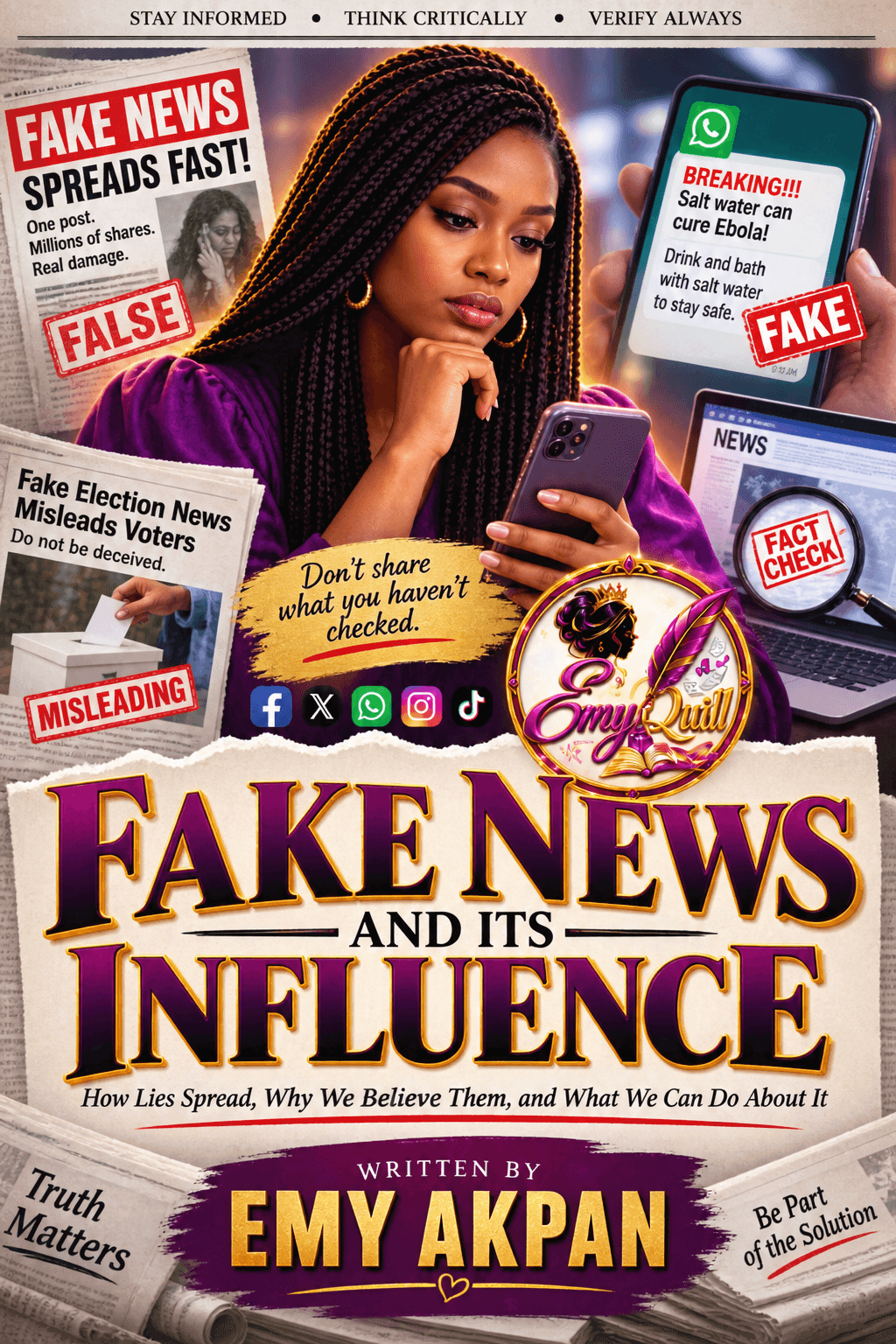
When a Lie Travels Faster Than the Truth
Imagine waking up one morning and seeing a message on WhatsApp:
“BREAKING! Share this immediately before it is deleted.”
There is a frightening story underneath it. Perhaps someone important has died. Perhaps a dangerous disease has entered the country. Perhaps the government has made a shocking decision. Perhaps a miracle cure has been discovered.
You read it.
You are surprised.
Then you see the words: “Please share. This is urgent.”
So you forward it.
A few minutes later, someone else forwards it to another person. Then another. Before long, hundreds or thousands of people have seen it.
Nobody knows exactly where it came from.
Nobody has checked whether it is true.
But because so many people have shared it, it begins to feel true.
That is one of the most powerful things about fake news.
It does not need to be true to travel. It only needs to be interesting enough to share.
The Lie That Made Nigerians Drink And Bath Salt Water
Nigeria has experienced the consequences of false information in ways that should make all of us take the subject seriously.
In 2014, when the Ebola outbreak created fear across West Africa, a message circulated widely in Nigeria claiming that bathing with hot salt water and drinking salt water could protect people from Ebola.
People believed it. I know I did,
Some woke up early to follow the supposed instructions. The rumour spread through text messages, social media and word of mouth. Reports documented hospitalisations and deaths linked to excessive salt consumption after people acted on the false advice.
Think about that for a moment.
The message was not simply wrong.
People acted on it.
That is where fake news becomes dangerous.
A false story sitting harmlessly on someone's phone may seem insignificant. But when thousands of people believe it and change their behaviour because of it, misinformation becomes a real-world problem.
During the COVID-19 pandemic, the same pattern appeared again.
False claims circulated about supposed cures, miracle treatments, government conspiracies and even fabricated news reports. Fact-checkers documented manipulated screenshots, old photographs presented as new events, doctored videos and completely invented claims relating to Nigeria's COVID-19 response.
The problem was not simply that people had access to false information.
The bigger problem was that false information often arrived faster than people's willingness to question it.
But Where Did Fake News Come From?
Fake news is not actually a new invention.
People have always spread rumours.
Before smartphones, a false story could travel through a village, a market, a workplace, a newspaper, a radio programme or a conversation between neighbours.
What has changed is the speed.
One person can now publish something from a bedroom in Lagos and potentially reach people in Kano, London, New York and Johannesburg within minutes.
Social media has removed many of the old barriers between creating information and distributing it.
And that has been both wonderful and dangerous.
The Internet has given ordinary people a voice. It has made information more accessible. It has helped people report events journalists may not have reached yet.
But the same technology can also turn one person's mistake into a national rumour.
And sometimes the information is not a mistake at all.
Sometimes someone deliberately creates it.
Why Would Anyone Create False News?
There is no single reason.
Some people create false stories for attention.
Some want followers, likes and engagement.
Some want to make money from advertising or clicks.
Others want to damage someone's reputation.
Political actors may use false or misleading information to influence public opinion. During Nigeria's 2023 election season, fact-checkers documented numerous forms of false political information targeting candidates, political parties and the electoral process.
There are also people who simply pass along something they believe to be true.
That distinction matters.
Not everyone who spreads fake news is deliberately lying.
Sometimes the original creator is dishonest, but the person forwarding it genuinely believes they are helping.
That is how misinformation grows.
One person creates it.
Another believes it.
Another forwards it.
Another adds a little information.
Someone else removes an important detail.
By the time the story reaches the twentieth person, it may barely resemble what actually happened.
Why Do We Believe It So Easily?
This is where the problem becomes personal.
Most of us like to think we are too intelligent to fall for fake news.
But intelligence alone does not make anyone immune.
Sometimes a false story confirms something we already believe.
If I already dislike a particular politician, I may be more willing to believe a negative story about that politician.
If I strongly support someone, I may quickly reject negative information about them—even when it is true.
Our emotions can get involved before our reasoning has a chance to catch up.
Fear makes us react.
Anger makes us share.
Excitement makes us forward.
And sometimes, curiosity does the rest.
A headline that says “SHOCKING!!! YOU WON'T BELIEVE WHAT JUST HAPPENED” is designed to make you click.
Then comes another powerful trick: Urgency.
“Share before it is deleted.”
“Send this to ten people.”
“Don't let the government hide this.”
“Media houses won't report this.”
The message is trying to prevent you from thinking.
And unfortunately, it often works.
Why Don't We Verify Before Sharing?
As at the day of writing this post, Tuesday, September 1st, 2026. I received an email from OPAY on exactly 6:28am with the headline: 🌟This is FALSE: OPay is NOT going on break!
I'll quote part of the body of content here to illustrate how fake news can go viral and some times, we believe it without doing a proper verification before spreading it.
“Dear Valued Customer,
We are aware of a false and misleading publication circulating across social media claiming that OPay will be going on an indefinite break from September 1, 2026, and advising customers to withdraw or transfer their funds.
This claim is completely false. OPay is not going on any break. We remain fully operational, and our services continue as normal.
The circulating publication is not an official OPay communication. We urge you to disregard the information and not take any action based on the fabricated claim.
Please always verify information concerning OPay through our official communication channels before sharing or acting on it...”
If you are patronizing this online bank, Opay, you must have also gotten that same mail from them on that date and time. And if you were having a good amount of money saved with them, you must have felt the panic when you heard the rumors
Some of you may even, have actively encouraged your friends, family, colleagues, etc, to close down their account with Opay because of the rumors.
I'm glad the bank tackled the situation earlier to prevent mass panic from their customers and encouraged them to verify any information from them through their proper channel.
The uncomfortable truth is that verifying information takes effort.
Believing it takes seconds.
Imagine receiving a message from your aunt, church member, teacher, friend or colleague.
You trust the person.
So you think, “If she sent it, it must be true.”
But the person may have received it from someone else.
And that person may have received it from someone else.
Trusting the messenger is not the same thing as verifying the message.
Another problem is that people sometimes mistake professional appearance for credibility.
A fake news story can contain a photograph.
It can have a logo.
It can use impressive language.
It can even imitate the design of a respected television station.
During COVID-19, for example, a fabricated screenshot was made to look like a CNN report concerning Nigeria's COVID-19 cases. Fact-checkers found that the supposed report did not exist on CNN and that versions of the same screenshot had been reused with completely different claims.
A picture is not proof.
A logo is not proof. The rapid growth of AI and the existing skill of Photoshop has made it easy to create and manipulate images to backup fake news and it will be done so neatly, it becomes difficult to discern.
Also, a forwarded message is certainly not proof.
So How Do We Fight It?
We do not need to become professional journalists to become more responsible information users.
We simply need to slow down.
Before forwarding something, ask: Who originally reported this?
If there is no source, that is already a warning sign.
Next, ask: When did this happen?
Old stories are frequently recycled as though they happened yesterday.
Then ask: Where is the evidence?
Is there an official statement? Is there a credible report? Are reputable news organisations reporting the same event?
And perhaps the most important question: Who else is reporting it?
If something truly major has happened, it is reasonable to look beyond one WhatsApp message.
Search for the story yourself.
Check the date.
Read beyond the headline.
Look at the original source instead of trusting a screenshot.
For photographs and videos, remember that something can be genuine but still misleading. A real photograph from five years ago can be presented as though it was taken yesterday. A genuine video can be given a completely false description.
That is why context matters.
Who Should We Trust?
No news organisation gets everything right. Responsible journalism still involves corrections and mistakes.
But when you are trying to establish whether a major claim is genuine, start with established news organisations and official sources rather than anonymous social-media accounts.
For Nigerian and international reporting, useful outlets to compare include:
[Reuters], [BBC News], [Channels Television], [Premium Times], [TheCable], [Vanguard Nigeria], [The Guardian Nigeria], [Punch Newspapers]
For fact-checking:
[Africa Check] is particularly useful for claims circulating across African countries.
For health-related information, especially during outbreaks, it is wise to check authoritative health organisations such as [the World Health Organization] and Nigeria's [Nigeria Centre for Disease Control and Prevention]
The goal is not to believe a particular organisation blindly.
The goal is to compare, question and verify.
The Five-Second Rule
Perhaps we need a simple habit.
Before forwarding any surprising piece of information, pause.
Don't immediately press Forward.
Take a few seconds and ask:
Is it true?
Who said it?
When was it published?
Where is the evidence?
Would I be comfortable if my name appeared beside this information publicly?
If you cannot answer those questions, don't spread it yet.
You can always share later after checking.
But once you send a false story to fifty people, you cannot easily retrieve it from their phones.
The Truth Needs Help Too
We often complain that fake news spreads quickly.
But perhaps the problem is not only that lies are fast.
Perhaps the truth is sometimes too quiet.
A responsible news report may take time to investigate. A journalist may need to speak to several people, check documents, confirm details and obtain an official response.
Meanwhile, a false WhatsApp message takes five seconds to write.
That is an unfair race.
But ordinary people can help.
We can stop forwarding everything.
We can teach children and young people how to question what they see online.
Schools can teach media and digital literacy.
Families can discuss online information instead of treating every message as fact.
News organisations can correct false claims clearly and quickly.
Governments and public institutions can communicate important information promptly, especially during emergencies, because information gaps create room for rumours to grow. The World Health Organization describes this overwhelming mixture of accurate and inaccurate information as an “infodemic” and recommends stronger information literacy, trusted communication and community engagement.
And each of us can make one small decision:
I will not share what I have not checked.
That decision may seem insignificant.
But imagine millions of people making it.
The fake story would still exist.
The rumour would still be created.
The lie would still be posted.
But it would have nowhere near as many people willing to carry it.
And perhaps that is how we begin to slow fake news—not by pretending we can silence the Internet, but by becoming people who refuse to give every unverified story a free ride.
Because sometimes the most responsible thing you can do with a message is not forward it.
Stopping the spread of fake news begins with you.