Writers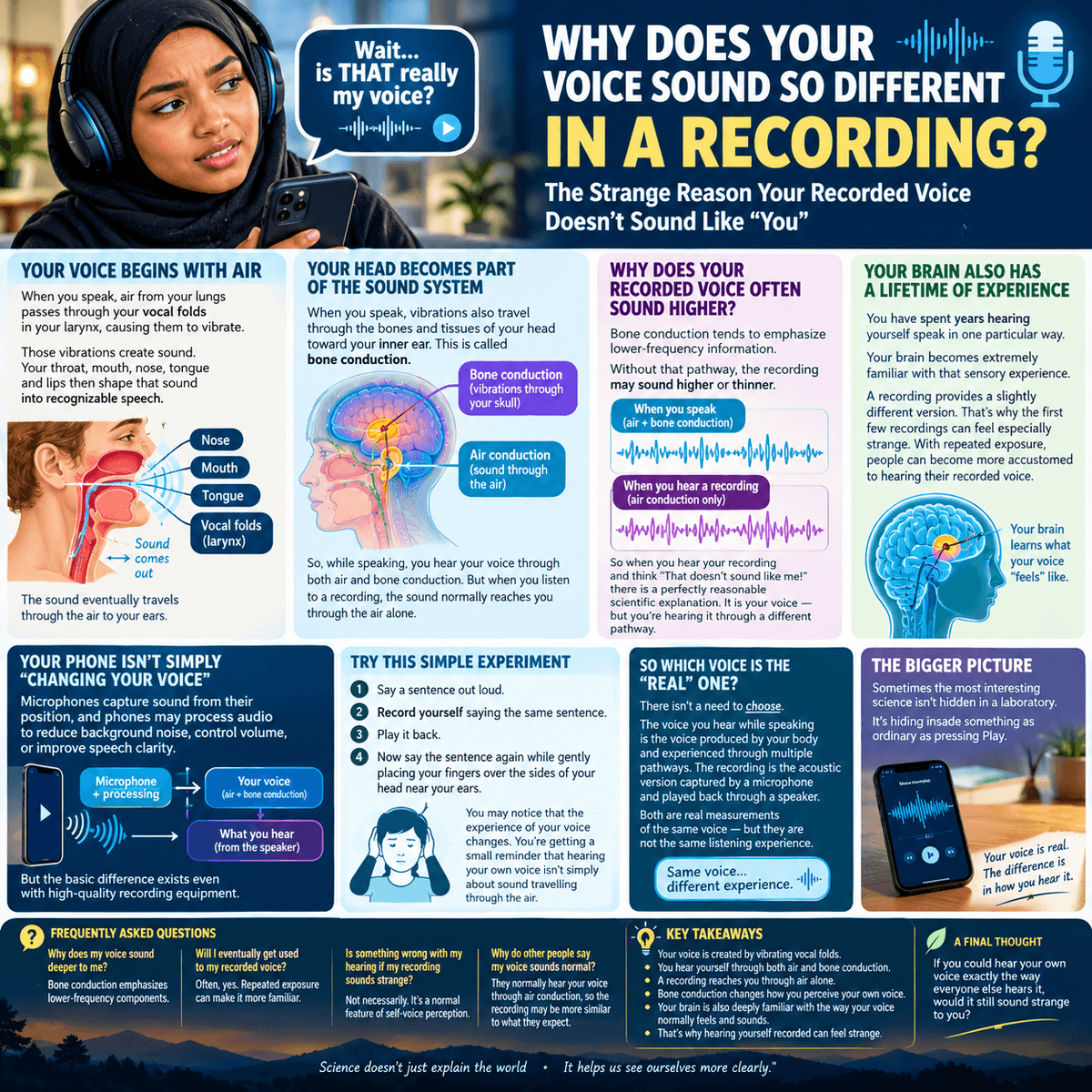
The Strange Reason Your Recorded Voice Doesn’t Sound Like ‘You’
Have you ever left a voicemail or recorded an audio message, then played it back and thought:
“Wait… is THAT really my voice?”?
You know your voice better than anyone else, so why does it sound so weird coming out of your phone?
The strange thing is… the recording is probably accurate.
It’s your brain that’s playing tricks on you!
🗣️ Let’s Talk About Your Voice
Your lungs push air through your vocal folds (in your larynx) and cause them to vibrate.
These vibrations create sound and your throat, mouth, nose, tongue, and lips shape the sound into speech.
The resulting sound travels outwards into the air and into your ears.
But this is just part of the story…
🦴 Your Head Is Part of the Process Too
Some of the sound vibrations from your voice travel through the bones and tissues of your head directly to your inner ear.
This is called bone conduction.
So in effect, when you produce sound, your brain hears two versions of the sound: the vibrations that travel through the air and into your ears, and the vibrations that travel through your bones and directly to your inner ear.
But recordings only pick up the sound vibrations that travel through the air.
It turns out this has an effect on your perception of your own voice.
Researchers who study self-voice perception have discovered that bone conduction plays an important role in the way that we hear our own speech.
Bone conduction alters the acoustic information of your voice and provides additional vibrotactile information to your brain.
🎧 Why Does My Voice Sound Higher in a Recording?
A major factor in the way that you hear your voice is the way that you perceive frequency or pitch.
One reason that your recorded voice sounds strange is that the vibrations that travel through your skull tend to carry more low frequency information.
So the voice that you hear while you speak sounds lower than the voice that you hear in a recording.
This means that your brain has become accustomed to hearing your voice in a certain way, and hearing it in a different way can be confusing.
🧠 Another Interesting Fact About Your Brain
Another reason that your recorded voice may sound strange is because it’s familiar to your brain in a slightly different way than the voice that you hear every day.
You hear your voice countless times each day and your brain knows what to expect.
Recordings provide slightly different information to your brain about the way that your voice sounds.
That’s why the first few recordings that you hear may sound strange – your brain is trying to interpret slightly different information than it normally would.
However, with repeated exposure, people can get used to hearing their recorded voice.
Interestingly enough, there is also research to suggest that previous exposure has an effect on the way that people identify their own voice.
Phones don’t just distort your voice – they change the way that you hear it.
📱 The Role of Recording Equipment
Although phones do affect the way that people hear their recorded voices, one of the biggest changes happens before the sound is picked up by a microphone at all.
When you speak, the sound that you hear is shaped partly by the vibrations that you feel in your bones and tissues.
Recordings do not include this.
This may be an important reason why a lot of people think their recorded voice sounds strange.
To experiment for yourself, try saying a sentence out loud, then recording yourself saying the same sentence.
Now say the sentence again, but place your fingers lightly on either side of your head near your ears.
You’ll probably notice that your experience of saying the sentence is slightly different.
It’s all part of the listening process.
🤔 Wait, So What’S the Real Voice?
Interestingly enough, there’s really no one ‘real’ voice.
The voice that you hear when you speak is the voice that your body produces, and it uses several methods of transmitting sound – your vocal folds, throat, mouth, nose, tongue, and lips all play a part in shaping the sound.
The recording is a slightly different version of the same voice.
It’s created by your vocal folds and shaped by your mouth, but the sound is picked up by a microphone and played back out of a speaker.
Both versions are real, but they are both slightly different.
That’s also why your voice can sound strange to you, but normal to other people.
Since other people hear your voice roughly the way that you normally would, they’re more accustomed to the sound of it.
❓ Frequently Asked Questions
Why does my voice sound deeper to me?
Bone conduction affects the way that we hear our own voices and can add lower frequency information that makes our voices sound deeper.
Will I eventually get used to my recorded voice?
Yes – repeated exposure can cause people to become more accustomed to hearing their recorded voices.
Is something wrong with my hearing if my recording sounds strange?
No, it’s completely normal for your recorded voice to sound strange to you.
Why do other people say my voice sounds normal?
They normally hear your voice in the same way that you do (through air conduction).
So the way that they hear your voice is probably more similar to the way that you hear your own voice day to day.
🔑 Final Thoughts
Your voice is created when air passes through your vocal folds and causes them to vibrate.
As you speak, you hear the sound of your voice in two ways: through the air, and through the vibrations that you feel in your bones and tissues.
Recordings only pick up the sound of your voice through the air.
Bone conduction changes the way that you hear your own voice, and your brain also becomes accustomed to hearing your voice in a certain way – which is why you may find that your recorded voice doesn’t always sound familiar.
The world that we experience is mostly made up of things that we can see, hear, taste, touch, and smell.
But sometimes, the most amazing discoveries are hidden in things that we take for granted – like the strange way that our voices work!
🌿 An Ethical Perspective
One of the best things about science is that it helps us to understand the world around us.
Sometimes, the most amazing scientific discoveries are the ones that help us to understand ourselves.
When it comes to understanding our own voices, science has some really fascinating things to say.
Although we may think that we hear the world around us, our senses and experiences shape the way that we perceive the world.
Even something as simple as leaving a voicemail or recording an audiobook can teach us a thing or two about the way that our brains work.
The next time that you hear your recorded voice and think that it doesn’t sound like you, take a deep breath and remember that your brain isn’t faulty – your phone probably just hasn’t invented a stranger.
💭 Question to Ponder
If you could hear your own voice the way that everyone else hears it, would it still sound strange to you?
📚 Source
National Institute on Deafness and Other Communication Disorders (NIDCD), National Institutes of Health – information on voice production and hearing.