 Writers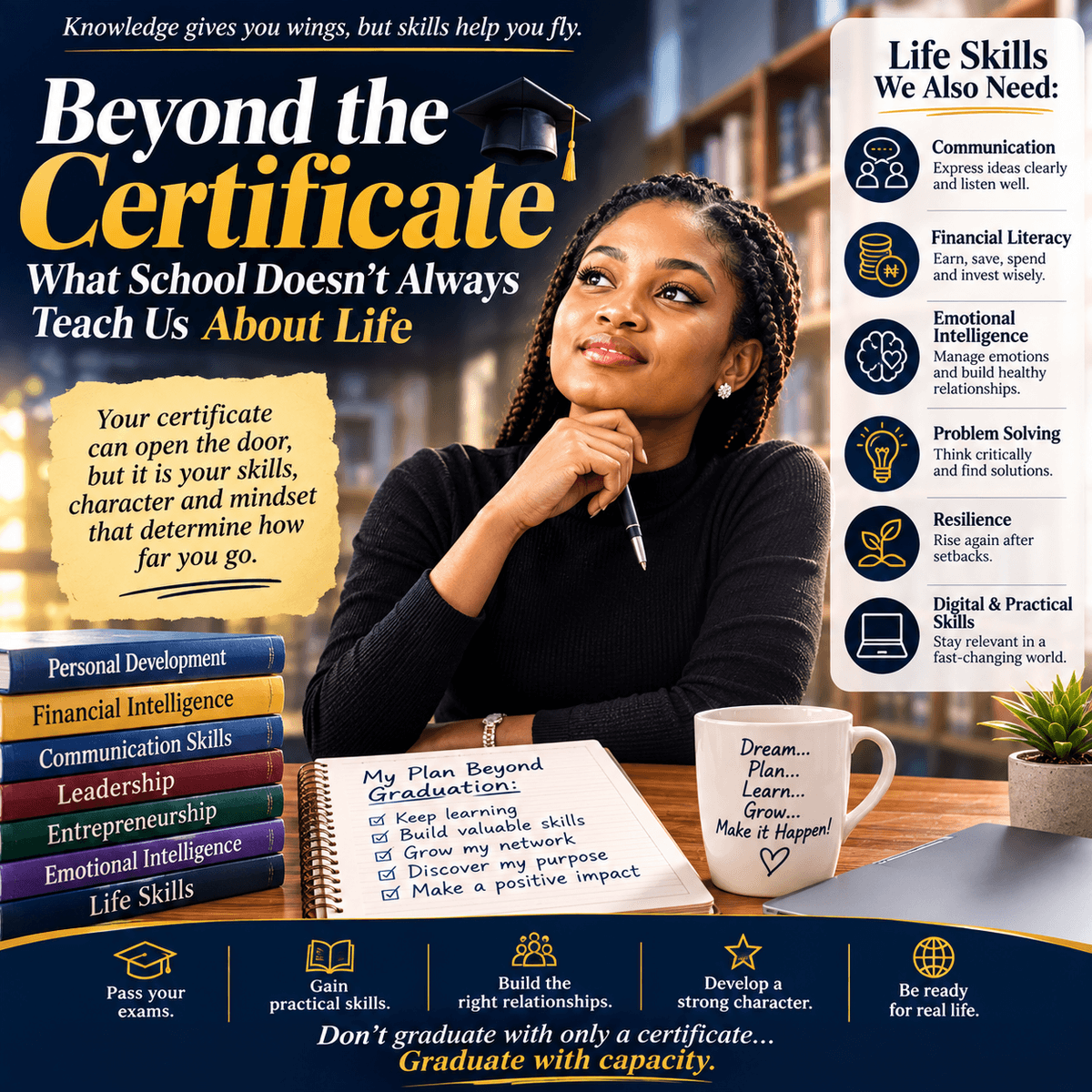
Beyond the Certificate: What School Doesn't Always Teach Us About Life.
There is a moment every student eventually faces.
The lectures are over. The examinations have been written. The final results are out. The certificate that once seemed so far away is finally in your hands.
Then someone asks:
“So, what next?”
For years, school has given us answers to questions in textbooks. We have written assignments, memorised theories, passed examinations and collected grades. But when the classroom doors finally close, life begins asking a different set of questions.
Can you communicate effectively?
Can you manage your money?
Can you handle rejection?
Can you solve problems without someone giving you the answer?
Can you work with people who think differently from you?
Can you make a decision when nobody is there to tell you what to do?
These questions rarely appear on an examination paper, yet they can determine how well we navigate the real world.
Education remains one of the most powerful tools a person can possess. A good education develops knowledge, exposes us to different ideas and opens doors that might otherwise remain closed. Certificates can also provide opportunities for employment and further study.
But a certificate is not a complete instruction manual for life.
One of the most important skills young people need is communication. Knowing something is one thing; being able to explain it clearly is another. A brilliant student who cannot communicate an idea may struggle in an interview, workplace or leadership position. Learning to speak confidently, write properly, listen attentively and express disagreement respectfully can be just as valuable as earning good grades.
Then comes financial literacy.
Many students spend years learning complex academic concepts without learning how to create a realistic budget, save consistently, distinguish between needs and wants, or plan for financial emergencies.
Making money is important, but knowing what to do with the money you make is equally important.
Another lesson life teaches us is that rejection is not the same as failure.
You may apply for a job and not get it. You may start a business that doesn't work. You may audition for an opportunity and be told no. You may work hard and still not receive the result you expected.
School often trains us to look for correct answers. Life is different. Sometimes there is no perfect answer, and sometimes failure is simply part of the learning process.
This is where resilience becomes important.
Resilience is the ability to recover, learn and continue after difficulties. It doesn't mean pretending that disappointment doesn't hurt. It means refusing to allow one disappointing experience to become the definition of your entire life.
Emotional intelligence is another skill that deserves attention.
You can be academically brilliant and still struggle to manage anger, communicate during conflict or understand how your behaviour affects others. Knowing when to speak, when to listen, when to apologise and when to walk away from unnecessary conflict can save you from problems that no textbook can solve.
And then there is adaptability.
The world young people are entering today is changing rapidly. Technology is transforming workplaces, new careers are emerging and some traditional jobs are being redesigned. The ability to learn something new and adjust to change is becoming increasingly valuable.
Instead of asking only, “What certificate do I need?”, young people should also ask, “What problems can I solve?”
That question changes everything.
A certificate may tell an employer what you studied. Your skills show what you can actually do.
This is why students should look beyond the classroom while they are still in school. Volunteer. Join organisations. Learn public speaking. Take internships seriously. Learn how to use technology. Read outside your course. Develop relationships with people from different backgrounds. Try things that make you uncomfortable.
You don't have to become an expert at everything.
You simply need to avoid becoming someone whose only strength is passing examinations.
Some of the most important lessons will come from experiences that cannot be graded.
The first time you organise an event.
The first time you stand before an audience with trembling hands and still deliver your speech.
The first time you earn money from something you created.
The first time you have to resolve a disagreement without walking away.
The first time you fail at something and decide to try again.
Those experiences shape you.
So, if you are currently a student, don't wait until graduation before you begin preparing for life. Your education is happening both inside and outside the classroom.
Read your books. Take your examinations seriously. Pursue good grades.
But while you are building your academic qualifications, build yourself too.
Learn how to communicate.
Learn how to think.
Learn how to manage money.
Learn how to work with people.
Learn how to handle failure.
Learn how to keep learning.
Because one day, your certificate will be framed on a wall, but it will be your character, competence and capacity that determine what you do with the opportunities that certificate brings.
School can open the door. What you become beyond the classroom determines how far you can go.
Don't graduate with only a certificate. Graduate with skills, character, confidence and the ability to navigate real life.