 Writers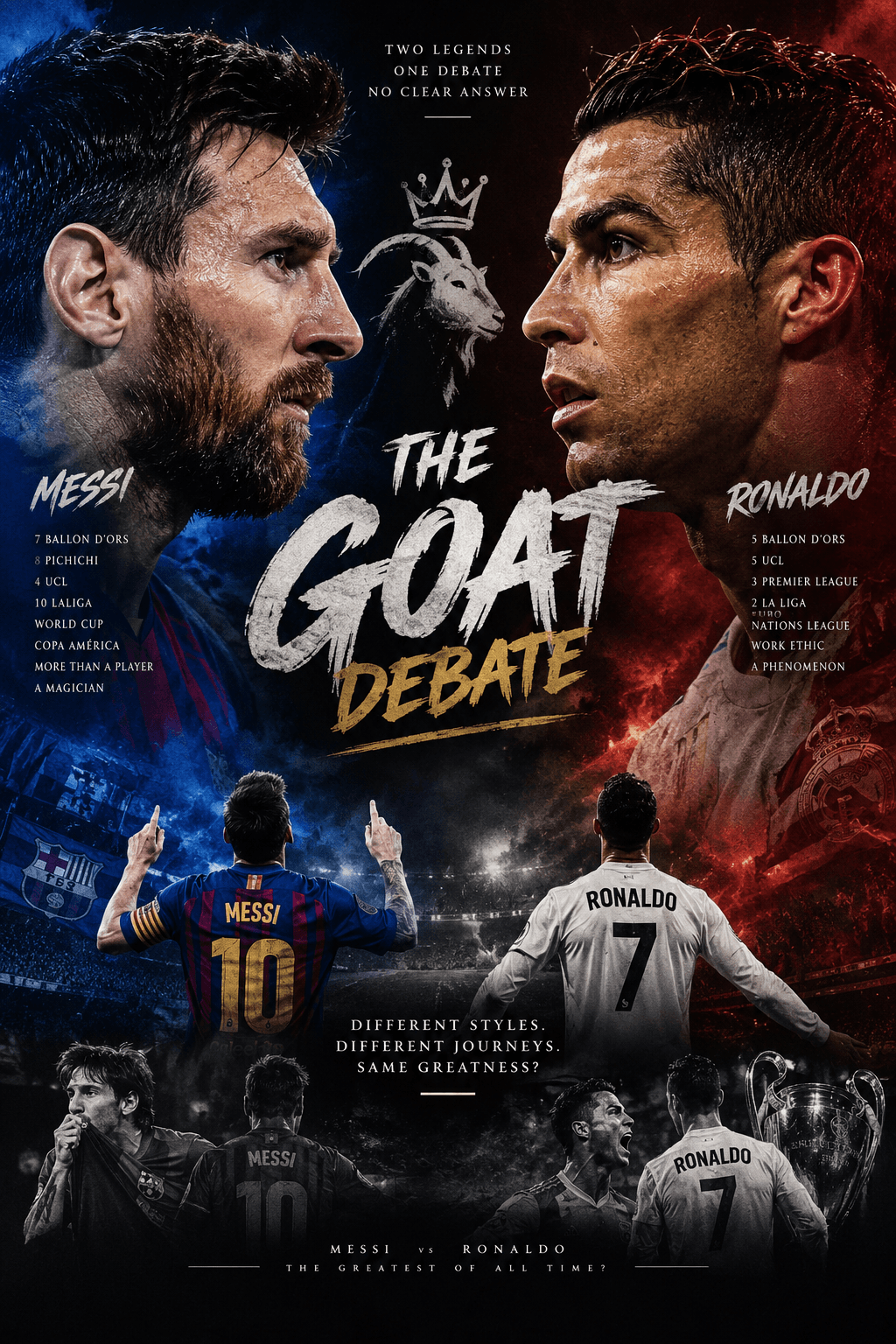
For almost two decades, football fans have been involved in one of the biggest debates the sport has ever seen: who is the greatest footballer of all time? For most of the modern era, the conversation has revolved around two extraordinary players — Lionel Messi and Cristiano Ronaldo. Both have dominated football for years, broken countless records, won major trophies and created unforgettable moments. However, when the entire career is considered, there is a strong argument that Lionel Messi has the more complete case for being called the GOAT.
Messi’s greatest strength is that he has never been defined by just one part of football. He is a goalscorer, but he is also a playmaker. He is a dribbler, but he can also control the tempo of an entire match. He can create chances, score from outside the box, deliver free kicks, make passes that defenders cannot see coming and decide games almost by himself. His ability to combine so many aspects of football into one style is a major reason why his supporters place him above everyone else.
One of the biggest arguments in Messi’s favour is his individual success. He has won the Ballon d’Or eight times, the most in the history of the award. While individual awards should never be the only way to judge a footballer, they show how consistently Messi has been recognised among the best players in the world over a long period. He was not simply brilliant for a few seasons; he remained at the highest level for more than a decade.
Then there are the trophies. Messi has won domestic league titles, domestic cups, UEFA Champions League trophies and international honours. But one trophy stands above the rest when discussing his legacy: the FIFA World Cup.
For years, critics used Argentina’s lack of a World Cup title during Messi’s career as an argument against him. Some believed that winning the World Cup was necessary before he could truly be considered the greatest. In 2022, Messi and Argentina finally lifted the trophy in Qatar. Messi scored seven goals during the tournament, provided three assists and won the Golden Ball as the tournament’s best player. More importantly, he played a central role in Argentina’s journey to the title.
That World Cup changed the conversation around Messi’s career. He had already achieved almost everything possible at club level, but now he had also reached the highest point in international football. He had won the Copa América with Argentina in 2021, followed by the World Cup in 2022, giving his international career an entirely different level of completeness.
Another major part of Messi’s case is his creativity. Football is not only about putting the ball into the net. There is also the ability to create something from nothing. Messi has produced thousands of moments where a seemingly impossible situation suddenly becomes a goal-scoring opportunity. His close control, balance, vision and passing have allowed him to escape defenders and create chances that most players would not even attempt.
His dribbling is another part of his legacy. During his peak years at Barcelona, Messi regularly took on several defenders at once. Instead of relying mainly on physical strength, he used acceleration, balance, body movement and close control to move through defensive lines. Some of his most memorable goals came after beating multiple opponents before finishing calmly.
His relationship with Barcelona also played a huge role in his legacy. Messi became one of the defining figures of the club’s history and spent the majority of his prime years there. During that period, Barcelona experienced one of the most successful eras in its history. Messi won numerous trophies while producing extraordinary individual performances season after season.
But perhaps the most impressive part of Messi’s career is his longevity. He has remained relevant across different generations of football. The teenager who first emerged at Barcelona eventually became the experienced captain who lifted the World Cup for Argentina. His game also evolved over time. As his physical abilities changed, he increasingly relied on his vision, passing, intelligence and understanding of the game.
Of course, Cristiano Ronaldo’s case cannot simply be ignored. Ronaldo has an extraordinary career of his own. His goalscoring record, Champions League achievements, international career, physical transformation and success in different leagues have made him one of football’s greatest-ever players. The rivalry between Ronaldo and Messi pushed both players to extraordinary levels and gave fans one of the greatest individual battles football has ever witnessed.
That is ultimately what makes the GOAT debate so special. There is no single statistic that can completely measure greatness. Some fans value goals, others value trophies, longevity, creativity, individual awards, international success or the ability to influence matches.
For those who put the greatest value on being an all-round footballer, however, Messi’s case is incredibly strong. He has combined goalscoring with playmaking, individual brilliance with team success, club dominance with international glory, and spectacular moments with remarkable consistency.
Lionel Messi’s legacy is therefore about more than numbers. It is about the way he played the game. The dribbles, the assists, the goals, the celebrations, the trophies and the moments of pure footballing genius have created a career that will be discussed for generations.
The debate between Messi and Ronaldo may never truly end — and honestly, that is what makes it so entertaining. But for the millions of fans who believe Lionel Messi is the greatest of all time, the argument is simple: he did not just score goals or win trophies; he combined almost every beautiful part of football into one extraordinary career.
That is why, in the eyes of many supporters, the little magician from Argentina has a place at the very top of football’s GOAT debate. 🐐⚽