Writers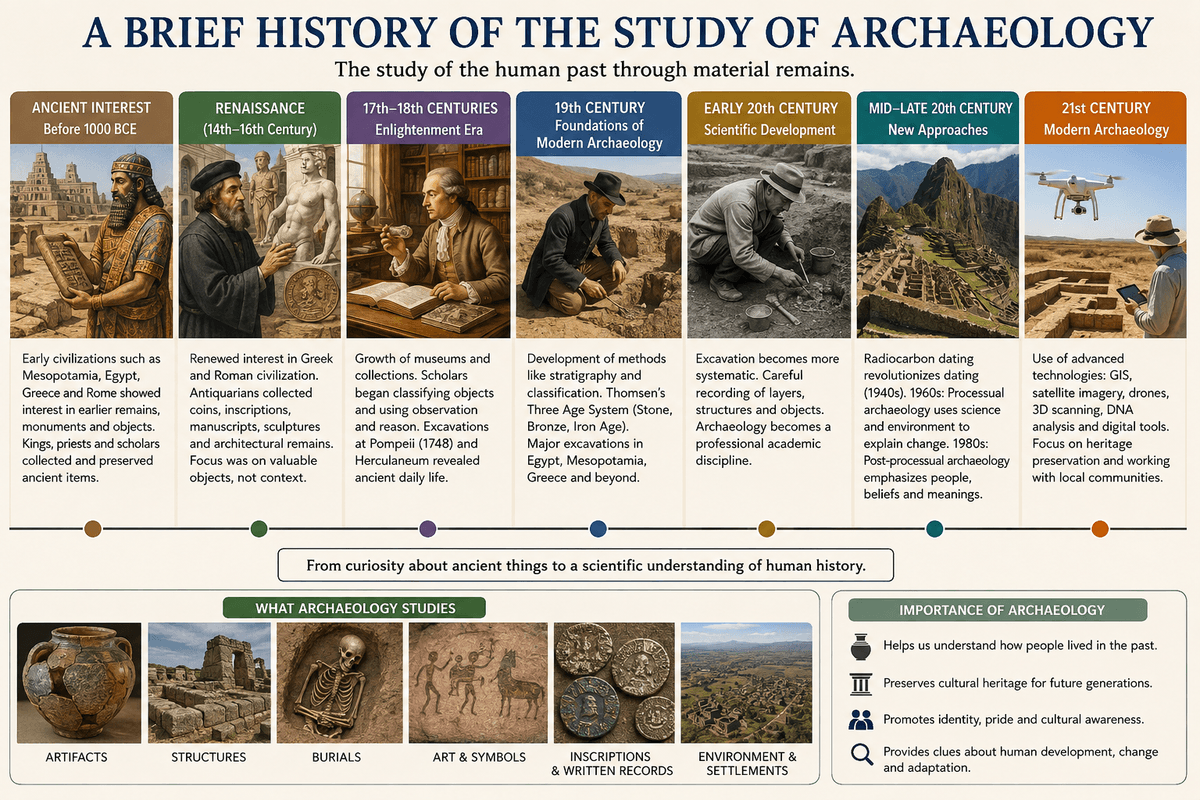
BRIEF HISTORY OF THE STUDY OF ARCHAEOLOGY
Archaeology is the systematic study of the human past through the examination of material remains left behind by people. These remains include tools, pottery, bones, buildings, weapons, coins, monuments, artworks, burials, and other objects. Archaeology helps us understand how people lived, worked, organized their societies, interacted with their environment, and developed over time. The word archaeology comes from the Greek words arkhaios, meaning “ancient,” and logia, meaning “study.”
The interest in the human past is very old. Even in ancient civilizations, people sometimes investigated and preserved remains from earlier societies. In ancient Mesopotamia, for example, some rulers excavated old temples and collected inscriptions. The Greeks and Romans also showed interest in ancient monuments, sculptures, and other objects. However, these activities were not archaeology in the modern sense because they were mainly motivated by curiosity, religion, collecting, or political interests.
A significant development occurred during the Renaissance in Europe, particularly from the fourteenth to the sixteenth centuries. There was renewed interest in ancient Greek and Roman civilization. Scholars, artists, architects, and wealthy collectors began searching for ancient statues, coins, inscriptions, manuscripts, and architectural remains. People who studied and collected such materials were known as antiquarians. Antiquarianism was an important foundation for archaeology because it encouraged systematic interest in ancient remains, although antiquarians were often more interested in individual objects than their archaeological context.
During the seventeenth and eighteenth centuries, the study of ancient remains became more organized. The Enlightenment encouraged observation, classification, and the use of evidence. Archaeological discoveries, especially the excavation of Pompeii and Herculaneum, increased interest in the study of ancient societies. These Roman cities had been buried by the eruption of Mount Vesuvius in 79 CE, preserving buildings, artworks, household objects, and other evidence of everyday life.
The nineteenth century was a major turning point in archaeology. Scholars began developing methods for classifying artifacts and establishing their ages. Danish archaeologist Christian Jürgensen Thomsen introduced the Three Age System, which divided prehistoric technological development into the Stone Age, Bronze Age, and Iron Age. This system provided an important framework for organizing prehistoric materials.
Archaeologists also began paying greater attention to context and stratigraphy. Stratigraphy involves studying layers of soil and archaeological deposits to establish the sequence in which materials were deposited. This meant that archaeologists were no longer interested only in finding valuable objects; they wanted to understand where objects were found and how they were related to other remains.
The nineteenth century also witnessed major excavations in Egypt, Mesopotamia, Greece, and other parts of the world. Discoveries of temples, tombs, inscriptions, sculptures, and settlements provided valuable information about ancient civilizations. The decipherment of Egyptian hieroglyphs through the Rosetta Stone further demonstrated the importance of combining archaeological evidence with written records.
During the twentieth century, archaeology became increasingly scientific and professional. Archaeologists developed better excavation and recording techniques and began working with scientists from other fields. A major breakthrough was the development of radiocarbon dating in the late 1940s by Willard Libby and his colleagues. This method made it possible to estimate the age of certain organic materials and greatly improved archaeological dating.
Archaeology also became more concerned with understanding human behavior. Processual archaeology, which became influential in the 1960s, encouraged archaeologists to use scientific methods, statistics, environmental studies, and models to explain why societies changed. Later, Post-Processual archaeology emphasized human beliefs, identity, symbolism, gender, social power, and cultural meanings.
Archaeology has also made important contributions to the study of Africa. Africa contains some of the earliest evidence of human evolution and prehistoric activity. Archaeological research has helped reveal the history of ancient societies in Egypt, Ethiopia, Kenya, Tanzania, South Africa, Nigeria, and other parts of the continent.
In Nigeria, archaeology has contributed greatly to the understanding of cultures such as Nok, Igbo-Ukwu, Ife, and Benin. Discoveries of terracotta sculptures, bronze objects, ironworking evidence, pottery, settlements, and trade materials have demonstrated the technological and artistic achievements of ancient Nigerian societies.
Today, archaeology is a highly interdisciplinary field. Archaeologists work with experts in anthropology, geology, biology, chemistry, physics, geography, and environmental science. Modern technologies such as satellite imagery, Geographic Information Systems (GIS), drones, 3D modelling, DNA analysis, and advanced dating techniques have made archaeological research more accurate and effective.
In conclusion, archaeology has developed from the simple collection of ancient objects into a scientific discipline concerned with understanding human life and cultural change. Through archaeological evidence, researchers can reconstruct aspects of the past that written records may not reveal. Archaeology therefore remains an important means of understanding humanity's long and complex history.