 Writers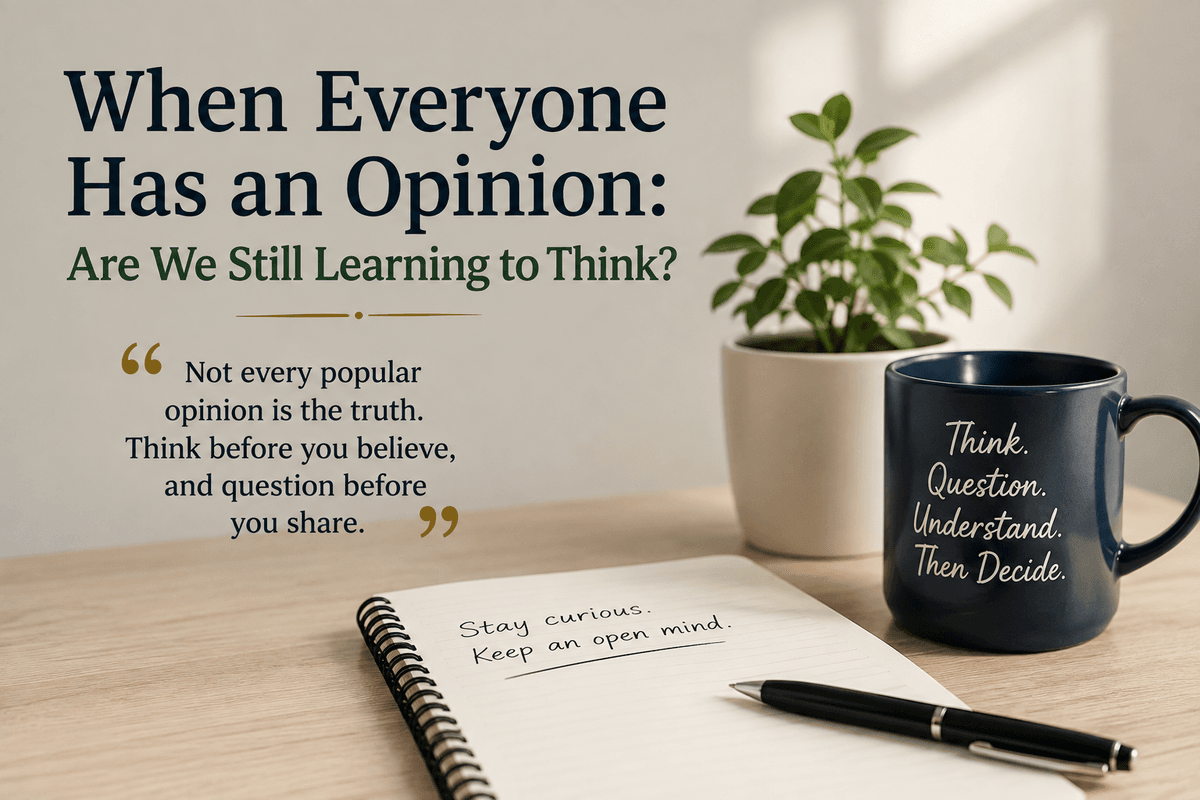
When Everyone Has an Opinion: Are We Still Learning to Think?
There is something strange about the way we consume information today.
A person can wake up, pick up a phone, scroll through hundreds of opinions before breakfast, watch a few short videos, read several comments, and already feel like an expert on subjects they only discovered twenty minutes ago.
Everyone has something to say.
Everyone has a reaction.
Everyone has a position.
But in the middle of all this noise, there is a question we don't ask often enough:
Are we actually thinking, or are we simply repeating what we have heard?
We live in an age where information is everywhere. If we want to know something, we can search for it within seconds. If we are confused about a topic, there are videos explaining it. If we want someone's opinion, we can find thousands of people willing to give one.
This should make us more knowledgeable.
Yet access to information does not automatically produce wisdom.
Sometimes, it simply gives us more things to repeat.
Think about how quickly opinions spread online. Someone makes a statement, thousands of people agree with it, and suddenly the statement begins to feel true simply because it is popular.
But popularity and truth are not the same thing.
A large crowd can be wrong.
A confident speaker can be wrong.
A person with millions of followers can be wrong.
And sometimes, the person we disagree with may actually have something valuable to teach us.
This is where critical thinking becomes important.
Critical thinking does not mean disagreeing with everything. It means being willing to examine information before accepting it. It means asking questions such as:
Where did this information come from?
Is there evidence to support it?
Could there be another explanation?
Am I accepting this because it is true, or simply because I agree with it?
That last question is particularly uncomfortable.
Human beings naturally prefer information that confirms what they already believe. When we encounter something that challenges our opinions, our first reaction may be to reject it rather than examine it.
But intellectual growth requires a certain level of discomfort.
Sometimes we need to be able to say:
"I may have been wrong."
Those four words are not a sign of weakness.
They are a sign of maturity.
Unfortunately, social media can make changing our minds difficult. Once we publicly defend an opinion, admitting that we have changed our position may feel embarrassing. We begin defending our previous statement simply because we don't want to appear inconsistent.
But changing your mind after learning something new is not hypocrisy.
Sometimes, it is growth.
Imagine a student who believes they are poor at public speaking. Every time they are asked to speak, they become nervous. Eventually, they stop trying because they have convinced themselves that confident speaking is simply something other people are born with.
Then they attend a speaking class.
They practise.
They make mistakes.
They improve.
Their original belief changes.
That is what learning does.
It challenges the version of ourselves we thought was permanent.
The same principle applies to almost every area of life.
Perhaps we should become more comfortable saying, "I don't know."
There is nothing shameful about not knowing something. In fact, "I don't know" can be the beginning of genuine learning.
The dangerous person is not the one who lacks knowledge.
It is the person who lacks knowledge but is convinced they have nothing left to learn.
We should also learn to listen beyond our comfort zones.
Talk to people who disagree with you not necessarily to change your beliefs, but to understand how they arrived at theirs. Read books outside your usual interests. Ask questions. Listen before responding.
You may not change your mind.
But you may strengthen your understanding.
And that is important because good communication is not simply the ability to express an opinion. It is also the ability to understand another person's reasoning.
Imagine what our conversations would look like if we stopped trying so hard to win every argument.
Instead of asking, "How can I prove you wrong?"
We could ask,
"Why do you see it that way?"
That simple change could transform many conversations.
It would make us better students, better leaders, better friends and better speakers.
Because a powerful speaker is not someone who has an opinion about everything.
A powerful speaker is someone who has taken the time to think deeply about something before speaking about it.
So the next time you see a controversial post, don't rush to share it.
Pause.
Read.
Question.
Think.
Then decide what you believe.
The world does not need more people shouting their opinions simply because everyone else is shouting.
It needs people who can slow down, examine information, listen carefully and think independently.
In an age where everyone is eager to speak, perhaps one of the most valuable skills we can develop is the ability to think before we do.