Writers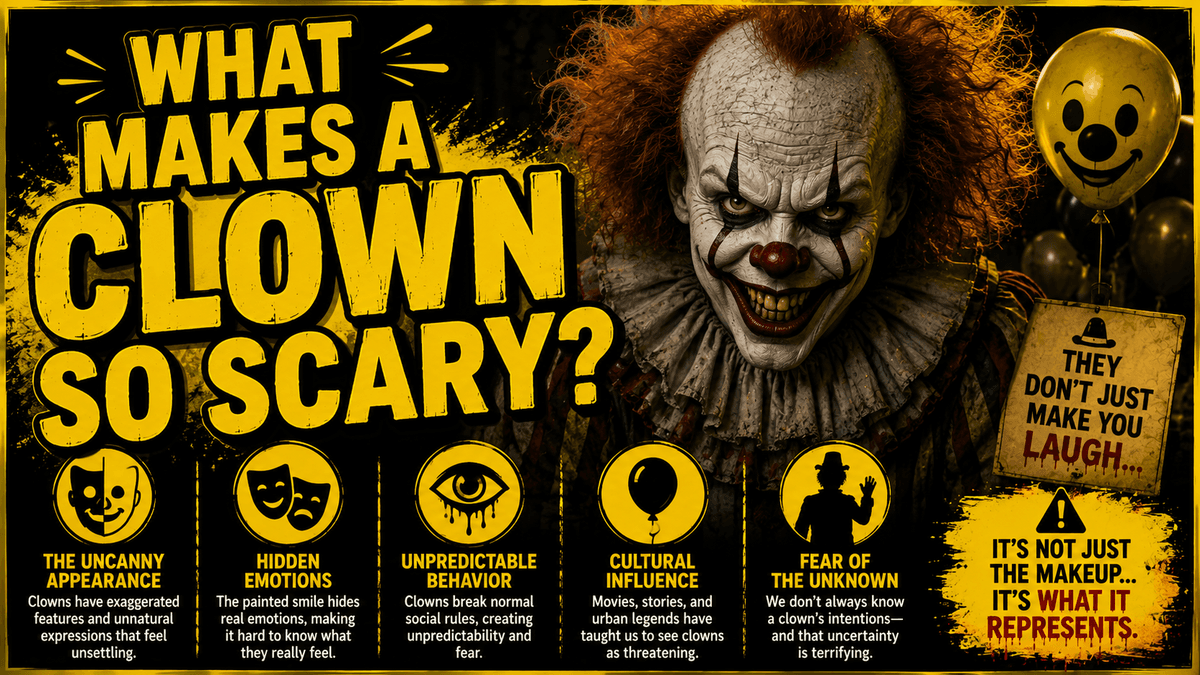
You're walking through a circus. There's music playing, children laughing, colorful balloons floating above the crowd...and then you notice him.
A clown is standing completely still.
He's smiling. But something about that smile feels... wrong.
You don't even know why. It's not like he's holding a weapon. He's not chasing you. He's not even doing anything.
Yet your instincts are telling you to stay away.
So why are you terrified? The answer is hiding behind the makeup.
Humans are constantly reading other people's faces.
A raised eyebrow can mean suspicion. A frown can signal anger. A smile usually means happiness.
Our brains have become incredibly good at interpreting these tiny facial signals.
Then there's a clown. Everything is covered.
White makeup.
Painted eyebrows.
Exaggerated lips.
A giant smile.
The clown's face is giving you information—but you can't tell whether it's real. You're not sure if the clown actually happy? Angry? Mocking you? Or hiding something?
The brain doesn't like uncertainty, and when it can't figure out someone's intentions, it may interpret the person as a potential threat.
What even makes everything worse is the the classic creepy smile.
It's freakishly enormous - far bigger than a normal human smile, and because it's painted on, it doesn't necessarily change when the rest of the face changes.
Just imagine someone looking furious while still wearing a giant painted grin. Your brain receives two completely different messages.
The eyes tells you one thing but the mouth says another. That mismatch can feel deeply unsettling.
You've probably experienced this feeling before. You see something that looks almost human - but not quite.
A realistic doll (like Chucky or Anabelle).
A strangely lifelike mannequin.
An artificial face that seems just slightly wrong.
It makes you uncomfortable. This phenomenon is often called the uncanny valley.
Clowns aren't exactly robots or human-like machines, but their appearance can create a similar effect. They're human underneath the makeup, yet the exaggerated features make them look almost like something else - and your brain notices.
There's another problem about clowns is their identity.
When you see a normal person, you can usually recognize them.
With a clown, that's much harder. The makeup hides their natural facial features. Their clothes hide their body shape. Their oversized shoes and exaggerated movements make them even harder to read.
Essentially, you're looking at a person whose identity has been deliberately concealed and we aren't always comfortable with people we can't identify.
Apart from identity, clowns don't just look unusual. They behave unusually and may move suddenly.
They walk strangely, stare for too long, make exaggerated gestures, appear unexpectedly, and even fall down and immediately get back up.
That unpredictability can make people nervous. Your brain constantly tries to predict what will happen next.
When someone's behavior doesn't follow normal social patterns, your brain has to work harder to understand them.
The most interesting part of this article is that not everyone is afraid of them. Millions of people see clowns and think that they are funny, entertaining and harmless.
Children may laugh when a clown pulls a colorful handkerchief from their pocket. Adults may remember birthday parties or circuses from their own childhood.
So the fear isn't built into the clown itself. It's partly about how our brains interpret the image. For some people, the exaggerated makeup is playful. For others, it crosses the line into disturbing.
The movie Pennywise from It has perhaps become the most famous example.
Suddenly, an image associated with children's entertainment became connected with something horrifying. Films, television and urban legends continued reinforcing the connection.
Eventually, even people who had never been afraid of clowns began to associate them with danger.
The "Killer Clown" Phenomenon
There have also been real-world incidents involving people dressing as frightening clowns to scare others.
During the 2016 "killer clown" panic, reports of creepy clown sightings spread across several countries, especially the United States and United Kingdom. Some sightings were hoaxes, while others involved people deliberately using clown costumes to frighten or intimidate others.
The phenomenon showed just how powerful the image had become. A person could put on clown makeup and suddenly become frightening without changing anything else.
In conclusion, the real truth about is that the painted smile doesn't tell you what the person underneath is thinking, the exaggerated face hides their emotions, the costume hides their identity, and their unpredictable behavior makes it difficult to guess what they'll do next.
So our brain sees the smile but it can't determine whether there's anything friendly behind it.