 Writers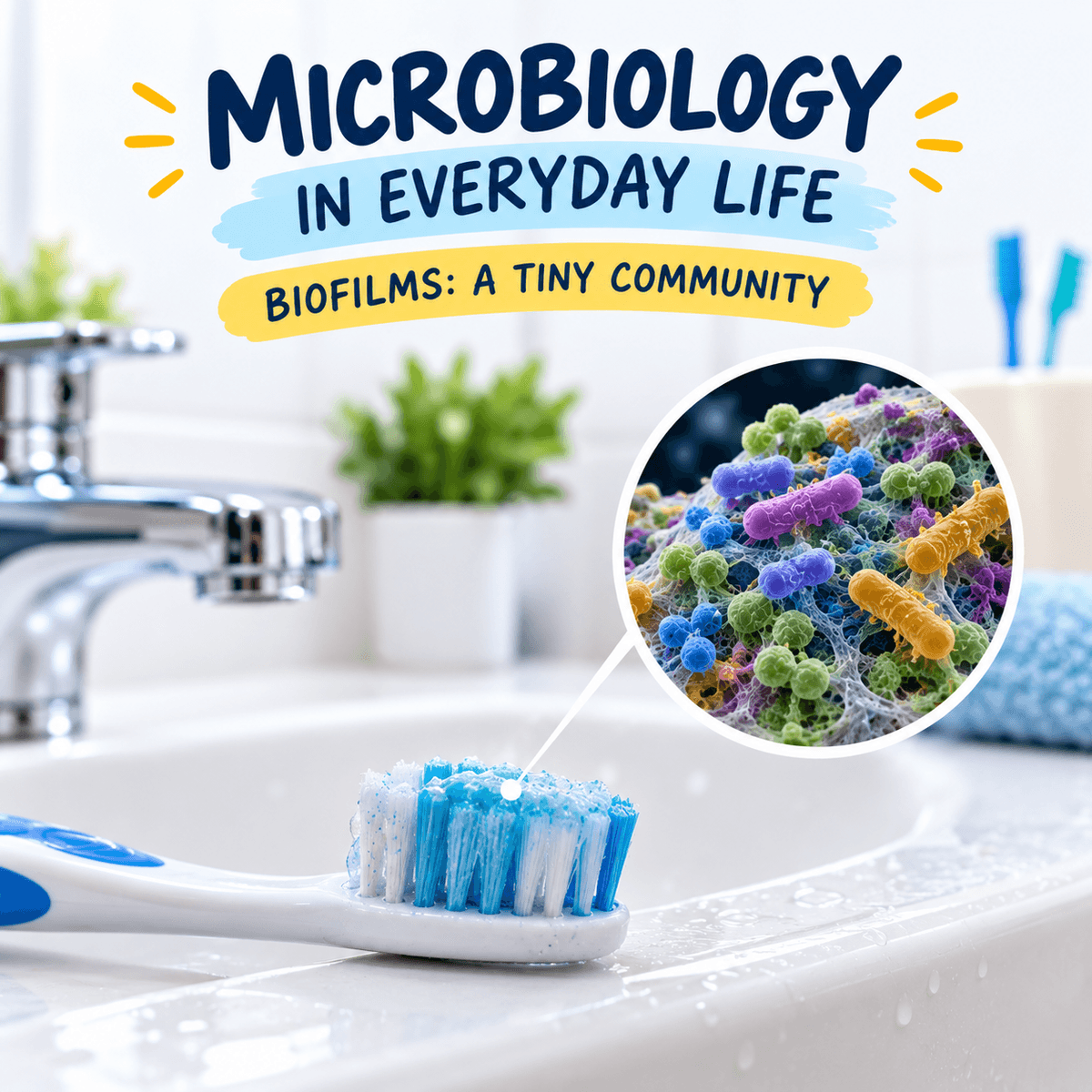
Bacteria Don’t Have Phones. So How Do They Communicate?
Yesterday, we talked about biofilms the slimy communities microorganisms can build on surfaces.
But after learning that bacteria can live together in these communities, a strange question comes to mind:
How do they know what to do?
Bacteria don't have mouths for conversation. They don't have ears to listen. They don't have phones, computers or WhatsApp groups.
Yet, some bacteria can coordinate certain activities as a community.
So, how?
The answer takes us into one of the fascinating areas of microbiology: chemical communication.
Bacteria Can Send Signals
Bacteria can produce and release tiny chemical molecules that other bacterial cells can detect. Some of these molecules are called autoinducers.
The process through which bacterial cells produce, detect and respond to these chemical signals is known as quorum sensing.
The easiest way to imagine it is to think about people entering a room.
If there are only two people in the room, the situation is different from when the room becomes crowded.
Bacteria have their own chemical version of this idea.
As bacterial cells multiply, the concentration of certain signalling molecules around them can increase. When the signal reaches a particular level, bacteria that can detect it may change the expression of certain genes and, as a result, change their behaviour.
They are not literally counting themselves.
They are responding to chemical information in their environment.
What Can This Communication Do?
This is where things become even more interesting.
Depending on the bacterial species and the particular signalling system involved, quorum sensing can influence different group behaviours.
These can include biofilm formation, production of certain virulence factors, movement, light production and other activities that help bacteria adapt to their environment.
One famous example comes from a marine bacterium called Vibrio fischeri.
This bacterium can produce light, but the light production is connected to its population density and quorum-sensing system. When enough cells are present and the appropriate signal accumulates, the bacteria can switch on genes involved in producing light.
Imagine that.
A microorganism too small to see with your naked eyes can participate in a chemical system that allows a whole population of cells to behave in a coordinated way.
And What Does This Have to Do With Biofilms?
Remember yesterday's biofilm?
A biofilm is not simply a pile of bacteria sitting on a surface. It can be an organised microbial community in which cells live within a self-produced matrix.
Quorum sensing can contribute to how some bacterial communities develop and coordinate their activities within these environments. However, the relationship is not identical in every species; bacterial signalling systems are diverse and sometimes very complex.
This is important because it changes the way we think about bacteria.
We often imagine bacteria as isolated cells: one cell here, another cell there.
But microbiology has shown us something much more interesting.
Bacteria can interact with their environment and with other microorganisms.
They can sense chemical signals, respond to changes around them and, in some cases, coordinate behaviours as a population.
Of course, saying that bacteria “communicate” does not mean they communicate exactly like human beings.
There is no tiny bacterial conversation happening inside your sink.
It means that chemical signals can carry information from one cell to another, triggering biological responses.
And that simple idea opens a much bigger window into the microbial world.
The Invisible World Is Not a Simple World
When we started this series, we began with a simple question:
What exactly is microbiology?
Then we slowly entered the microbial world.
We met bacteria, fungi, protozoa, algae and viruses.
We looked at bacterial shapes.
We learned how microbiologists use microscopes to see what our eyes cannot.
We followed bacteria into culture plates and learned how colonies can give microbiologists important clues.
We looked at what a bacterial colony can tell us.
Then we discovered biofilms—the communities microorganisms can build on surfaces.
And now we have seen that some bacteria can even use chemical signals to coordinate certain activities.
All of this came from something we encounter every day but rarely stop to question.
A toothbrush.
A sink.
Food.
Water.
Our bodies.
The environment around us.
That is what makes microbiology so fascinating to me.
The microbial world is invisible, but it is never irrelevant.
For now, let's pause here.
Not because there is nothing more to learn—far from it.
There is still so much more: how microorganisms cause disease, how our immune system responds to them, how antibiotics work, why resistance develops, how laboratories identify unknown organisms, how microbes help produce food and medicine, and so much more.
But sometimes, learning is better when we stop, breathe and allow what we have discovered to settle.
So this is not goodbye to the microbial world.
It is simply a pause.
We will come back to it.
And when we do, we will open another door into the invisible world that has been around us all along.
