Writers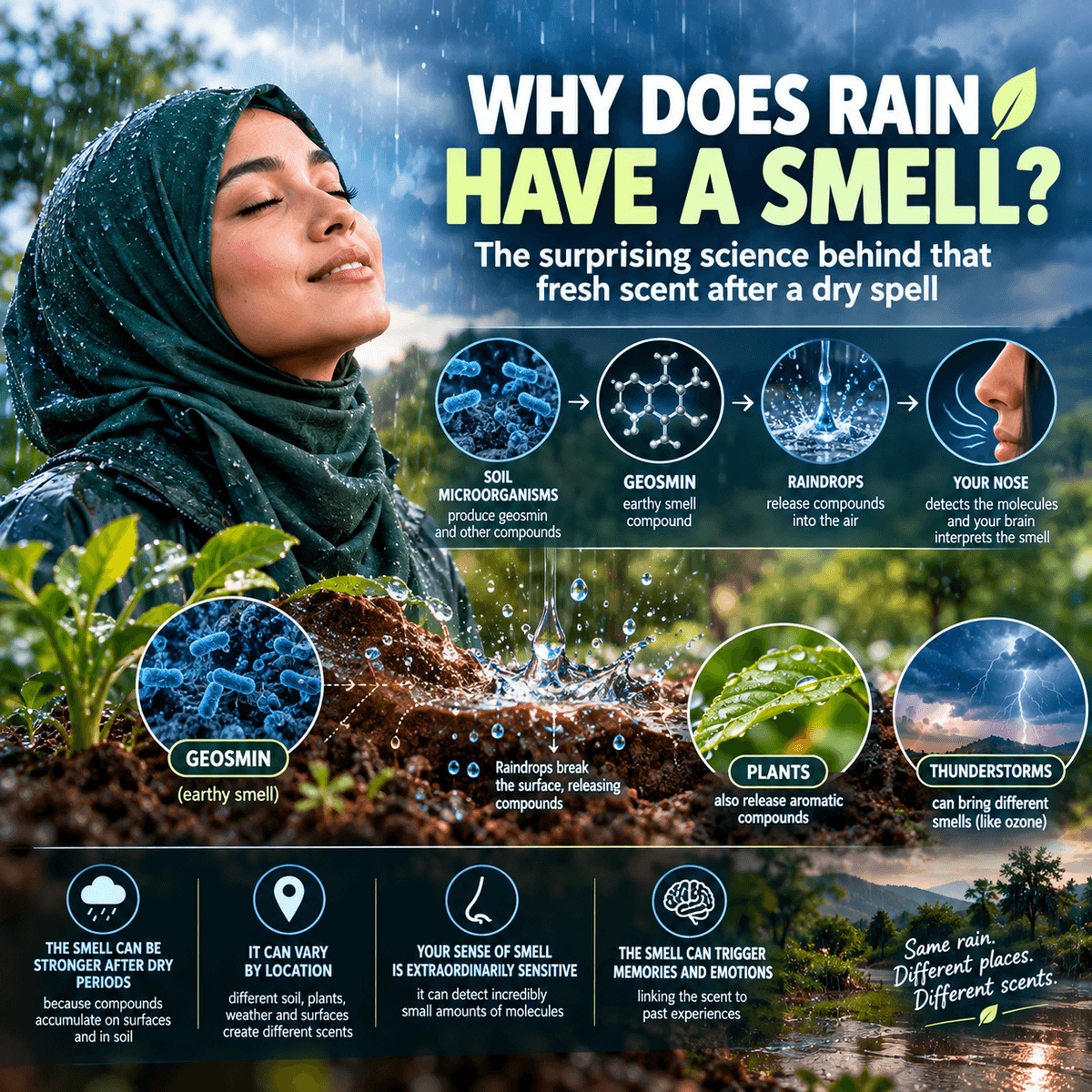
The Surprising Science Behind That Fresh Scent After a Dry Spell
There is that moment that many of us can recognize.
The ground has been dry for sometime, and suddenly rain clouds build up.
Before long, drops of water come falling from the sky to rehydrate the thirsty land.
As the water meets the earth, a new scent seems to arise from the ground.
Something that you don't necessarily find raining down on you, but rather coming from the earth below, is the smell that follows a prolonged period of sunshine and heat.
Rain is not the cause of this smell, though.
It appears to be rather the environment reacting to rain, rather than the rain itself providing an aroma all on its own.
WHAT MAKES THE EARTHY SMELL?
The smell after rain has a name, and that name is geosmin.
It is one of those chemicals that humans have an acute sense of smell for.
What makes the scent especially interesting is the fact that while it is found in soil, it is actually produced by specific types of bacteria, giving credit to the environment for the olfactory experience.
Soil is not the only contributor, either.
Plants in the ground have various chemicals that can combine on the earth or airborne particles that can be detected by the nose.
After rain, the combination of these chemicals can create that familiar scent that we so often recognize.
The scent can be stronger after a long period of drought as more of these compounds will have built up on the ground and in the atmosphere prior to the first shower of the season.
The environment plays a major role: Soil, Vegetation, Weather Conditions, Rainfall Intensity, Ground Surfaces and a variety of other variables will determine what the rain will smell like.
A forested area will smell different from a farm, the city or a grassland biome. This is a major factor for difference in the environment's aroma.
HOW DOES YOUR NOSE PLAY A ROLE IN THIS PROCESS?
The human nose has incredible precision when it comes to picking up on miniscule amounts of specific molecules.
Specialized cells in your nose detect the odor molecules that come wafting into your nostrils and send the information to your brain to register and identify each smell.
So, your brain knows when it smells rain because it receives a complex series of molecules picked up by your nose.
When we say we smell rain, then, we aren't just detecting water molecules, because at the molecular level water isn't really a smell, but a physical substance that we register with our eyes.
However, your nose has likely picked up on some airborne particles or odors that were released and picked up by the raindrops.
WHAT ABOUT THE SMELL BEFORE A THUNDERSTORM?
Storms have a peculiar type of smell due to the combination of electrical discharges and atmospheric oxidants.
Ozone, which is a reactive form of oxygen has a distinctive smell in the air during lightning strikes, wind and changing atmospheric pressure conditions can help carry the scent to your nose.
So, the smell of storms is yet another unique variation of the earthy scent that we detect after rainfall.
HOW DOES RAIN SMELL DIFFERENT PLACES?
Every drop of water that has fallen on earth has had some effect on the environment it touched.
From microorganisms, vegetation, rocks, ground surfacing or even buildings, raindrops alter the chemistry of the surfaces they meet and become carriers for odorous molecules that rise back into the atmosphere.
Therefore rain can carry an indication of the environment that it has touched.
There are several different combinations that come into play for the unique smell after rain, including:
SOIL TYPES,
PLANTS AND VEGETATION,
MICROORGANISMS, ATMOSPHERIC CONDITIONS
GROUNDSURFACING AND WEATHER CONDITIONS
That's quite an array of variables to take into consideration when thinking about the reason for differing aromas.
So essentially, your nose is detecting microscopic information from its environment through the power of smell.
HOW DOES THE NOSE REMEMBER SMELLS?
Smell is one of those senses that is very connected with memory.
A smell can often trigger an emotion or memory without any effort on our part, since our brain stores memories tied to certain scents almost instinctually.
In this way a scent can become something of a personal experience.
While the chemical that creates the smell is physically the same, the meaning it holds can be drastically different from person to person.
A MINOR LESSON BEHIND A SIMPLE RAINDROP
Rain may appear to be a simple thing.
A drop falls from the sky to meet the thirsty earth, but behind that drop there is a mixture of scientific reactions occuring, between the physical properties of rain and chemical properties of the environment.
Sometimes the most fascinating lessons are found in the things we take for granted.
❓ QUICK QUESTIONS
Does rain have a smell of its own?
Rain itself does not really have a smell of its own.
Most of the smell we detect after rainfall comes from the ground and environment reacting to the presence of water.
What is geosmin?
Geosmin is an earthy scent that comes from the soil and is produced by certain types of bacteria.
Why can rain make the ground smell stronger?
Raindrops can cause volatile compounds and particles to rise into the air, which makes the smell more detectable by the nose.
Why does rain smell different in different places?
Soil, plants, microorganisms, surface materials and atmospheric conditions all play a role in the scent after rainfall. The combination of these elements can vary from place to place. As such, the scent of rain will be different in different environments.
Can you smell rain before it arrives?
Sometimes you can pick up on the scent before it arrives due to atmospheric conditions. Wind can carry airborne particles to the nose before the rain reaches the ground.
📌 KEY TAKEAWAYS
• The smell after rain mostly comes from the environment, not the rainfall itself.
• Geosmin is a scent commonly found in the soil that is created by microorganisms.
• Raindrops can cause volatle compounds and tiny airborne particles to rise into the air.
• Vegetation and microorganisms can add to the scent of rain.
• Thunderstorms can create new scents with ozone.
• The nose has an amazing ability to pinpoint specific molecules with miniscule amounts of matter.
• The scent of rain can become connected with memories and personal experiences.
CONCLUSION
The next time it begins to rain on a hot summer's day, think about the invisible processes occuring behind those falling drops.
Raindrops are interacting with the earth every time they fall, stimulating the ground and plants around them.
After rainfall, the ground produces new odors that float up into the air to meet your nose.
A drop of water may appear to be a small thing, but in reality it can have an impact on the physical and chemical makeup of the enivornment.
It takes millions of raindrops to alter a square meter of ground, but the nose can detect the miniscule changes those raindrops make every day.
QUESTION TO THINK ABOUT
What does the smell of rain remind you of?
SOURCE
American Chemical Society - Education: Chemistry of Rain and Petrichor
https://www.acs.org/