 Writers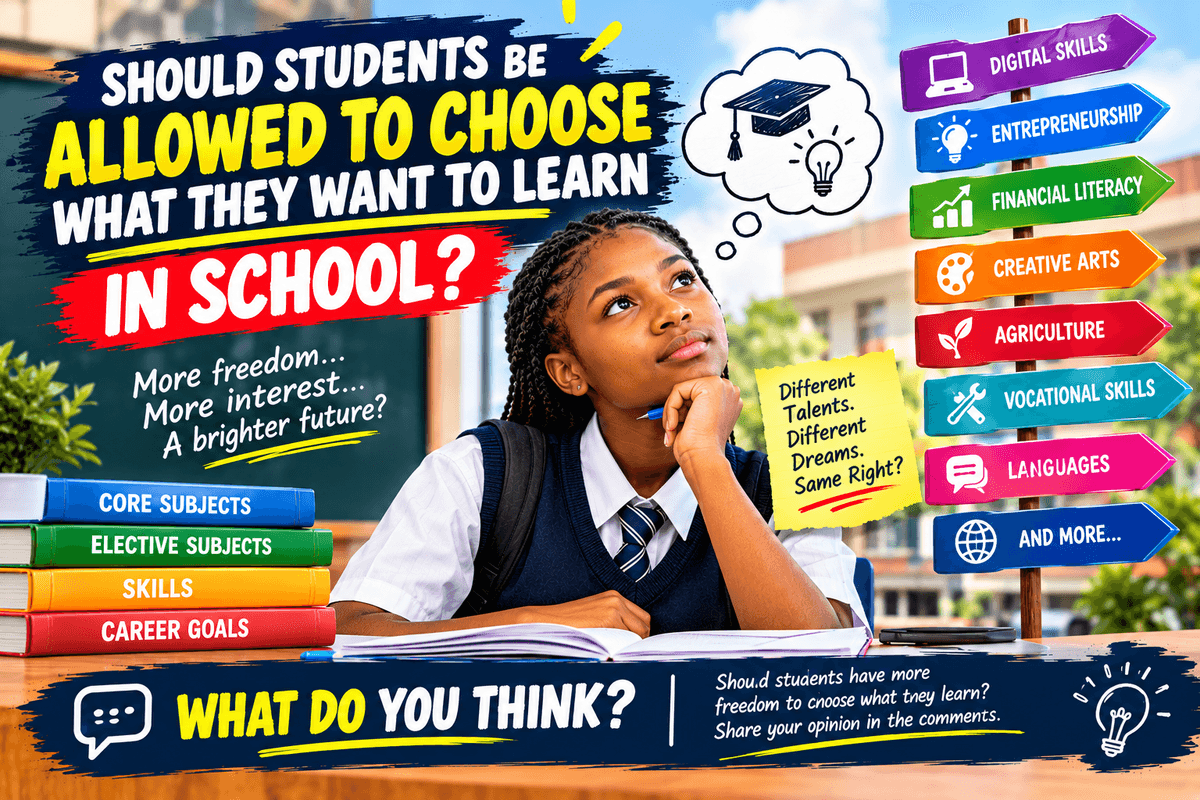
Imagine a student who loves technology but spends most of their time studying subjects they have little interest in. Another student dreams of becoming a doctor but struggles with subjects that have little connection to their intended career path.
This raises an important question:
Should students have more freedom to choose the subjects they want to study, or should schools decide what every student must learn?
Education is supposed to prepare young people for the future. But students have different talents, interests and career ambitions. What works for one student may not necessarily work for another.
Why Student Choice Could Be Helpful
Giving students some freedom to choose subjects could help them discover and develop their strengths.
A student who enjoys computer technology could be encouraged to study programming, digital skills or information technology. Someone interested in business could learn entrepreneurship, accounting or financial literacy. Another student who enjoys creative work could explore graphics, photography, music or other creative subjects.
When students study subjects they genuinely enjoy, they may become more motivated to learn.
They may also begin developing skills that could eventually become useful in their careers.
But Should Students Choose Everything?
Probably not.
Some subjects provide knowledge that every student needs regardless of their future career.
Basic literacy, numeracy, communication skills, civic knowledge and critical thinking are useful in almost every profession.
A student may say, for example, “I don't need Mathematics because I want to become a writer.” But basic mathematical and financial skills can still be useful in everyday life.
Similarly, someone interested in science still needs communication skills to explain ideas effectively.
Therefore, completely allowing students to ignore subjects they dislike may create educational gaps.
What Could Be the Solution?
Perhaps schools should combine core subjects with elective subjects.
Every student could be required to study essential subjects while also being allowed to select additional subjects based on their interests, abilities and career goals.
For example, students could choose from areas such as:
Digital technology
Entrepreneurship
Financial literacy
Agriculture
Creative arts
Vocational skills
Languages
Media and communication
Advanced sciences
This approach could make education more flexible without removing the basic knowledge students need.
What About Parents?
Parents naturally want the best for their children.
However, sometimes parents choose careers for their children based on their own expectations.
A parent may want a child to become a doctor, lawyer or engineer because those professions are considered prestigious, even when the child has completely different interests.
Parents should guide their children, but guidance is different from forcing them into a career they do not want.
A student who is passionate about a particular field may perform better when given the opportunity to develop that interest.
Education Should Discover Potential
Not every successful person follows the same path.
Some people succeed through university education, while others build careers through vocational training, entrepreneurship, technology, creative industries or professional skills.
The purpose of education should therefore not only be to produce students who can pass examinations. It should also help young people discover their abilities and prepare for meaningful careers and responsible adulthood.
Perhaps the question is not whether students should have complete freedom over what they learn.
Perhaps the better question is:
How much freedom should students have?
THE BIG QUESTION
If you were allowed to introduce three elective subjects into secondary schools, which three would you choose?
Would you choose digital skills, entrepreneurship, financial literacy, vocational training, creative arts, agriculture, communication skills—or something else?
Do you think students should have more freedom to choose what they learn? Share your opinion in the comments.
