 Writers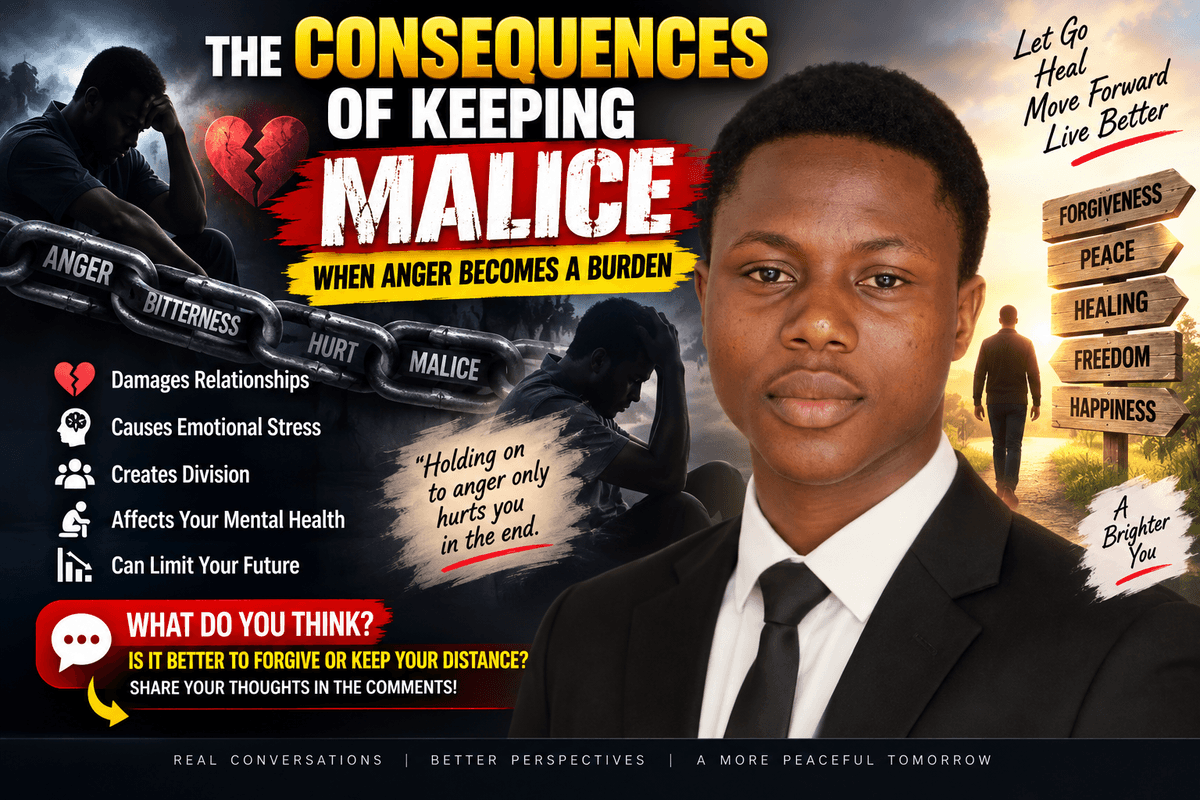
Have you ever been hurt by someone and decided never to speak to that person again?
Perhaps a friend betrayed you, a family member offended you, a colleague disappointed you, or someone said something that deeply hurt your feelings. Instead of addressing the issue, you decided to keep malice.
At first, staying silent may feel satisfying. You may feel that you are teaching the other person a lesson. But sometimes, the person we are angry with may have already moved on while we continue carrying the burden.
Keeping malice can become a heavy emotional burden.
Malice often creates distance between people. Two people who once laughed together may suddenly become strangers because neither is willing to make the first move. A simple disagreement can gradually become years of silence.
The painful part is that some conflicts begin over issues that could have been resolved through a simple conversation.
Another consequence is constant emotional stress. When you continue thinking about what someone did to you, the incident may remain alive in your mind long after it happened. You may repeatedly replay the conversation, imagine what you should have said or become angry whenever you remember the person.
In this way, the conflict continues to occupy your mind even when the other person is not around.
Keeping malice can also affect relationships with other people.
Imagine two siblings who stop speaking because of a disagreement. Their parents may become uncomfortable. Other family members may feel forced to take sides. Eventually, one person's anger can affect the entire family.
The same thing can happen among friends, colleagues and neighbours.
There is also a danger in allowing pride to control us.
Sometimes, both people involved in a disagreement are waiting for the other person to apologise first. Days become weeks, weeks become months, and eventually neither person remembers exactly how the disagreement started.
At that point, the relationship may have suffered more damage than the original problem deserved.
This does not mean that we should tolerate every form of mistreatment.
Forgiveness does not mean accepting abuse or allowing someone to repeatedly hurt you. You can forgive someone while maintaining healthy boundaries. You can also decide not to continue a relationship that is harmful to you.
The important thing is not to allow anger to control your life.
If someone has offended you, consider having a calm conversation when appropriate. Explain how their actions affected you. Listen to their perspective. Sometimes, you may discover that the situation was misunderstood.
And if an apology is necessary, be willing to give one.
There is strength in saying:
“I was wrong.”
There is also strength in saying:
“What you did hurt me, but I don't want to continue carrying this anger.”
Life is too short to spend years fighting battles that could have been resolved through communication and forgiveness.
Not every relationship will return to the way it was, and not every conflict will have a perfect ending. But you can choose to protect your peace.
Don't allow someone else's mistake to become a permanent burden that you carry everywhere.
Sometimes, the person you need to forgive is not only the person who hurt you—you may also need to forgive yourself for holding onto the pain for too long.
What do you think?
When someone hurts you, is it better to keep your distance and remain silent, or should you try to talk about the problem and seek forgiveness?
Share your thoughts in the comments.
