 Writers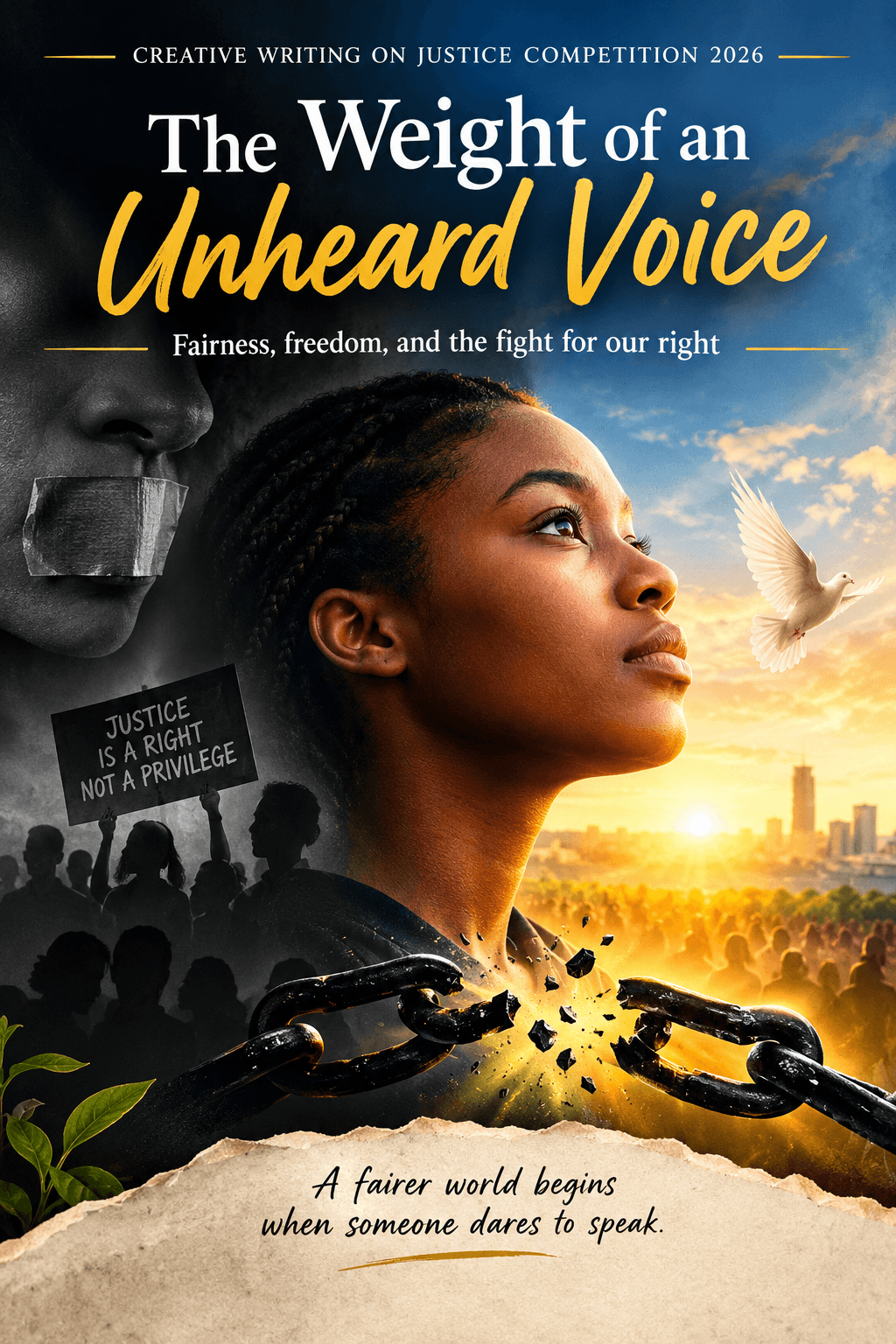
The day Amara lost her voice, the world did not stop.
The sun rose. Children laughed. Buses rumbled through crowded streets. Somewhere, someone celebrated a victory while someone else silently endured defeat.
The world continued.
That was the frightening part.
Injustice does not always arrive with sirens. Sometimes, it slips into ordinary life so quietly that people mistake it for normal.
Amara was seventeen when she discovered this.
Her voice had not disappeared. She still greeted neighbours and laughed with friends. But after witnessing an injustice that frightened everyone into silence, she found herself afraid to speak.
Her mother once told her, “A person can survive hunger. What is harder to survive is being treated as though you do not matter.”
Amara finally understood.
It happened in a crowded market. Traders called out prices, customers hurried between stalls, and the air carried the smell of freshly cooked food.
Everyone was busy living.
And injustice flourished in the background.
Amara witnessed something wrong. Others witnessed it too. Yet nobody spoke.
Not because they did not care, but because they feared what speaking might cost.
That is how injustice survives: through the cruelty of those who commit it and the silence of those who witness it.
Silence can look harmless.
Sometimes, however, it is a locked door. Sometimes, it is a blindfold. Sometimes, it is the comfortable excuse, It is not my problem.
Until one day, it is.
That evening, Amara discovered an old notebook beneath her mother's bed. On its first page, someone had written:
“A right that must be begged for is a right already in danger.”
She read the sentence twice.
Then she understood: rights do not survive merely because they are written down. They survive because people defend them.
The following morning, Amara spoke.
Her hands trembled. Fear stood beside her like a shadow.
But she spoke anyway.
Nothing extraordinary happened. The sky did not change. The powerful did not suddenly become humble.
Yet something changed.
Amara had stopped allowing fear to speak for her.
She discovered that courage is not the absence of fear; it is the decision that fear will not have the final word.
Her voice was only one voice.
But one voice can become a question. A question can become a movement. A movement can transform a future.
Sometimes, justice begins with four simple words:
“This is not right.”
Justice is larger than a courtroom. It lives wherever human beings recognise one another's dignity.
It exists when poverty does not determine whose rights matter, when children are heard, when women can speak without fear, and when the powerful are held accountable.
Justice is not simply the punishment of wrongdoing. It is the refusal to allow wrongdoing to become normal.
And freedom?
Freedom is more than walking through an open door.
What is freedom if fear determines what you can say? What is equality if opportunity depends on wealth or connections? What is a right if only the powerful can exercise it?
Freedom is the right to remain fully human.
To think. To speak. To question. To disagree. To dream without surrendering one's dignity.
Yet freedom without fairness can become another prison.
A society cannot call itself just when some people are protected while others are abandoned. Nor can it claim to value equality when a person's dignity depends on their background, beliefs, or social standing.
Perhaps the greatest test of justice is not how we treat people who resemble us.
It is how we treat people who do not.
It is easy to defend fairness when we are suffering. It is harder when fairness benefits someone we dislike.
It is easy to demand freedom for ourselves. It is harder when another person's freedom challenges our beliefs.
But justice that protects only our friends is not justice. Freedom reserved for the majority is not freedom.
Justice must remain justice even when the face before us is unfamiliar.
Throughout history, people have challenged injustice despite being told they were powerless, troublesome, or destined to fail.
Some marched. Some wrote. Some protested. Others simply refused to participate in wrongdoing.
Their circumstances differed, but they shared one conviction: accepting injustice was not the only available choice.
Change often begins when one person acts and another discovers the courage to follow.
Years later, a young girl asked Amara, “Were you afraid?”
“Yes,” Amara replied.
“Then why did you speak?”
Amara looked towards the horizon.
“Because I realised my silence was helping the wrong person.”
The girl fell quiet.
Some truths require no decoration.
They simply need to be heard.
Perhaps that is what justice asks of every generation: not perfection, but participation.
We will never inherit a flawless world. There will always be another unfairness to confront, another voice to defend, another door to open.
Our responsibility is not to create a perfect world overnight. It is to leave behind a world fairer than the one we inherited.
One day, history may forget our names and speeches. But the consequences of our choices will remain.
It will matter who looked away, who chose comfort, and who stood trembling but determined when silence seemed easier.
So listen when someone is silenced. Challenge unfairness when others accept it. Defend freedom when doing so becomes inconvenient. Choose fairness even when it costs you something.
Because justice does not begin when everyone agrees.
It begins when someone decides that another person's dignity is worth defending.
And when the crowds have disappeared, the arguments have faded, and the world has moved on, one question will remain for each of us:
When you heard a voice being silenced, what did you do with the silence?