Writers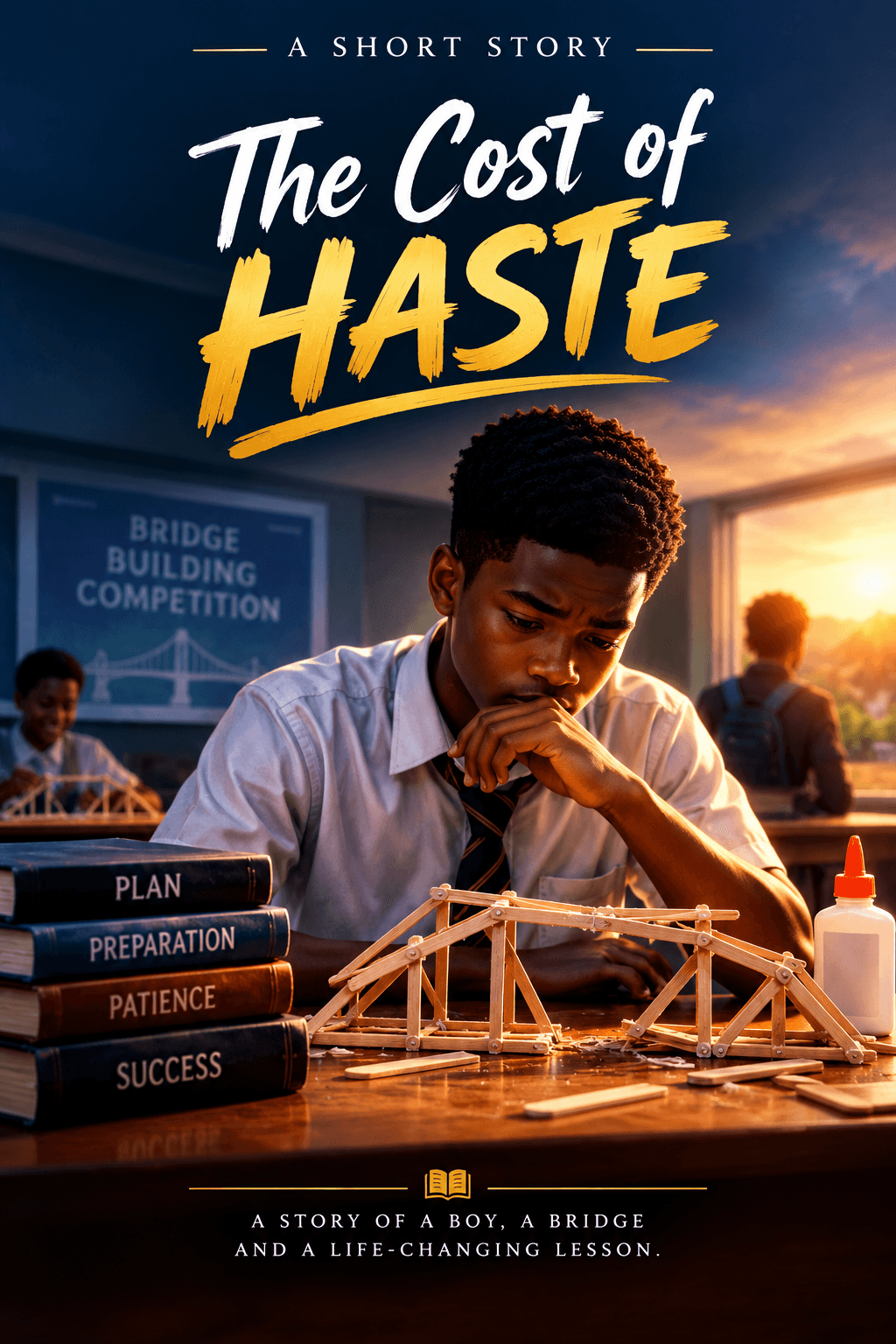
The Cost of Haste
Every morning, Daniel watched the school bus disappear around the corner while he struggled to fasten his shoelaces.
“Tomorrow, I shall wake up earlier,” he would promise himself.
Yet, somehow, tomorrow always arrived with the same familiar chaos.
Daniel was an exceptionally bright student, and he knew it. He completed his assignments with remarkable speed, often finishing long before his classmates. Whenever his teacher advised him to slow down and review his work, he would merely smile with the confidence of someone who believed mistakes belonged to other people.
“I already know what I’m doing,” he would reply.
One Monday morning, an announcement stirred excitement throughout the school. A competition was to be held, challenging students to construct a bridge using nothing but wooden sticks and glue. The strongest structure would earn its creator a scholarship prize.
At once, Daniel’s imagination carried him to the stage, where he pictured himself receiving the coveted award beneath the applause of his classmates.
Beside him sat Samuel, a quiet and diligent student who approached the task with admirable patience. He measured each wooden stick meticulously, examined every joint, and tested the stability of his work before proceeding.
Daniel glanced at him and chuckled.
“Why are you wasting so much time? Just glue everything together!”
Samuel raised his eyes from his work.
“I would rather take my time than be forced to start all over again,” he replied calmly.
Daniel dismissed the advice and hurried through his construction. Within a short while, his bridge stood proudly upon the desk. Its appearance was impressive, and he regarded it with the satisfaction of someone who believed victory was already within his grasp.
That evening, he carried the project home, scarcely considering whether its elegant appearance concealed any weaknesses.
The following morning, Daniel decided to test its strength by placing several heavy books upon it.
For a brief moment, the bridge remained upright.
Daniel smiled, his heart swelling with relief. He imagined the admiration of his classmates and the pride that would shine in his parents’ eyes when he told them he had won.
Then came a sharp crack.
The bridge buckled beneath the books and collapsed.
Daniel stared at the scattered wooden pieces, unable to comprehend what had happened. Just moments earlier, he had been standing in the bright landscape of his imagination, receiving applause and celebrating his success. Now, all that remained before him was a heap of broken sticks and a silence that seemed to press against his chest.
“No… no, this can’t be happening,” he whispered.
He hurried to gather the pieces, his fingers trembling as he tried to fit them together. He pressed one stick against another, hoping that somehow he could undo the mistake. But the glue had dried unevenly, and several pieces were too short. The harder he tried, the more obvious the damage became.
His eyes drifted towards Samuel’s bridge. It stood firm, carefully constructed and patiently tested. Daniel remembered laughing at his classmate, dismissing his careful work as a waste of time.
Now, those words returned to him with painful clarity.
He lowered his head, struggling to contain the disappointment that had gathered inside him. It was not merely the lost competition that hurt. It was the realization that he had been given an opportunity and had squandered it—not because he lacked ability, but because he had believed his ability made preparation unnecessary.
When his teacher approached, Daniel quickly wiped his eyes and turned away.
“I thought I had it all figured out,” he admitted quietly.
His teacher sat beside him.
“Sometimes,” she said, “the hardest lessons are the ones we learn when our confidence outruns our preparation.”
Daniel looked at the broken bridge once more. For the first time, he understood that failure was not simply about losing. Sometimes, it was about confronting the part of yourself that had led you there.
After a moment, Daniel turned towards Samuel.
“Would you please show me how you built yours?” he asked, his voice quieter than usual. “I thought I could do it all by myself, but I was wrong.”
Samuel nodded without hesitation.
“Of course. We can rebuild it together.”
They began gathering the scattered sticks. This time, Daniel listened carefully as Samuel explained how to measure each piece, strengthen the joints, and test the structure before moving on. Daniel worked more slowly, paying attention to details he had previously dismissed as unimportant.
Although the competition had already ended, he no longer felt the same urgency to prove himself. For the first time, he was more interested in understanding his mistakes than in pretending he had made none.
Daniel did not win the prize that day. Nevertheless, as he watched the rebuilt bridge stand firm, a quiet sense of accomplishment settled within him.
He had lost the competition, but he had gained something far more lasting: the humility to learn, the patience to improve, and the courage to begin again.
From that day onward, Daniel continued to pursue his ambitions, but he no longer regarded every step as an obstacle to be hurried past. He learned to appreciate the quiet value of preparation, the wisdom of patience, and the importance of learning from his mistakes.
Whenever impatience tempted him to rush ahead, he remembered the little wooden bridge that had taught him a lesson he would never forget.
Moral: Haste may promise a quicker path to success, but patience, diligence, and thoughtful preparation often determine whether that success can truly be achieved.