Writers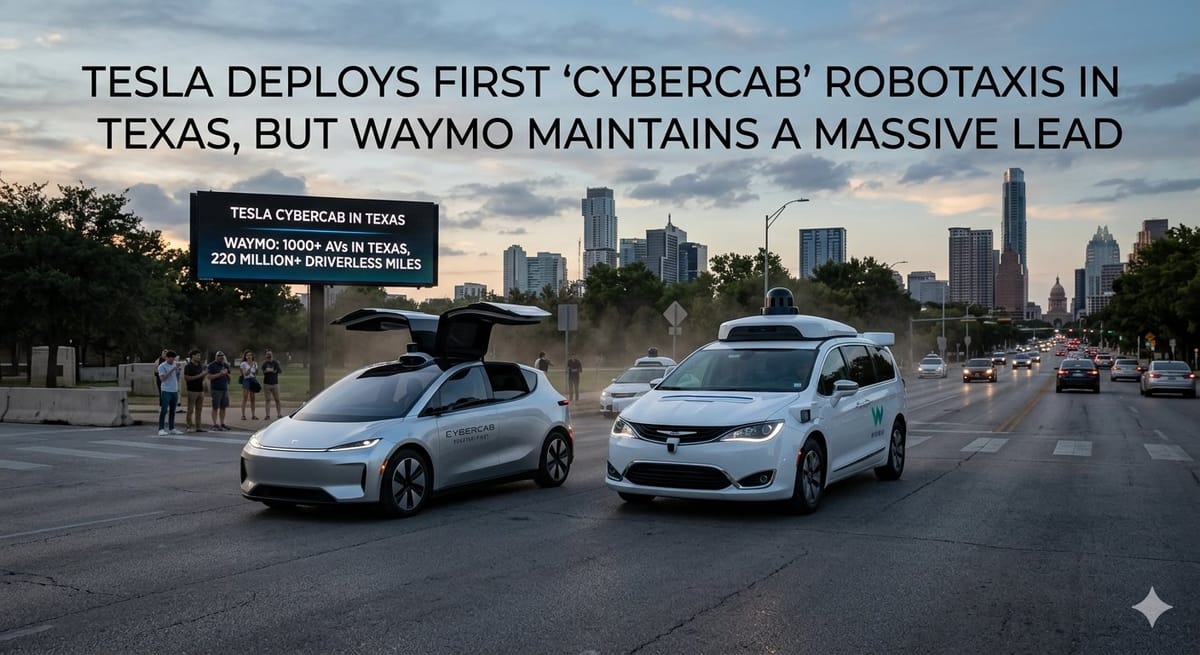
Tesla has officially taken its biggest gamble on artificial intelligence yet, registering its first fleet of purpose-built Cybercab robotaxis for public roads in Austin, Texas. The move represents a critical shift for the electric vehicle pioneer, as CEO Elon Musk attempts to pivot the company away from traditional auto sales toward autonomous mobility services.
However, newly revealed regulatory data shows Tesla faces a staggering gap if it hopes to catch market leader Waymo.
Inside the Cybercab
According to official documentation submitted to the U.S. Environmental Protection Agency (EPA), the Cybercab is a radical departure from traditional automotive design:
- No Manual Controls: The two-seater vehicle completely lacks a steering wheel and pedals, relying entirely on Tesla’s Full Self-Driving (FSD) camera system.
- The Specs: It features vertical gull-wing doors, weighs 3,113 pounds (1,412 kg), and is powered by a 219-horsepower front-wheel-drive electric motor.
- Range and Price: In laboratory environments, the car achieved an unadjusted combined range of 418.2 miles (approx. 673 km). Tesla is targeting a highly competitive retail price of $30,000 to make autonomous transit affordable to the masses.
The Texas Robotaxi Stand-Off
While Tesla’s milestone marks a major step forward, regulatory filings reveal just how far behind the company is in terms of real-world deployment.
A direct comparison of the autonomous landscape in Texas highlights the steep hill Tesla has to climb:
- Waymo (Alphabet): The undisputed industry titan has near 1,000 autonomous vehicles registered in Texas alone. Globally, its fleet has logged over 220 million fully driverless miles and has been offering fully public, driverless commercial rides since 2020.
- Tesla: Currently has 420 total autonomous vehicles registered in Texas—but only 45 of them are the new Cybercabs. The remainder of its pilot fleet consists of Model Y vehicles, which have accumulated 380,000 unsupervised miles across six cities in Texas and Florida.
- Zoox (Amazon): Another formidable rival that similarly built a vehicle without pedals or a steering wheel. Zoox recently launched commercially in Las Vegas and holds a federal exemption to deploy up to 2,500 driverless vehicles per year while it actively maps Austin and Houston.
The Long Road to Public Trust
Musk believes Tesla's unmatched manufacturing capacity will allow it to produce millions of cheap Cybercabs faster than competitors, who rely on modifying expensive third-party vehicles.
Yet, technology is only half the battle. Tesla still has to clear strict regulatory hurdles and overcome heavy consumer skepticism. Recent market surveys indicate that 7 out of 10 American adults admit they are deeply uncomfortable riding in a vehicle with no human driver behind the wheel.
Sources:
- https://clarin.com
- https://reuters.com
What's your opinion if such electric vehicles come into existance fully especially, here in Nigeria. Can you be one of those at the fore-front to get the ride or you would still be with the usual transit familiar. Let me know about it. For me I am always part of any positive developmental change provided it means good to myself and the general environment ecosystem! Have fun reading.