Writers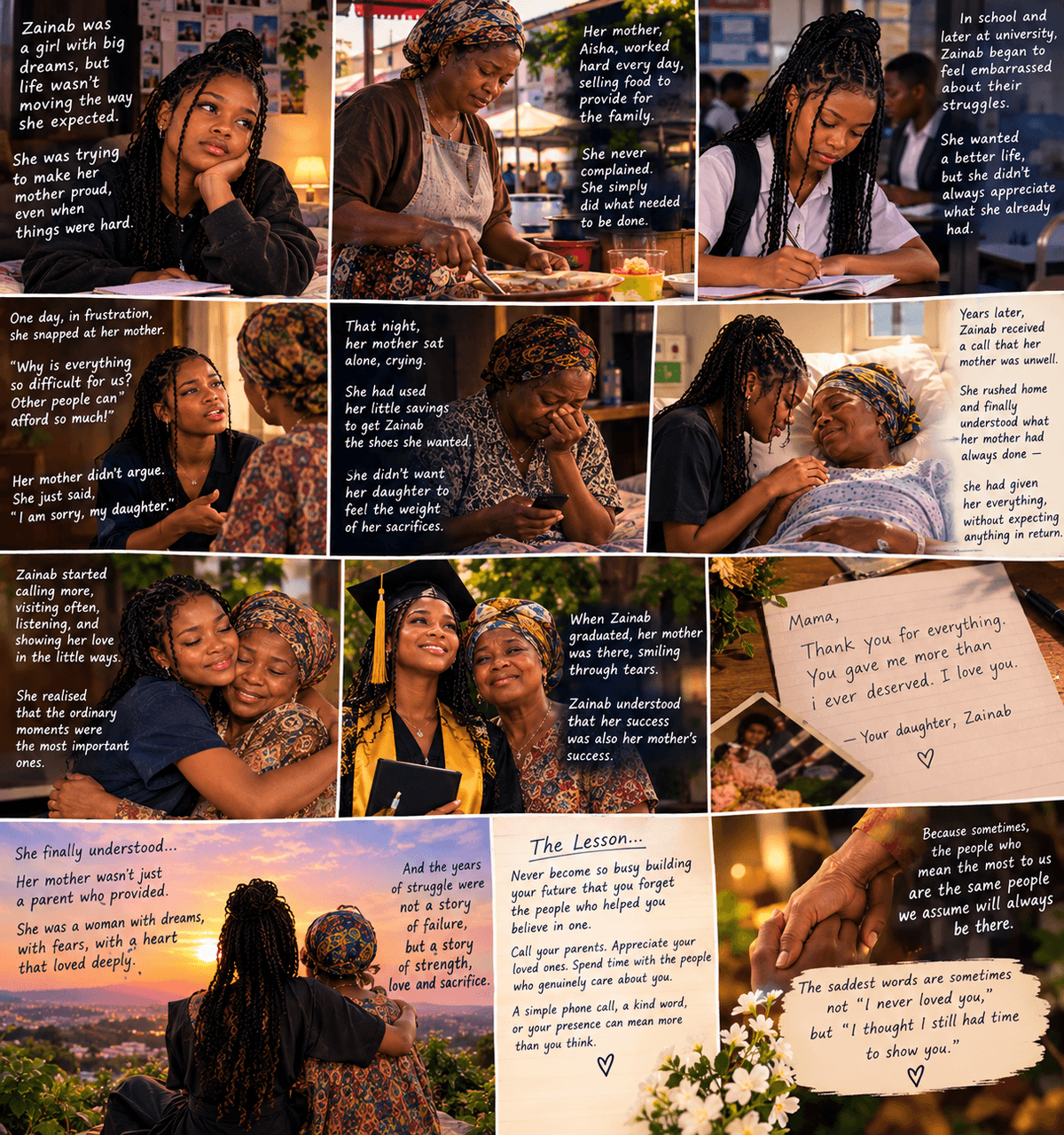
There was a girl named Zainab who believed she had all the time in the world to make her mother proud.
She was nineteen, full of dreams, and convinced that one day she would become successful enough to give her mother the life she had always deserved.
Her mother, Aisha, was a hardworking woman who sold food in a small roadside shop. Every morning, she woke up before sunrise, prepared her meals, and walked to her shop carrying a basket filled with hope and responsibility.
Life had never been easy for them. Since Zainab's father left when she was young, her mother had raised her alone, doing everything possible to ensure her daughter received an education.
Sometimes, Zainab wondered how her mother managed to smile even when things were difficult.
Whenever she asked, her mother would simply say, "As long as you are doing well, my daughter, I am happy."
Those words made Zainab feel loved, but as she grew older, she began to feel embarrassed by their poverty.
At school, some of her classmates wore expensive clothes and carried the latest phones. They talked about holidays, parties, and the things their parents bought for them.
Zainab rarely joined those conversations.
She wore the same shoes until the soles began to separate. Her mother repaired them whenever she could, and although Zainab knew the woman was doing her best, she sometimes wished things were different.
She never understood why she felt ashamed of the very person who was sacrificing everything for her.
Perhaps it was because she was young.
Perhaps she had not yet learned that love does not always arrive in beautiful packages.
Sometimes, love comes wearing an old wrapper, standing beside a cooking pot, counting the little money left after paying school fees.
And sometimes, we fail to recognise it because we are too busy looking at what other people have.
One afternoon, Zainab returned home from school in a terrible mood.
She had asked her mother for money to buy a new pair of shoes for an upcoming school event, but her mother had told her they would have to wait.
That answer upset her.
"Mama, you always say we should wait!" she complained. "When will we stop living like this? Other people's parents can afford to give them whatever they need. Why is everything difficult for us?"
Her mother stopped arranging the clothes she had been washing.
For a moment, she said nothing.
Then she looked at her daughter and replied softly, "I know things are difficult, Zainab. I wish I could give you everything you want."
"But wishing is not enough!" Zainab shouted.
The moment the words escaped her mouth, the room became silent.
Her mother lowered her eyes.
Zainab expected an argument. She expected her mother to remind her of everything she had done for her.
Instead, Aisha simply picked up the basket beside her and prepared to leave for work.
"I will see what I can do," she said.
That evening, Zainab found a new pair of shoes beside her bed.
They were not expensive, but they were clean and beautiful.
She was surprised.
"Mama, where did you get the money?"
Her mother smiled. "Don't worry about that. Just make sure you do well at your event."
Zainab hugged her and thanked her.
She never asked another question.
She did not know that her mother had used money she had been saving for a medical appointment.
She did not know that Aisha had spent the previous evening wondering how she would manage without that money.
All Zainab knew was that she had finally received what she wanted.
And sometimes, the people who love us make sacrifices we never notice because they do not want us to feel the weight of them.
Years passed.
Zainab gained admission into a university in another city.
On the day she left home, her mother packed food into a small bag and placed some money inside Zainab's purse.
"It is not much," she said, "but please manage it carefully."
Zainab nodded.
Her mother held her for a long time before letting her go.
"Call me when you arrive."
"I will, Mama."
"Eat properly."
"I will."
"And remember that no matter what happens, you can always come home."
Zainab smiled.
"Mama, you worry too much."
Then she entered the vehicle and waved goodbye.
As the vehicle moved away, Aisha stood by the roadside, watching until she could no longer see her daughter's face.
She returned home alone.
For the first time in years, the house felt unusually quiet.
University changed Zainab.
She met new people, discovered new opportunities, and began imagining a future much bigger than the little world she had known growing up.
She made friends who came from wealthy families. They invited her to restaurants, bought fashionable clothes, and introduced her to experiences she had never known.
She wanted to fit in.
Slowly, she began to distance herself from the things that reminded her of home.
She stopped answering her mother's calls regularly.
Sometimes, when her phone rang during a gathering with friends, she would silence it and promise herself she would call later.
Later became tomorrow.
Tomorrow became next week.
When her mother asked whether she was eating well, Zainab sometimes became impatient.
"Mama, I'm fine. Please stop worrying about everything."
When Aisha asked whether she needed money, Zainab would say she had enough, even when she was struggling.
She did not want her friends to hear her talking about financial problems.
She did not want to explain why she could not afford certain things.
Most importantly, she did not want to be reminded of the life she was trying so hard to leave behind.
But her mother never stopped calling.
Sometimes, she called just to ask what Zainab had eaten.
Sometimes, she wanted to tell her about something funny that had happened at the shop.
Sometimes, she had no news at all.
She simply wanted to hear her daughter's voice.
And every time Zainab ended a call quickly, Aisha told herself that her daughter was busy building her future.
She never wanted to become another burden on her shoulders.
One rainy evening, Zainab was studying when an unfamiliar number called her.
She almost ignored it.
But something made her answer.
"Hello?"
A man's voice came through the phone.
"Good evening. Please, are you Zainab, the daughter of Mrs Aisha?"
"Yes. Who is this?"
"I'm your mother's neighbour. Your mother has been unwell, and we took her to the hospital. She keeps asking for you."
Zainab's heart began to race.
"What happened to her?"
The man explained that her mother had become seriously ill and was receiving medical attention.
Zainab stood up so quickly that her chair fell behind her.
She packed her things, called a friend, and arranged the earliest transport she could find.
Throughout the journey, she kept calling her mother's number.
Nobody answered.
She stared through the window as the world passed by, remembering all the calls she had ignored.
She remembered the times her mother had asked her to visit.
She remembered saying she was too busy.
She remembered promising to call back.
And suddenly, the things she had considered unimportant became the things she wished she could experience again.
She wished her mother would call her just to ask what she had eaten.
She wished she could hear her complain about how late she slept.
She wished she could return home and find her sitting outside, waiting for her.
For the first time, Zainab understood that the ordinary moments she had taken for granted were not ordinary at all.
They were pieces of a life she had been too busy to appreciate.
When she arrived at the hospital, she found her mother resting on a bed.
Aisha looked tired, but when she saw her daughter, she smiled.
"My baby is here."
Zainab rushed to her side and held her hand.
"Mama, I'm sorry," she whispered.
Her mother looked at her with confusion.
"Sorry for what?"
"For not calling. For not visiting. For making you feel like you were disturbing me. I'm sorry, Mama."
Tears rolled down Zainab's cheeks.
"I thought I had more time. I kept telling myself I would visit next month, call tomorrow, and spend more time with you when I became successful."
She squeezed her mother's hand.
"I didn't realise that while I was busy chasing the life I wanted, I was neglecting the person who helped me dream of it."
Aisha gently touched her daughter's face.
"My child, I never wanted you to stop growing because of me. I wanted you to have opportunities I never had."
"But I should have made time for you."
Her mother smiled weakly.
"Then make time now."
Those three words stayed with Zainab.
Make time now.
Not when she had more money.
Not when life became less stressful.
Not when she finally achieved everything she wanted.
Now.
Because love should not always be postponed until a more convenient day.
Her mother eventually recovered, and Zainab returned to university with a different understanding of life.
She began calling home more often.
Sometimes, she called while walking to class. Other times, she called late at night, simply to listen to her mother talk.
She visited whenever she could.
She learned to ask about her mother's day, not just answer questions about her own.
She discovered that her mother had funny stories, personal worries, old memories, and dreams she had never completely abandoned.
One weekend, Zainab bought her mother a beautiful dress with money she had saved.
When Aisha opened the package, she stared at the dress in disbelief.
"For me?"
"Yes, Mama."
Her mother touched the fabric carefully.
"It is beautiful."
Then she looked at Zainab and smiled.
"But you didn't have to spend your money on me."
Zainab laughed through her tears.
"You spent years spending yours on me."
Her mother pulled her into an embrace.
And for a moment, Zainab felt like the little girl who used to fall asleep on her mother's lap.
She wished she could return to those childhood days and appreciate them properly.
But life does not allow us to go backwards.
It only gives us the opportunity to do better with the time we have left.
Years later, Zainab graduated from university and found a good job.
She bought her mother new clothes, helped improve their home, and made sure she received proper care.
But the greatest gift she gave her mother was not money.
It was her presence.
She listened when her mother spoke.
She called when she was busy.
She visited even when there was nothing special to celebrate.
And whenever her mother repeated a story she had heard before, Zainab listened as if it were new.
Because she had finally understood that love is not measured only by the big things we do.
Sometimes, it is measured by the small things we choose not to neglect.
One evening, while cleaning an old cupboard, Zainab discovered a small notebook belonging to her mother.
Inside were handwritten lists of household expenses, school fees, and little savings.
On one page, she found a sentence written in her mother's handwriting:
"I hope my daughter grows up to have a life easier than mine."
Zainab sat down.
She read the sentence again and again.
Then she held the notebook against her chest and cried.
Her mother had spent years hoping Zainab would have a better life, never realising that Zainab had sometimes mistaken that difficult life for something to be ashamed of.
She had wanted to escape her circumstances without understanding the love that had helped her survive them.
That night, Zainab wrote a letter to her mother.
She wrote about the things she had never properly said, the sacrifices she had failed to recognise, and the moments she wished she could live again.
At the end, she wrote:
"Mama, if I could choose again, I would still choose you. Not because you gave me everything I wanted, but because you gave me everything you could. And now that I understand what that means, I will spend the rest of my life making sure you know how deeply you are loved."
She folded the letter and placed it inside an envelope.
The following morning, she gave it to her mother.
Aisha read it slowly, wiping her eyes as she went.
When she finished, she looked at her daughter.
"You didn't need to write all this, my child."
Zainab smiled.
"Maybe not, Mama. But you deserved to hear it."
Her mother embraced her.
And Zainab finally understood that some words should never be left for another day.
Because sometimes, the people who mean the most to us are the very people we assume will always be there.