Writers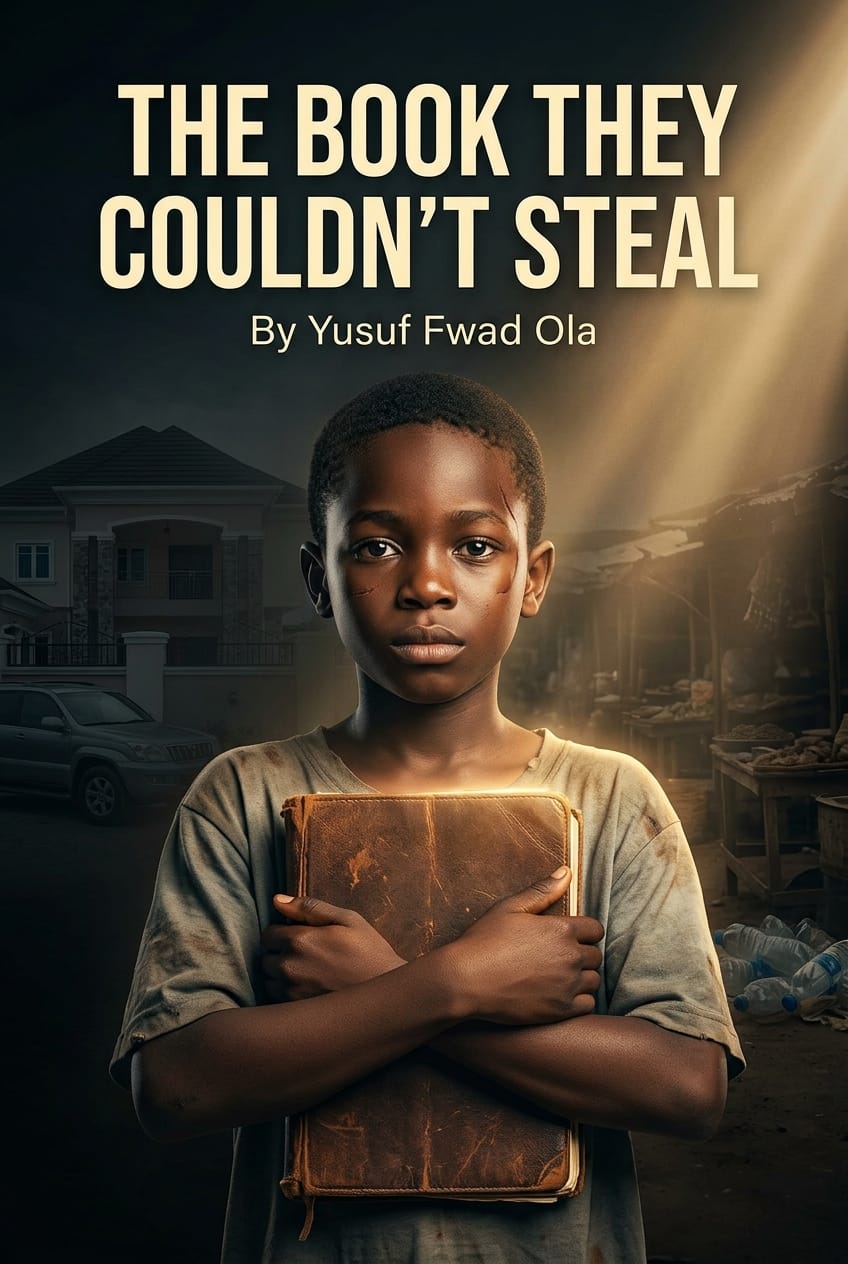
Suleiman was born into comfort. His father owned a thriving transport business in Ilorin, with three houses and two cars, and the kind of name people said with respect whenever it came up in conversation. Suleiman grew up knowing nothing of lack. He had a driver who dropped him at a private school every morning. He had toys other children in the neighborhood only saw in adverts. He was a boy born with a silver spoon.
Then, when Suleiman was nine years old, his father died suddenly of a heart attack.
Grief hadn't even finished settling into the house before the vultures arrived. Uncles he barely knew, cousins his father used to help with school fees. People who had once smiled and called his father "the great man" now stood in the sitting room, arguing over who deserved properties. Within months, the houses were gone. The cars were gone. The bank accounts were emptied by relatives who claimed they were only holding the money for Suleiman until he was older and realized it is money he would never see again.
His mother, a quiet woman who had never needed to fight for anything in her marriage, suddenly had to fight for everything. She fought and lost. One by one, the family stripped them of all they had, until Suleiman and his mother were left with a single room, a few clothes, and nothing else except one thing nobody thought was worth stealing: his father's old book.
It was a thick, leather-covered notebook his father used to write in every night, filled with his own handwriting — business notes, prayers, life lessons, and letters he had written to Suleiman when he is grown up. The relatives took the properties, the money, the cars but nobody wanted a dead man's notebook. So it stayed. It became the only proof Suleiman had that his old life, and his father, had ever existed.
By the time Suleiman was eleven, poverty had fully arrived. They became poor to the extent of borrowing Garri (cassava flakes) to drink. His mother sold what little she could, cleaned houses when she found the work, and still, some nights, there was no food. So Suleiman started scavenging behind Tanke market — searching through refuse for plastic bottles and scrap metal he could sell for some money. The same hands that once flipped through picture books in a private school library now dug through rubbish heaps under a punishing sun.
He always carried his father's notebook with him, wrapped carefully in a polythene bag, tucked into his shirt. It was the one thing he refused to let go of.
One Tuesday morning, while he bent over a heap searching for bottles, a group of older boys spotted him. They found it entertaining, they called him the "rich boy" who used to look down on nobody, now digging through rubbish like everyone else. One of them, Wasiu, picked up a bottle and threw it straight at Suleiman's head. Not as a warning but just because he could. Suleiman didn't see it coming. Everything went white, then wet, then dark. (Feeling hurt)
He woke up in a small clinic nearby, a nurse pressing a cloth firmly to his head, saying how close the wound had come to something far more serious. When the bandage finally came off days later, a curved scar remained above his left ear — a mark that would stay with him for life.
For years, he hated it. Children mocked him, calling him "curve Head." He grew his hair long to hide it and turned his head at odd angles in photographs. Every stare felt like confirmation that he was no longer the boy people used to respect — just another discarded child the world had marked.
But at night, when the shame became too heavy, he would open his father's notebook and read the same page over and over. His father had written: "Suleiman, a man is not what he owns. A man is what he builds after he has lost everything." At nine years old, those words meant nothing to him. Until he turns sixteen, sitting on a mattress with a scarred head and empty pockets. He read the sentence carefully and digest it and that single sentence became the seed of something new in him.
He began writing his own thoughts in the back pages of his father's notebook, he firstly started with angry, messy paragraphs about hunger, loss, and humiliation. Slowly, his writing changed. It became clearer, calmer, and full of purpose. He started writing about the boy who lost everything, the boy who was mocked and injured, and the boy who was slowly learning to rebuild — not with money, but with words.
A teacher at the community school where he studied part-time noticed his writing and encouraged him to keep going. That teacher submitted one of Suleiman's essays to a foundation that supported students from difficult backgrounds. The foundation read his story, and something in it moved them enough to offer him a scholarship.
Fortunately, Suleiman returned to full-time education. He studied hard, determined never to let anyone strip him of anything again — not knowledge, not dignity, not his father's memory. He graduated with excellent results and, years later, he built a business of his own, bigger than his father's business.
Today, Suleiman is often invited to speak to young people about resilience. He always begins the same way. He tilts his head, points to the curved scar above his ear, and says:
"This is not where my story ended. This is where it finally started to make sense."
Then he opens an old, worn notebook — his father's notebook — and reads that same sentence to every new audience:
"A man is not what he owns. A man is what he builds after he has lost everything."
Every time, there is always one young person in the crowd who understands exactly what those words cost. Suleiman always finds that person after the talk. He always sits beside them first.
-------------------The End-----------------
Note: This is only a summary of a bigger story coming soon.
Stay updated here so you don’t miss it.