 Writers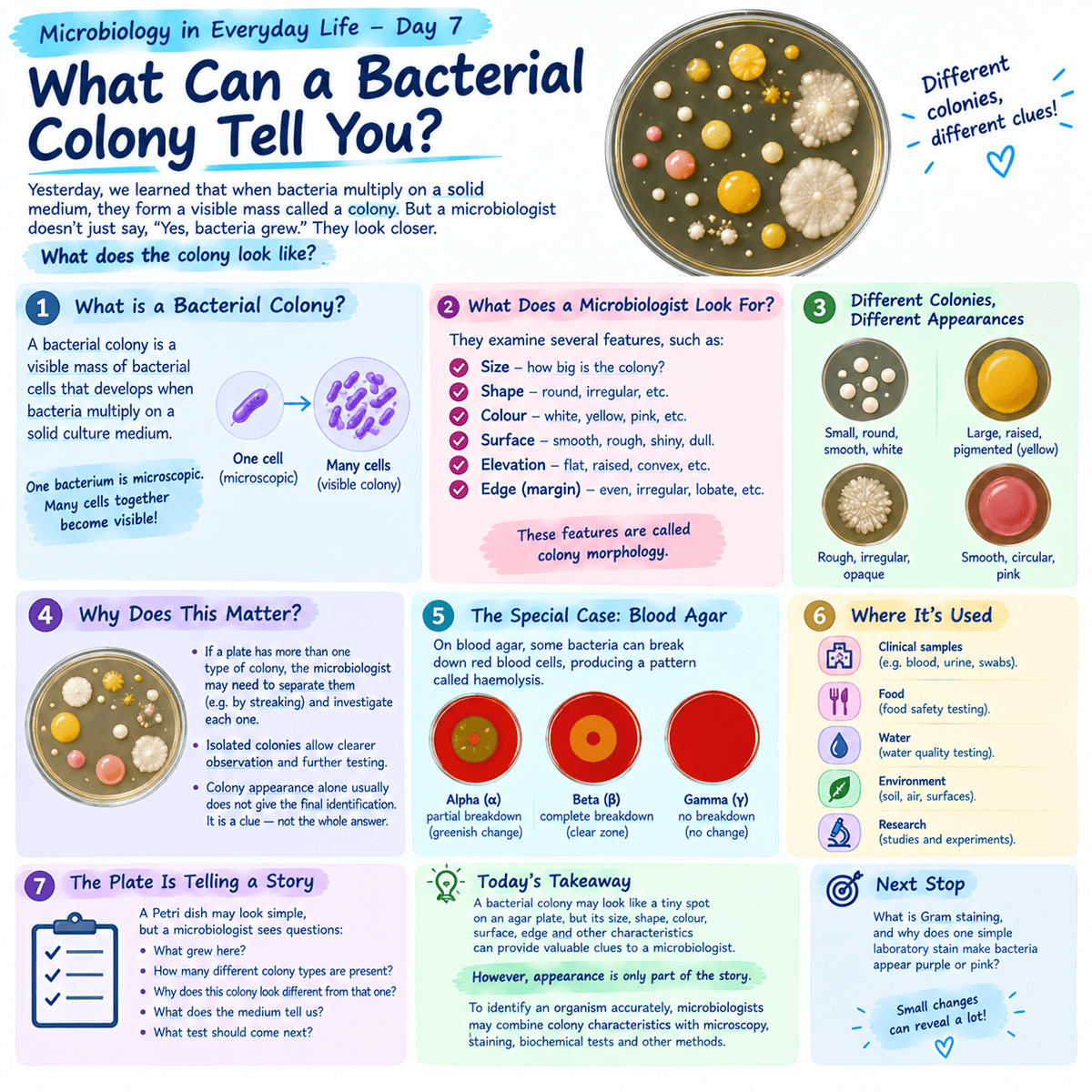
Microbiology in Everyday Life — Day 7
What Can a Bacterial Colony Tell You?
Yesterday, we talked about growing bacteria in the laboratory.
We learned that when bacterial cells multiply on a suitable solid medium, they can form something we can actually see with our eyes: a colony.
But here is something interesting.
A microbiologist does not simply look at a Petri dish and say, “Yes, bacteria grew.”
They look more closely.
What does the colony look like?
Because sometimes, its appearance can provide useful clues about the organism growing on the plate.
What is a bacterial colony?
A bacterial colony is a visible mass of bacterial cells that develops when bacteria multiply on a solid culture medium.
Remember, an individual bacterium is microscopic.
You cannot normally look at one bacterial cell with your naked eyes.
But when many cells multiply in one area, the resulting growth can become visible as a colony.
And that colony has characteristics that can be observed.
What does a microbiologist look for?
Imagine placing a culture plate in front of a microbiologist.
They may start asking questions such as:
How big is the colony?
What shape is it?
What colour is it?
Is the surface smooth or rough?
Is it raised or flat?
What does the edge look like?
These features are collectively described as colony morphology.
CDC laboratory materials identify characteristics such as colony size, form, margin, surface appearance, colour and opacity as important features to observe.
Not every colony looks the same
Look at a plate containing several different types of bacterial growth.
One colony might be small and circular.
Another might be larger with an irregular edge.
One may look smooth and shiny, while another may appear rough or wrinkled.
Some colonies may produce visible pigmentation, giving them different colours.
This variation can be useful because microorganisms can produce characteristic patterns of growth under particular conditions.
But there is an important warning:
Colony appearance alone usually does not give the final identification.
It is a clue—not the whole answer.
Why does this matter?
Think about what happens in a microbiology laboratory.
A specimen may contain more than one microorganism.
If several different types of colonies appear on a culture plate, the microbiologist may need to separate them and investigate each one.
This is one reason isolated colonies are important.
When colonies are well separated, their individual characteristics can be observed more clearly and further tests can be performed.
So when you see a microbiologist carefully examining a culture plate, they are not just looking at “spots.”
They are gathering information.
What about blood agar?
Here is another interesting example.
On some culture media, the interaction between a microorganism and the medium can provide additional information.
Blood agar, for example, contains red blood cells. Some bacteria can damage or break down these cells around their colonies, producing a visible pattern called haemolysis.
Microbiologists commonly describe haemolysis as:
- Alpha (α) haemolysis — partial breakdown, often producing a greenish change around the colony.
- Beta (β) haemolysis — complete breakdown, producing a clear zone around the colony.
- Gamma (γ) haemolysis — no haemolysis.
That is another example of how a culture plate can provide information beyond simply showing that something grew.
The plate is telling a story
This is one of the things I find fascinating about microbiology.
A Petri dish may look simple to someone who is not a microbiologist.
But a microbiologist may see questions everywhere:
What grew here?
How many different colony types are present?
Why does this colony look different from that one?
What does the medium tell us?
What test should come next?
The answers help guide the next stage of investigation.
And that is why microbiology is not simply about seeing microorganisms.
It is about observing, questioning and gathering evidence.
Today's takeaway
A bacterial colony may look like a tiny spot on an agar plate, but its size, shape, colour, surface, edge and other characteristics can provide valuable clues to a microbiologist.
However, appearance is only part of the story.
To identify an organism accurately, microbiologists may combine colony characteristics with microscopy, staining, biochemical tests and other identification methods.
So the next time you see a Petri dish filled with different-looking colonies, don't just think:
“Something grew.”
Think:
“What is this growth telling us?”
Next stop: What is Gram staining, and why does one simple laboratory stain make bacteria appear purple or pink?
