 Writers
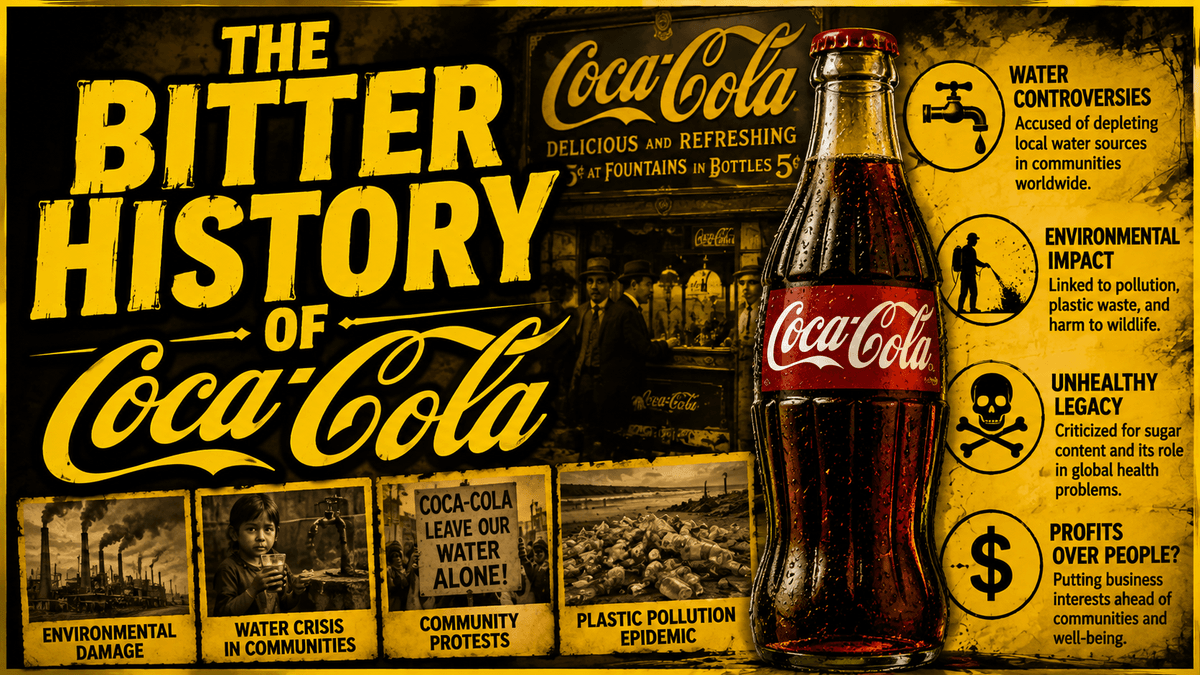
The Bitter Truth About Coca-Cola: What Exactly Have We Been Drinking?
You probably know the sound: "Open happiness."
For more than a century, Coca-Cola has become one of the most recognizable drinks on Earth. But the strange part is that the story behind that famous red label isn't nearly as sweet as the drink itself.
From its unusual beginnings as a medicinal tonic to the debate surrounding sugar, caffeine, marketing, and health, Coca-Cola has a history that is far more complicated than most people realize.
So before you take another sip, let's look inside the bottle.
Coca-Cola was invented in 1886 by a pharmacist, John Stith Pemberton in Atlanta, Georgia. Pemberton was simply developing a medicinal beverage, not trying to create the world's most famous soda.
At the time, patent medicines were extremely popular, and people consumed all sorts of strange concoctions that promised to cure headaches, nervousness, exhaustion and other ailments.
Pemberton's new drink contained ingredients derived from the coca leaf and kola nut. The combination provided caffeine and contributed to the drink's original identity.
It was eventually mixed with carbonated water and sold at a pharmacy soda fountain.
The drink that would become a global empire had begun as a pharmacist's experiment.
This is a part about Coca Cola early history that sounds like an internet conspiracy.
The original formula used coca-leaf extracts, and those leaves naturally contain cocaine.
However, it's important not to imagine people drinking modern Coca-Cola with a significant dose of cocaine. The formulation changed over time, and Coca-Cola has not contained cocaine as an active ingredient for generations.
Today, the company says its products do not contain cocaine. So the famous "cocaine in Coca-Cola" claim has a historical basis—but it does not describe the drink you're buying today.
But we should not that the real problem isn't cocaine. It's something much more ordinary.
Sugar.
A typical 12-ounce can of Coca-Cola contains around 39 grams of added sugar. That's roughly the equivalent of several teaspoons of sugar disappearing into one drink.
And because liquid calories are easy to consume quickly, it's possible to drink a substantial amount of sugar without feeling as full as you would after eating solid food.
That's one reason health experts have become increasingly concerned about sugary drinks.
But what happens when you drink too uch?
One can of Coke isn't going to magically ruin your health.
The bigger concern is regular, high consumption. Frequent intake of sugar-sweetened beverages is associated with increased risks of problems such as weight gain, type 2 diabetes and cardiovascular disease.
Another problem there is that your brain doesn't necessarily treat calories from drinks as satisfying as calories from food.
So you can finish a sugary drink and still feel like you need something else to eat. That makes it surprisingly easy for those calories to pile up over time.
Then there's the caffeine.
Coca-Cola also contains caffeine. For many people, moderate caffeine consumption isn't a problem. In fact, caffeine can temporarily increase alertness and reduce feelings of tiredness.
But too much caffeine can cause problems such as sleep disruption, nervousness, restlessness and a racing heartbeat in sensitive people.
And if you're drinking Coke late at night because you enjoy the taste? You may unknowingly be making it harder to sleep.
The story gets fascinating when Coca-Cola didn't simply sell a drink.
It sold an experience.
Over decades, the company built one of the most recognizable brands in history through advertising, memorable slogans, distinctive packaging and enormous global distribution.
The red-and-white branding became almost universally recognizable. The famous contour bottle was designed to make Coca-Cola identifiable even when someone couldn't see the label.
And the company didn't just advertise the beverage. It associated Coca-Cola with happiness, friendship, celebration and togetherness.
That's powerful marketing.
You've probably heard that Coca-Cola's formula is one of the world's greatest trade secrets. That the owner/maker of Coke and Fanta can't be in the same airplanes.
That's largely true.
The exact recipe has been fiercely protected for decades.
So, should you be advised to stop drinking Coca-Cola? Not necessarily.
For most people, the sensible approach isn't to treat Coca-Cola as poison.
It's to recognize for what it actually is - A sugary soft drink - not a health drink.
Having one occasionally is very different from drinking several bottles every day. And if you enjoy it, there's nothing wrong with enjoying it occasionally while being aware of what you're consuming.
So the next time you hear that satisfying pssst when you open a Coke, remember:
You're not just opening a soft drink. You're opening more than a century of history, advertising, chemistry and culture - all inside one bottle.