Writers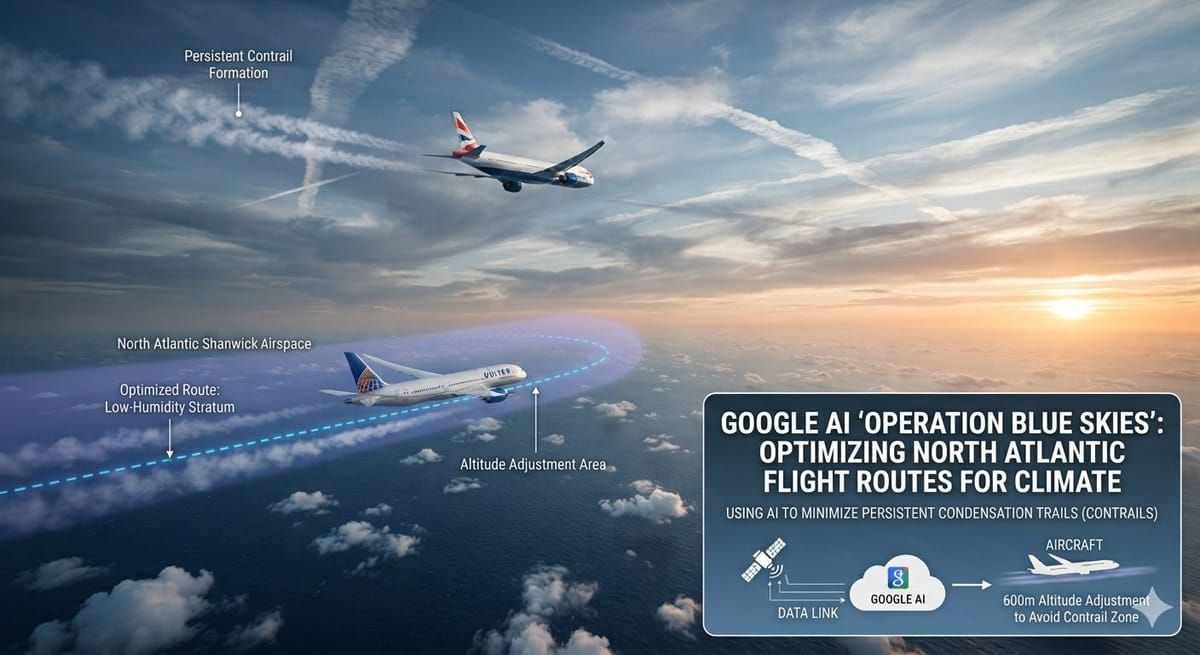
Artificial intelligence could help solve one of aviation’s more obscure problems: avoiding contrails that do their part in warming the atmosphere.
Contrails, short for conditional trails, are the white lines left in the sky by airplanes at high altitudes. They form when vaporized water and particulates in the exhaust of jet engines interact with cold, humid air. Most contrails dissipate quickly, but under the right conditions, they can linger long enough that they appear as wispy clouds that affect the Earth’s heat balance.
This is a far cry from conspiracy theories about “chemtrails” — a disinformation campaign falsely asserting that planes are using contrails to conceal that they are spraying harmful substances on the population. The science of contrails is much more mundane: what conditions make them form, and how they affect the climate.
Google’s Operation Blue Skies
Google, together with the UK government and others, is working on an ambitious project known as Operation Blue Skies, which would use artificial intelligence to keep airplanes out of contrail-forming conditions and reduce their climate impact.
The approach involves using satellite imaging, weather data and previous flights’ information for AI to find out where contrails are forming — and potentially avoid those areas. By analyzing those data, the AI can identify probable contrail formation areas with a high degree of accuracy.
This information could then be used by air traffic controllers to suggest modest adjustments to specific flights to keep them from forming contrails. In most cases, the adjustments would not be noticeable to passengers. “It could be something like suggesting a change of altitude by 600 meters, or something similar to what aircraft already do to fly around bad weather,” Google explained.
AI Can Learn From Every Flight
“The beauty of this is we can learn from every single flight,”
said Google project lead, Marko Bjelobora.
Once a flight has finished, imagery from the satellites can be compared to the predictions from before the flight, and the information from successful (that is, contrail-free) flights can be used to update the AI models for the next time the situation presents itself.
In essence, there is a feedback loop: the AI identifies conditions under which contrails form, aircraft make adjustments when they encounter those conditions and the results of their adjustments feed back into the AI to make it more accurate and enable it to make better suggestions.
These adjustments would most likely not be noticeable to passengers.
“The flight path is modified, but these changes are small and are usually comparable to typical wind variations aircraft already experience during flight,” stated Google.
Operation Blue Skies Will Test the Concept in the North Atlantic
Within the North Atlantic, specifically in a region of airspace called Shanwick, these tests will take place. The airspace is advantageous both because it has the necessary conditions to form contrails and because it is a strategically important area of the North Atlantic air route.
“It’s a place where contrails have a meaningful impact on the atmosphere, contributing to around 5% of global contrail warming,” said Google.
Operation Blue Skies will be carried out over 30 months, with two main campaigns taking place over the winter of 2026-2027 and 2027-2028, respectively. Approximately 10,000 flights are expected to be recorded in the test area per year, but only a fraction (between 1% and 5%) would be subject to adjustment in an attempt to avoid contrails.
This is a logical continuation of the work Google has already done in this area. The company has already tested its contrail prediction models with American Airlines and reported that the use of AI reduced contrails by 54% with only a 2% increase in fuel consumption on adjusted flights.
Operation Blue Skies will attempt to test this concept at a larger scale.
If the technology works as intended, this would be a significant step forward in reducing aviation emissions — one based on readily available technology that does not require any fundamental change in the way aviation operates.
What Does This Technology Mean for the Future of Aviation?
The technology that will be tested in Operation Blue Skies could become a significant step forward for the industry. By identifying flights that could potentially form contrails and making small adjustments to avoid those conditions, airlines could reduce their climate impact significantly.
Still, this technology has to prove itself.
Despite the promising results from a smaller-scale test, the technology has to prove itself in a real-world setting. There remain concerns about its accuracy in a dynamic and unpredictable environment, as well as the cost and safety implications of making those adjustments.
If it works, AI-assisted contrails avoidance could be a valuable addition to the industry’s suite of climate change mitigation technologies. But if it fails to deliver on its promises, these hopes will not come to fruition. The future of aviation’s climate impact will be decided in the next three decades — and one thing is certain: the industry needs to look towards the skies and the possibilities they offer.
Sources
Google: https://blog.google/innovation-and-ai/models-and-research/google-research/blue-skies/
Euronews: https://es.euronews.com/next/2026/08/29/blue-skies-la-ia-de-google-contra-el-calentamiento-de-las-estelas-de-los-aviones