 Writers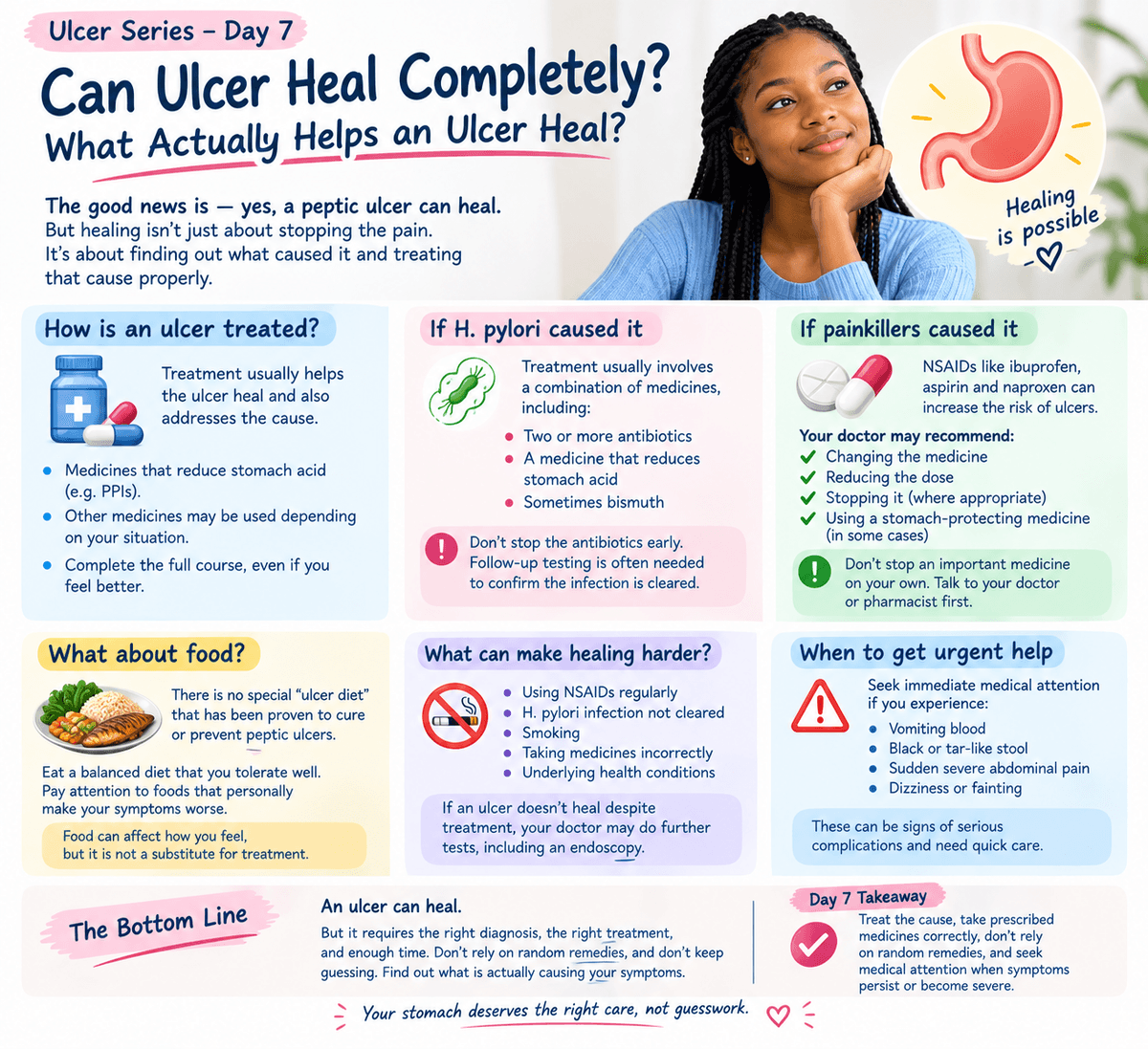
ULCER SERIES — DAY 7
Can Ulcer Heal Completely? What Actually Helps an Ulcer Heal?
One of the scariest things about hearing the word “ulcer” is the thought that you may have to live with it forever.
Some people hear that they have an ulcer and immediately start thinking about all the foods they can no longer eat, all the medicines they must take and whether the pain will ever stop.
But here is some good news:
A peptic ulcer can heal.
The important part is finding out what caused it and treating that cause properly.
Treatment is not just about stopping the pain
This is where many people get confused.
You take something, the pain disappears, and you assume the ulcer is gone.
But feeling better does not necessarily mean the underlying problem has been treated.
Doctors usually approach ulcer treatment in two directions: helping the ulcer heal and dealing with whatever caused it.
Medicines that reduce stomach acid, such as proton pump inhibitors (PPIs), can help create an environment where the ulcer can heal. Other medicines may also be used depending on the individual situation.
But what caused the ulcer still matters.
What if H. pylori caused it?
If testing shows that H. pylori is responsible, treatment usually involves a combination of medicines, commonly including two or more antibiotics together with a medicine that reduces stomach acid. In some treatment plans, bismuth may also be included.
And please don't make the mistake of stopping the antibiotics simply because you feel better.
Completing the prescribed treatment is important because stopping too early can allow some bacteria to survive and may contribute to antibiotic resistance. Follow-up testing is often recommended after treatment to confirm that the infection has actually been cleared.
What if painkillers caused the ulcer?
Remember our Day 4 conversation?
Regular or prolonged use of NSAID painkillers such as ibuprofen, aspirin and naproxen can increase the risk of ulcers.
If an NSAID is contributing to the problem, a healthcare professional may recommend changing the medicine, reducing the dose, stopping it where appropriate, or using another strategy depending on why you need the medication in the first place.
So please don't simply decide on your own to stop an important prescribed medicine. Talk to the person managing your treatment first.
What about food?
After everything we've discussed this week, this part should sound familiar:
There is no special “ulcer diet” that has been proven to cure peptic ulcers.
You don't have to survive on one particular food because someone told you that it is the “best food for ulcer.”
Eat a balanced diet that you tolerate well, and pay attention to foods that personally make your symptoms worse. Food choices can affect how you feel, but they are not a substitute for treating the actual cause of an ulcer.
What can make healing harder?
Taking medicines incorrectly, continuing to use ulcer-causing NSAIDs, an H. pylori infection that has not been cleared, and smoking can all contribute to an ulcer not healing properly or coming back.
If an ulcer refuses to heal despite treatment, doctors may investigate further and sometimes recommend additional testing, including endoscopy.
And this is why repeatedly treating stomach pain with random drugs isn't a good long-term plan.
So, can ulcer really heal?
Yes.
But healing is not simply about silencing the pain for a few hours.
It is about asking:
What caused this ulcer?
Was it H. pylori?
Was it frequent NSAID use?
Is there another underlying problem?
Once the cause is identified, appropriate treatment can help the ulcer heal and reduce the chance of it returning.
And if you ever experience vomiting blood, black or tar-like stool, sudden severe abdominal pain, dizziness or fainting, don't wait for your home remedy to work. Those can be signs of a serious complication and require urgent medical attention.
One final thought
Your stomach isn't asking for magic.
It needs the right diagnosis, the right treatment and enough time to heal.
So if you've been having persistent stomach pain, don't spend months guessing whether it is ulcer, gastritis or “just ordinary stomach upset.”
Find out what is actually happening.
Because sometimes, the biggest step toward healing is not finding another remedy.
It is finally finding the right cause.
DAY 7 summary
An ulcer can heal. Treat the cause, take prescribed medicines correctly, don't rely on random remedies, and seek medical attention when symptoms persist or become severe.
