 Writers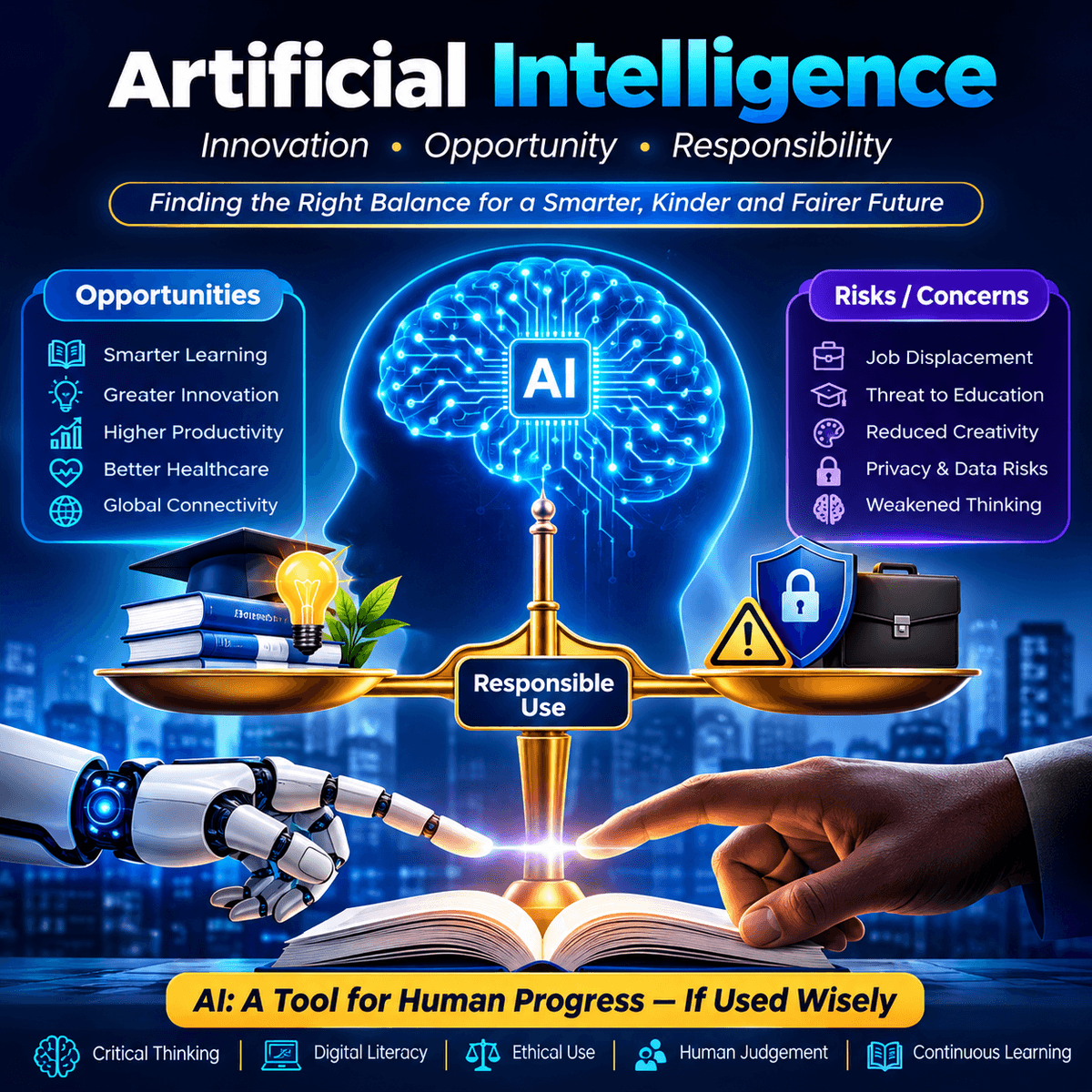
One of the loudest fears surrounding Artificial Intelligence is the belief that machines will eventually take over human jobs. This concern is understandable. AI systems can already perform many tasks that previously required human effort. They can analyse large amounts of information, generate written content, create designs, assist with programming, answer questions and automate repetitive processes.
For someone whose livelihood depends on performing tasks that can now be automated, the development of AI can understandably feel threatening.
However, history teaches us that technological advancement does not always simply eliminate work. It often changes the nature of work.
When computers became widespread, many people feared that they would make human workers unnecessary. Instead, computers created entirely new professions while changing existing ones. The internet produced careers that were difficult to imagine several decades ago. Smartphones transformed communication, marketing, photography, transportation and commerce.
AI is likely to create a similar transformation.
This does not mean that job displacement is imaginary. Some roles will probably shrink, disappear or change significantly as organisations discover more efficient ways of completing certain tasks. People whose work consists largely of repetitive and predictable activities may face greater pressure.
But the solution should not necessarily be to reject AI. The better response is to learn how to work with it.
A graphic designer, for example, can use AI to generate ideas while retaining responsibility for composition, visual judgment, branding and communication. A researcher can use AI to organise information but must still evaluate sources and determine whether the conclusions make sense. A writer can use AI for brainstorming or editing while preserving personal experience, perspective and originality.
The person who learns to use a tool effectively may become more valuable than the person who refuses to understand it.
This brings us to an important distinction: AI may replace some tasks without necessarily replacing the entire human being who performs them.
A calculator can perform arithmetic, but mathematics has not disappeared. A camera can capture an image, but photography remains an art. A word processor can correct spelling, but meaningful writing still requires thought.
Similarly, AI can produce words, images and patterns, but human beings remain responsible for deciding what deserves to be said, why it should be said and what consequences may follow.
The Controversy About Creativity
Another major controversy concerns creativity.
If an AI system can generate a poem, song, photograph, logo or article within seconds, does that mean human creativity is becoming irrelevant?
Not necessarily.
Creativity is more than producing an output. It involves experience, emotion, observation, imagination, cultural understanding, intention and personal interpretation.
A machine can generate an image of a lonely person standing beside an ocean. But the human being who has actually experienced loneliness understands the emotion differently. A machine can produce words about grief, but a person who has buried someone they love carries an experience that cannot simply be reduced to generated text.
AI can imitate patterns found in human-created material, but imitation and lived experience are not identical.
This is why AI should be viewed primarily as a tool for human creativity rather than a substitute for human identity.
The danger begins when people stop creating and simply begin accepting whatever the machine produces.
A designer who never develops visual judgment may become dependent on generated designs. A student who never learns to reason may become dependent on generated answers. A writer who never develops a personal voice may produce technically polished but emotionally empty work.
Technology becomes dangerous when convenience replaces capacity.
AI and Human Intelligence
There is also concern that excessive dependence on AI may weaken human thinking.
This concern deserves serious attention.
If we use AI every time we encounter a difficult question, we may gradually lose the patience required to struggle with difficult problems ourselves. If students allow AI to write every assignment, they may submit impressive work without developing the knowledge the assignment was intended to teach.
The problem, therefore, is not necessarily using AI. The problem is using AI instead of thinking.
A balanced approach allows AI to assist human intelligence rather than replace it.
Use AI to explain a difficult concept, but make sure you understand the explanation.
Use it to suggest ideas, but develop your own judgment.
Use it to identify possible errors, but verify the corrections.
Use it to improve your work, but do not surrender ownership of your thinking.
The future will probably not belong exclusively to humans or machines. It will increasingly belong to people who understand how to combine human judgment with technological capability.
AI can be powerful.
But the fact that a tool is powerful does not mean that it should become our master.