Writers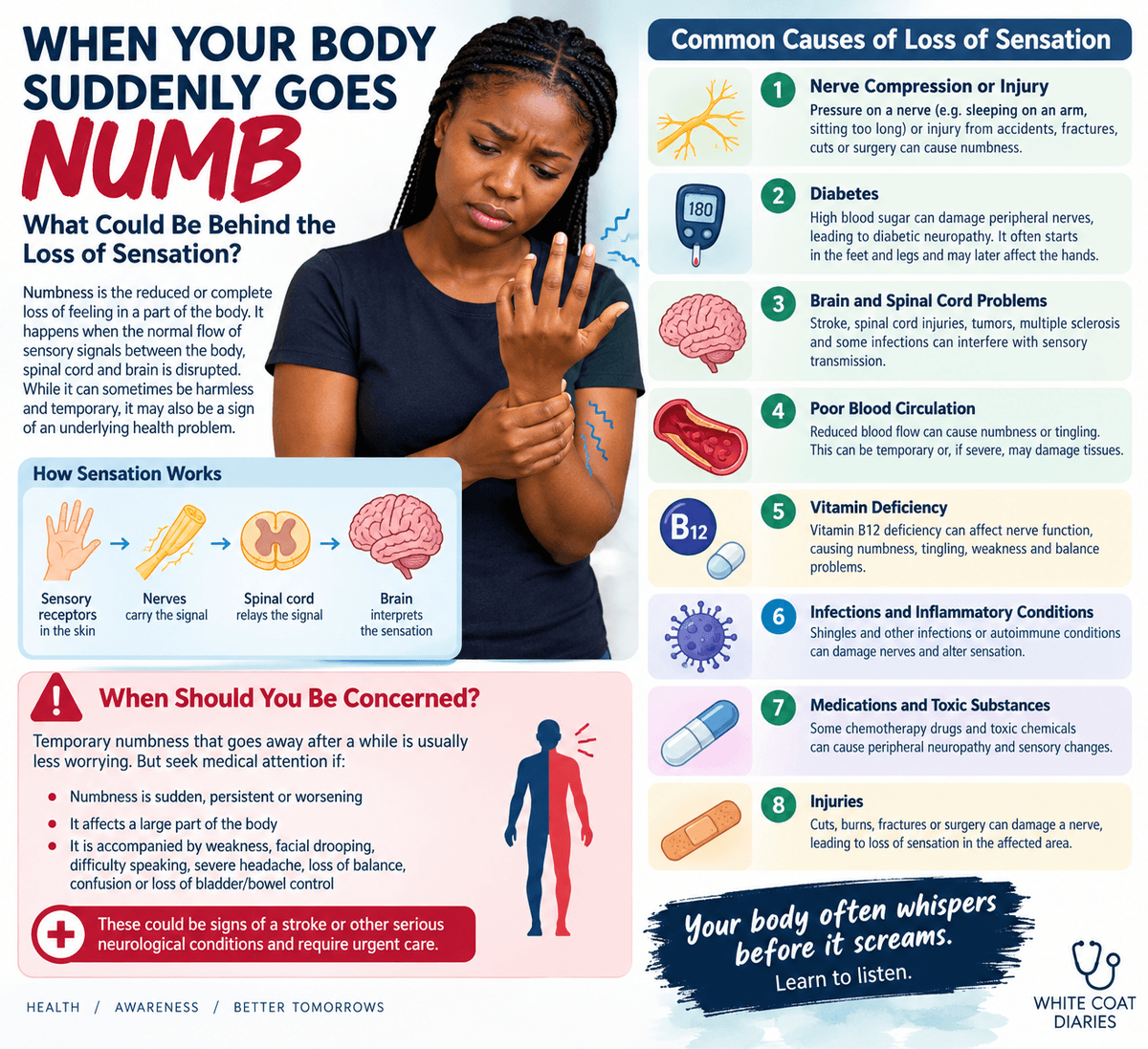
What Could Be Behind the Loss of Sensation?
Have you ever woken up and discovered that your arm feels strangely unfamiliar? You touch it, move it, or even press it, but the sensation is not quite there. Perhaps it feels heavy, tingles, or seems completely numb. Most times, the sensation gradually returns and we simply move on with our day. But what happens when the numbness does not go away—or keeps coming back?
Loss of sensation, commonly called numbness, occurs when the normal transmission of sensory information between a part of the body and the brain is disrupted. The nervous system is responsible for allowing us to feel touch, pain, pressure, heat, and cold. Sensory receptors detect these stimuli and send signals through nerves, the spinal cord, and finally to the brain. A problem at any point along this pathway can affect sensation.
Sometimes, It Is Simply a Compressed Nerve
Not every episode of numbness is a sign of disease. Sometimes, the explanation is surprisingly simple. Sleeping on your arm, sitting on your leg, or remaining in one position for too long can put pressure on a nerve. This may produce the familiar “pins and needles” sensation.
Once the pressure is removed, normal sensation usually returns. However, repeated or prolonged pressure can injure a nerve and cause more persistent sensory problems.
Diabetes Can Slowly Affect the Nerves
Diabetes is another major cause of reduced sensation. When blood glucose remains high for a long period, it can damage peripheral nerves, resulting in diabetic neuropathy.
The feet and legs are commonly affected first, followed by the hands. A person may experience numbness, burning, tingling, or reduced ability to feel pain. This can become particularly dangerous because a person may sustain a wound without realizing it.
Sometimes the Problem Is Higher Up
The nerves in our limbs are not the only structures responsible for sensation. Sensory information eventually travels through the spinal cord to the brain, where it is interpreted.
Problems involving the brain or spinal cord—including stroke, spinal cord injuries, multiple sclerosis, tumors, and some infections—can interfere with sensory transmission.
A sudden loss of sensation, especially on one side of the body, deserves immediate attention. If it occurs together with facial drooping, difficulty speaking, weakness, confusion, severe headache, or loss of balance, it could be a sign of a stroke.
Blood Flow Matters Too
Our nerves need adequate blood and oxygen to function normally. When blood flow to a body part becomes restricted, numbness can occur.
Sometimes this is temporary—for example, when you sit awkwardly and compress blood vessels. But sudden, severe, or persistent loss of blood supply can damage tissues and should be treated as an emergency.
What You Eat Can Affect Your Nerves
The nervous system needs certain nutrients to function properly. Vitamin B12 deficiency, for example, can cause nerve problems that manifest as numbness, tingling, weakness, and difficulty maintaining balance.
This is one reason persistent unexplained sensory changes should not simply be dismissed. Sometimes, something as basic as a nutritional deficiency may be contributing to the problem.
Injuries Can Leave More Than a Scar
A cut, fracture, burn, accident, or surgical procedure can damage a nerve. When this happens, the area supplied by that nerve may lose some or all of its sensation.
Depending on the severity of the injury, recovery may occur gradually, but some nerve injuries can result in long-term sensory changes.
Infections, Medications and Other Conditions
Certain infections can affect sensory nerves. Shingles, for example, may cause pain, tingling, burning, and altered sensation in the area supplied by an affected nerve.
Some medications, particularly certain chemotherapy drugs, can also cause peripheral neuropathy. In addition, exposure to some toxic substances can damage nerves and result in numbness or abnormal sensations.
When Should You Be Concerned?
The important question is not simply “Why am I numb?” but also “When did it start, where is it happening, and what else is happening with it?”
Temporary numbness that occurs after sitting or sleeping in an awkward position and disappears shortly afterward is usually less concerning.
However, numbness that is sudden, persistent, worsening, widespread, or associated with weakness or other neurological symptoms should be medically assessed.
Seek emergency medical attention if numbness suddenly develops with symptoms such as facial drooping, difficulty speaking, severe weakness, confusion, difficulty walking, severe headache, or loss of consciousness.
Listen When Your Body Whispers
Our bodies communicate with us in many ways. Sometimes the message is pain. Sometimes it is weakness. And sometimes, it is the strange absence of a sensation that should be there.
Numbness may be harmless, but it can also be an early warning sign of a condition that deserves attention. The goal is not to panic every time your body feels different, but to learn when a change should not be ignored.
Your body often whispers before it screams. Learn to listen.