 Writers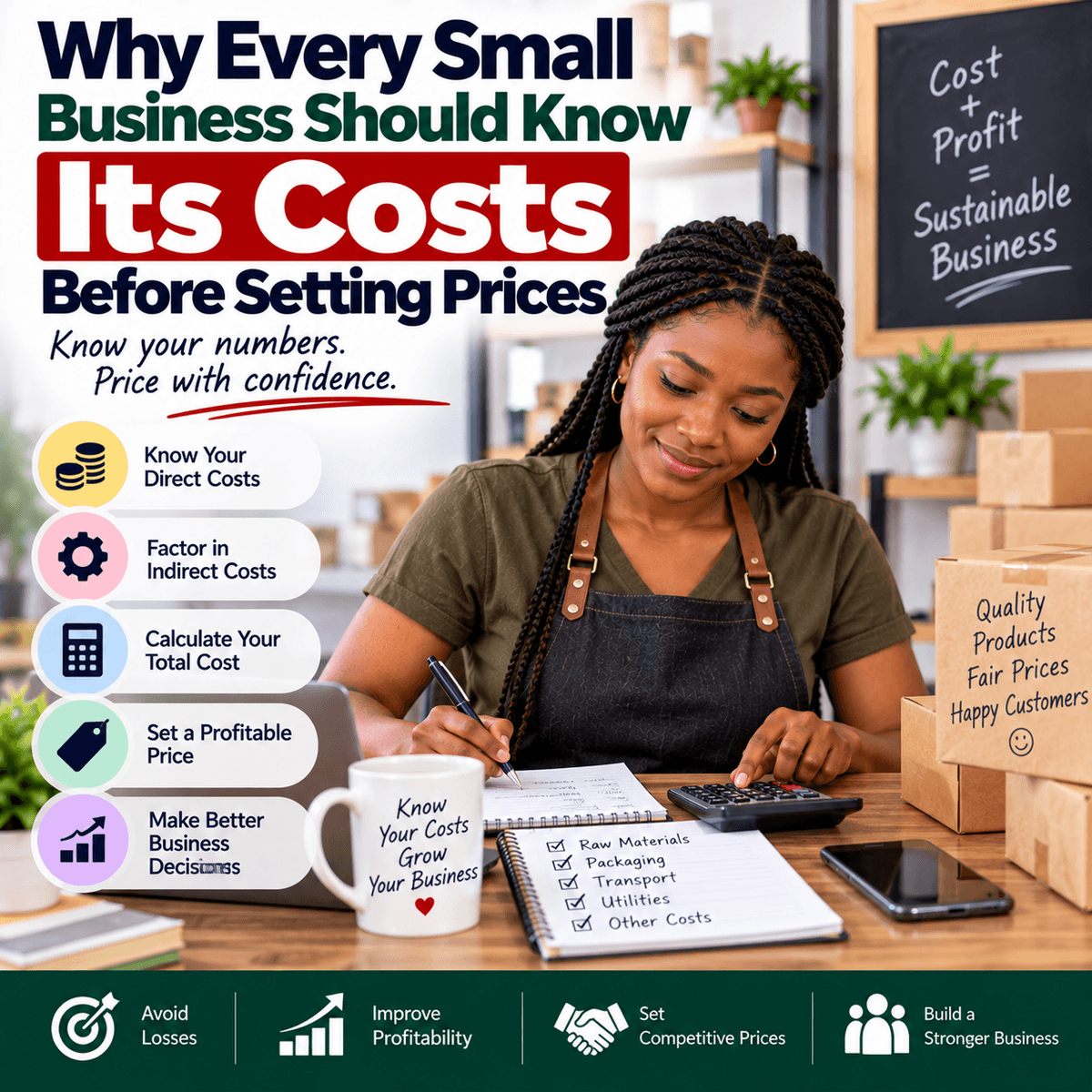
Setting the right price is one of the most important decisions a small business owner makes. Many people start a business by deciding how much to charge based mainly on what competitors are charging or what they believe customers will be willing to pay. Looking at competitors can provide useful information, but copying another business's price without understanding your own costs can create serious problems. Every business has a different cost structure. Two people may sell the same product at the same price and still make very different amounts of profit because their expenses are not the same. One seller may buy directly from a manufacturer while another buys through a distributor. One may operate from home while another pays rent for a shop. Their transport, electricity, packaging, staff and marketing costs may also be different. Before deciding what customers should pay, a business owner should first understand how much it actually costs to provide the product or service. This means looking beyond the obvious purchase price. If you buy an item for ₦8,000 and sell it for ₦10,000, it may appear that you have made ₦2,000 profit. But if you spent ₦500 on transport, ₦300 on packaging, ₦400 on delivery support and another amount on advertising or payment charges, your actual profit will be much lower. If all the related costs are greater than the difference between the buying and selling prices, you may even be losing money while believing the business is profitable. Knowing your costs gives you a stronger foundation for setting prices that can support the business.
A useful starting point is to understand the different expenses involved in running your business. Some costs are directly connected to each product or service you sell. If you make clothes, for example, fabric, buttons, thread and other materials are part of the cost of producing each item. If you sell food, ingredients and packaging are direct costs. If you buy finished products for resale, the amount you pay your supplier is a major direct cost. Other expenses support the entire business rather than one particular sale. These can include rent, electricity, internet subscriptions, staff wages, equipment maintenance, accounting costs and marketing. Even a business operated from home can have costs that are easy to overlook. You may use electricity to charge devices or run equipment, mobile data to communicate with customers and transport to meet suppliers. A service business also has costs even when it does not sell physical goods. A photographer may spend money on cameras, editing software, transport and equipment maintenance. A consultant may pay for internet access, professional tools, training and office expenses. Your time should also be considered when deciding whether a price is reasonable. If a service takes ten hours to complete but the amount charged barely covers your direct expenses, the business may not be rewarding the work involved. Writing down these costs makes pricing more practical. Instead of choosing a price because it sounds attractive, you can see what the business needs to earn from each sale to cover expenses and still leave something for profit.
Knowing your costs also helps you understand the difference between sales and profit. A business can receive a lot of money from customers and still struggle financially. Imagine a small business that makes ₦1,000,000 in sales during a month. The figure may look impressive when considered alone. However, if purchasing goods, paying rent, handling deliveries, paying workers, running advertisements and meeting other expenses cost ₦950,000, only ₦50,000 remains before considering any other obligations. Another business may record only ₦700,000 in sales but control its costs well enough to keep a larger amount after expenses. This is why business owners should not judge performance only by the amount entering their bank accounts. You need to know what it costs to generate those sales. Cost information can also help when deciding whether to offer discounts. Discounts can attract customers, clear old stock or encourage larger purchases, but they should be calculated carefully. If an item costs you ₦7,000 in total and normally sells for ₦10,000, reducing the price to ₦9,000 may still leave some room above the cost. Reducing it to ₦6,500 means selling below the total cost unless there is a specific business reason for accepting that loss. Problems arise when businesses announce discounts without first calculating how the new price affects their margin. A large number of discounted sales does not automatically mean a successful promotion. If every sale creates a loss, selling more may simply increase the total loss. Understanding your costs allows you to make these decisions with actual figures rather than assumptions.
Cost information becomes even more important when prices in the market change. Small businesses often face increases in the cost of supplies, transportation, electricity, rent and other services. If your expenses rise while your selling price remains unchanged, your profit can gradually disappear. For example, suppose a product previously cost ₦5,000 to buy and another ₦1,000 to prepare and deliver, giving you a total cost of ₦6,000. If you sold it for ₦8,000, the difference before other business expenses was ₦2,000. If the supplier later increases the product price to ₦6,200 and your transport and delivery expenses rise to ₦1,300, your total cost becomes ₦7,500. Continuing to sell at ₦8,000 leaves only ₦500 before other expenses. If you are not keeping records, you may continue using the old price because customers are still buying, without noticing how much the business has changed. This does not mean that every increase in cost should automatically be passed directly to customers. Customers also compare prices and decide what represents good value. A business may respond by negotiating with suppliers, buying in larger quantities where appropriate, reducing waste, changing packaging, improving operations or adjusting prices. The important thing is to make the decision with accurate information. Regularly reviewing your costs also helps you identify expenses that are increasing too quickly. You may discover that delivery charges are taking too much from certain orders or that a product with strong sales produces very little profit. This information can guide better decisions about what to sell, what to change and where to reduce unnecessary spending.
A small business does not need a complicated accounting system before it can start understanding its costs. A notebook, spreadsheet or suitable accounting application can be used to record what the business spends and what it earns. The important thing is to develop a consistent habit. Record the cost of stock or materials, transportation, packaging, wages, rent, utilities, marketing, maintenance, payment charges and other expenses related to the business. Keep business expenses separate from personal spending as much as possible so that you can see what the business itself is costing you. Review the figures regularly instead of waiting until the end of the year. When setting or reviewing a price, calculate the costs connected with providing the product or service and consider the wider expenses the business needs to cover. Then consider the market, the value you provide, customer demand and the profit needed to keep the business operating. Pricing is not simply about being cheaper than everyone else. A very low price may attract attention, but it is difficult to maintain if it cannot cover the cost of doing business. At the same time, a higher price needs to make sense to the customers you want to serve. The aim is to find a price that customers can accept while allowing the business to cover its expenses and work toward its financial goals. When you know your costs, you can explain your numbers, evaluate discounts, respond to changing expenses and make pricing decisions with greater confidence. Before deciding how much customers should pay, first understand how much it costs you to serve them. That simple habit can make a major difference in the financial stability of a small business.
