 Writers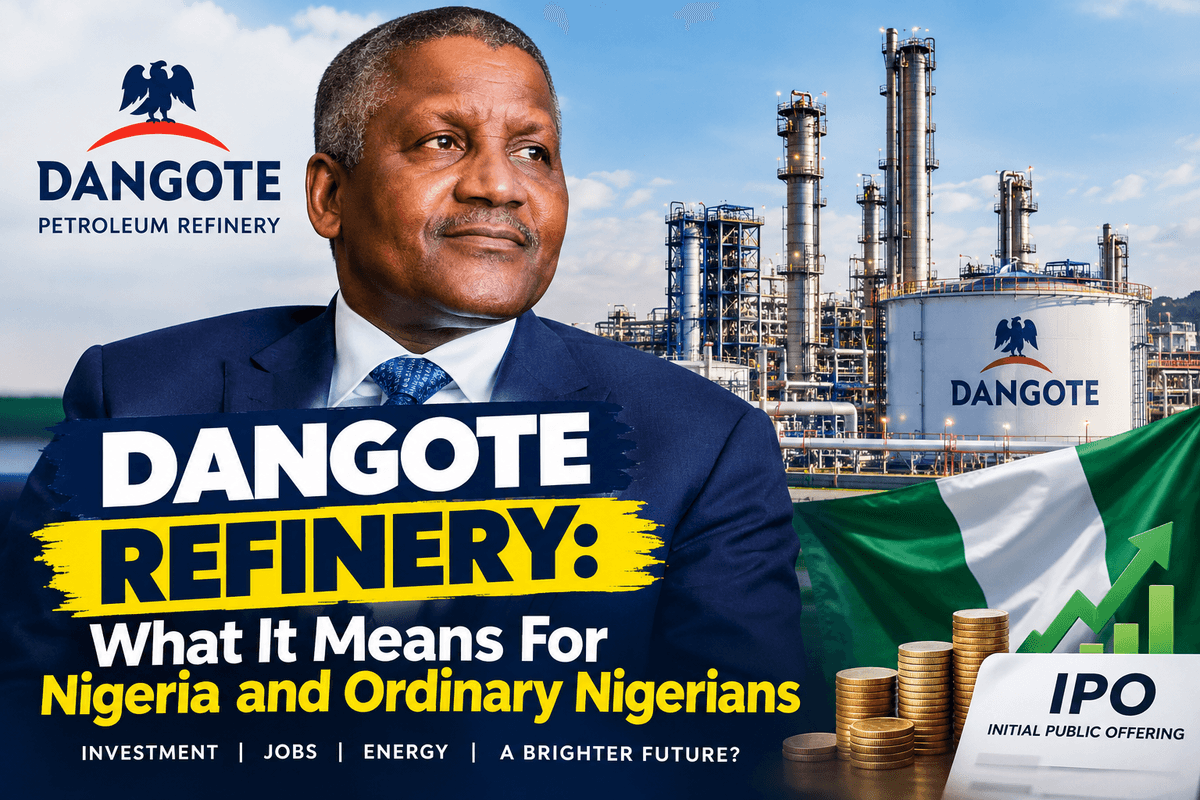
Dangote Refinery: Why Nigeria May Be Watching This IPO More Closely Than You Think
For years, Nigerians heard about the Dangote Refinery as a project that could change the country’s oil industry. There were expectations of local refining, reduced dependence on imported petroleum products, more exports and a stronger position for Nigeria in the global energy market.
Now, something different is happening.
The Dangote Petroleum Refinery is opening part of its ownership to the Nigerian public through an Initial Public Offering, commonly known as an IPO.
And this is bigger than simply buying shares in a company.
A Refinery Nigerians Can Now Own a Piece Of
The public offer involves billions of shares and is seeking to raise a significant amount of money for the company. The development has attracted attention because the refinery is one of the largest industrial projects in Africa.
For an ordinary Nigerian, the idea is interesting.
Large infrastructure projects are usually things people hear about, use and pay for without having any ownership in them. This time, Nigerians are being given an opportunity to participate financially as shareholders.
However, opportunity does not mean guaranteed profit.
Anyone considering the IPO needs to understand that buying shares carries investment risks. Investors should use approved channels, read the relevant documents and understand what they are buying before committing money.
Why the Refinery Matters to Nigeria
The Dangote Refinery was built over several years at a reported cost of about $20 billion.
It has a stated refining capacity of 700,000 barrels per day and has become one of the most significant refining facilities in Africa.
For a country that has historically exported crude oil while importing significant quantities of refined petroleum products, the existence of a large domestic refinery represents an important change.
Instead of sending crude abroad and buying finished products back, Nigeria now has greater domestic refining capacity.
That could affect fuel supply, foreign exchange demand, industrial development and exports.
But Nigerians are asking a simple question:
What does all of this actually mean for the ordinary person?
Will It Automatically Make Fuel Cheaper?
This is where expectations need to be realistic.
Having a major refinery operating in Nigeria does not automatically mean petrol prices will always be low.
Fuel prices are affected by several factors, including crude oil prices, exchange rates, refining costs, transportation and market conditions.
Domestic refining can reduce dependence on imported refined products, but it does not completely remove the influence of the global oil market.
Therefore, Nigerians should separate two different questions.
One is whether Nigeria needs more domestic refining capacity.
The other is whether that capacity will immediately translate into cheap petrol.
They are not necessarily the same thing.
The Bigger Ambition
Perhaps the most interesting part of the Dangote story is that the current refinery may not be the final destination.
The company has discussed plans to expand its refining capacity significantly in the future.
If such expansion happens, the refinery’s importance to Nigeria and international fuel markets could become even greater.
It could potentially increase the amount of petroleum products available for export while strengthening Nigeria’s position as a refining and energy hub.
That would also create opportunities across other areas, including logistics, transportation, engineering, maintenance and related industries.
But There Is Another Side
The IPO is also generating questions.
Investors need to consider the company’s valuation, future performance, market conditions and the risks associated with investing in the petroleum industry.
The Dangote name is one of the most recognised business names in Africa, but a famous company name should never be a substitute for proper investment research.
An investment can perform well or poorly.
That is why anyone considering buying shares should make the decision based on information rather than pressure from friends, social media or people promising quick profits.
What This Means for Nigerians
The Dangote Refinery story is no longer only about Aliko Dangote.
It is increasingly becoming a story about Nigeria’s industrial future.
For decades, Nigeria has been known primarily as a major crude oil producer. The bigger question now is whether the country can increasingly process its own resources, create more industrial value locally and compete in international markets.
The IPO also introduces an interesting possibility: ordinary Nigerians can potentially become shareholders in a major Nigerian industrial company.
But participation should come with knowledge.
Don’t invest because someone on WhatsApp promises guaranteed returns.
Don’t send money to an unverified platform.
Don’t borrow money simply because you feel you are missing an opportunity.
Understand what you are buying.
Read the prospectus.
Use official channels.
And remember that an IPO is an investment, not a lottery ticket.
The real story of Dangote Refinery may ultimately be bigger than one businessman or one company.
It may become a test of whether Nigeria can transform more of its natural resources into finished products, attract investment into major industries and give its citizens greater opportunities to participate in the country’s economic growth.
For ordinary Nigerians, the refinery is not just a massive industrial facility sitting somewhere in Lagos.
It represents a question about the future:
Can Nigeria finally turn more of what it produces into value that Nigerians can see, use and participate in?