Writers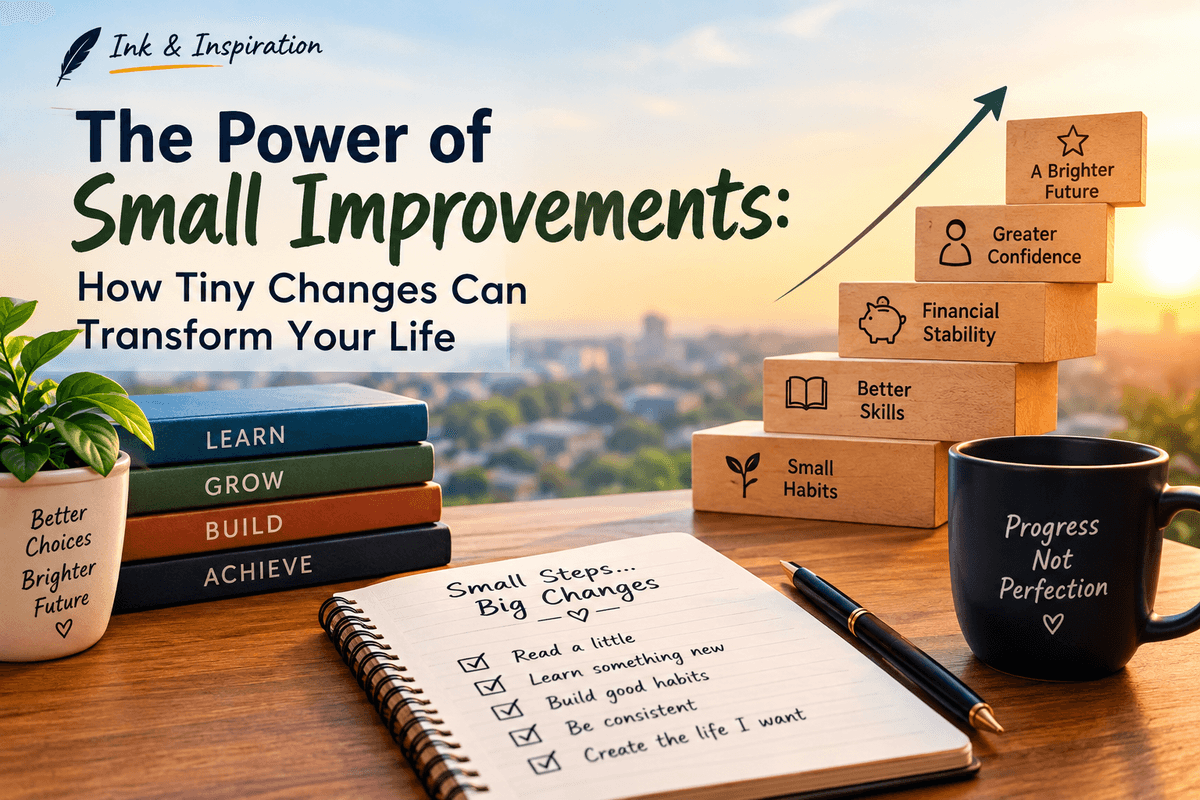
Many people believe that changing their lives requires making a huge decision or taking a dramatic step. They imagine that success begins when they suddenly become more disciplined, more confident, more productive, or more talented. However, meaningful change does not always happen through one enormous action. Sometimes, it begins with something much smaller: a decision to improve one little thing today.
Small improvements may not seem impressive at first. Reading a few pages of a book, learning one new skill, saving a small amount of money, exercising for a few minutes, or spending less time on distractions can feel insignificant. But when these actions are repeated consistently, they can gradually produce results that are much bigger than expected.
Why Small Changes Matter
One reason people struggle to improve themselves is that they set goals that are too large. Someone may decide to completely change their lifestyle overnight, only to become discouraged when maintaining the new routine becomes difficult.
Small goals are often easier to begin and maintain. Instead of saying, “I will read an entire book this week,” a person could decide to read five pages every day. Instead of deciding to exercise for two hours every morning, they could begin with fifteen minutes.
The first goal may sound more impressive, but the second one may be easier to turn into a habit.
Consistency is important because repeated actions become familiar. What initially feels difficult can eventually become part of a person's normal routine.
Progress Does Not Always Look Dramatic
Another important lesson is that progress can be difficult to notice while it is happening.
Imagine someone who wants to improve their writing. On the first day, they may write only a few paragraphs. A week later, their writing might not look dramatically different. After several months of reading, practicing, editing, and learning from mistakes, however, they may discover that expressing their ideas has become much easier.
The same principle applies to many areas of life. Financial progress, education, fitness, creativity, and personal development often happen gradually.
Because the improvement is slow, people sometimes give up before they have enough time to see the results.
Focus on What You Can Control
It is easy to become overwhelmed by everything we want to achieve. We may think about money, education, careers, relationships, responsibilities, and the future all at once.
When this happens, focusing on one manageable action can make things easier.
You may not be able to solve every problem today, but you can decide what you will do today. You can learn something useful, complete an important task, organize your plans, practice a skill, or take one step toward a goal.
A small action is still an action.
Instead of constantly asking, “How far am I from my goal?” it can sometimes be more helpful to ask, “What can I do today that will move me a little closer?”
Do Not Underestimate Learning
Small improvements are particularly powerful when they involve learning.
A person does not need to know everything before starting something new. They can begin with basic knowledge and gradually develop their understanding.
For example, someone interested in writing can start by learning how to create better titles, structure paragraphs, check grammar, research information, and communicate ideas clearly. Someone interested in technology can begin with basic concepts before moving to more advanced skills.
The important thing is to remain willing to learn.
Every new skill begins with a first attempt, and every experienced person was once a beginner.
Give Yourself Time
One of the biggest mistakes people make is expecting immediate results.
We live in a world where many things happen quickly, so it can be tempting to expect personal growth to happen at the same speed. But meaningful development usually requires patience.
There will be days when you feel productive and days when you accomplish very little. That does not mean your entire journey has failed.
What matters is the decision to continue.
A person who improves by just a small amount repeatedly may eventually become very different from the person they were when they started.
Final Thoughts
You do not need to transform your entire life in one day. Sometimes, the most practical way to move forward is to choose one small improvement and repeat it.
Read a few pages. Learn something new. Practice a useful skill. Save what you can. Write your ideas down. Spend less time on distractions. Take care of yourself. Then do it again tomorrow.
Small steps may look ordinary, but they can create extraordinary change when given enough time.
Your future does not have to be built in one giant leap. It can be built one decision, one habit, and one improvement at a time.
Start small. Stay consistent. Keep growing.