 Writers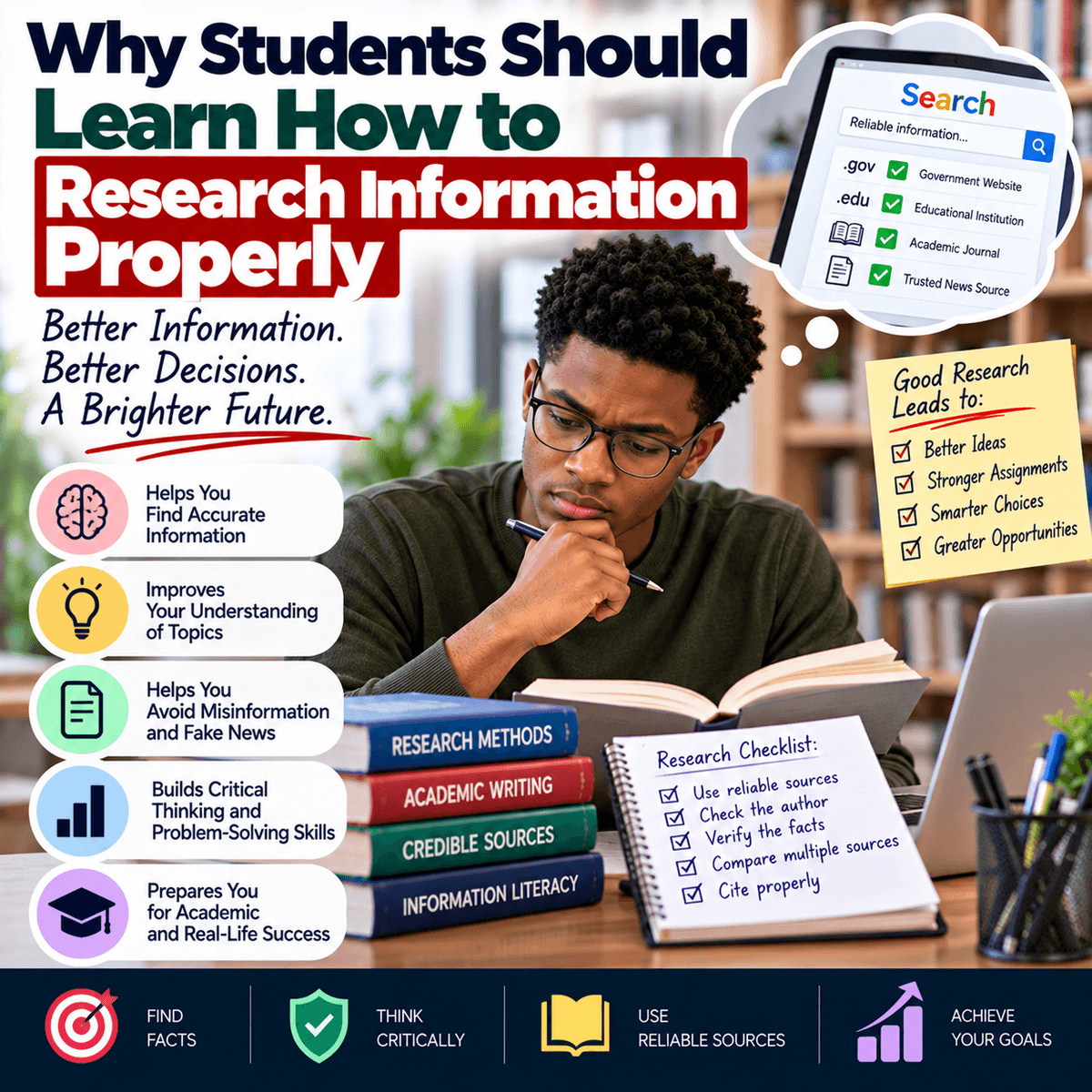
Students today have access to more information than previous generations could easily obtain. A phone or computer connected to the internet can provide articles, books, videos, reports, academic papers and explanations on almost any subject within seconds. This access can make learning easier, but it also creates a major challenge: finding information is not the same as finding reliable information. Search engines can return useful educational materials alongside outdated articles, personal opinions, advertisements, inaccurate claims and content created without proper evidence. Social media has made the problem even more difficult because information can spread quickly without being checked. A post may receive thousands of likes and shares and still contain incorrect information. For students, the ability to research properly is therefore an important part of education. Good research involves knowing what information you need, finding suitable sources, checking whether those sources are trustworthy, comparing information and using what you find responsibly. This matters when writing assignments, completing projects, preparing presentations or studying a topic independently. A student who simply copies the first answer found online may complete an assignment quickly but may not understand the subject or know whether the information is correct. Proper research requires more effort, but it helps students develop a deeper understanding of what they are studying. It also encourages them to ask questions instead of accepting every statement as fact. As access to information continues to grow, students need more than the ability to search the internet. They need the judgement to decide which information deserves their trust and how it should be used.
Good research usually begins with a clear question. When students search for a broad topic without knowing exactly what they need, they can easily become overwhelmed by the amount of information available. Imagine a student who has been asked to write about unemployment. Typing only “unemployment” into a search engine may produce millions of results covering different countries, years, age groups and causes. A better approach is to break the assignment into specific questions. The student might ask about the causes of graduate unemployment in Nigeria, the effects of unemployment on young adults or changes in unemployment over a particular period. A clear question makes it easier to choose useful search terms and recognise relevant information. Students should also learn to use more than one source. Finding the same claim on several random websites does not necessarily prove that it is correct because those websites may have copied the information from one another. When possible, students should look for original or authoritative sources, such as textbooks, academic journals, official statistics, government publications, recognised professional organisations and reputable educational institutions. The best source will depend on the subject. A student researching population figures may need official statistical data, while someone reviewing an academic theory may need textbooks and scholarly publications. Publication dates also matter. An older source may be valuable when discussing history or established theories, but it may be unsuitable for describing current statistics or recent developments. Learning to match the source to the research question is therefore just as important as finding information.
Students also need to learn how to evaluate the information they find. A professional-looking website is not automatically reliable, and an article appearing at the top of search results is not necessarily the most accurate source. Before using information, consider who produced it. Is the author's name provided? Does the person or organisation have relevant knowledge of the subject? Is the information supported by evidence, references or data that can be checked? When was it published or last updated? Is the purpose to inform, persuade, entertain or sell something? These questions can help students judge the quality of a source. Bias should also be considered. Every source is created from a particular perspective, but students should be especially careful when a source presents strong claims without evidence or ignores important information that challenges its position. Comparing reliable sources can help students identify areas where there is broad agreement as well as areas where experts disagree. Students should also separate facts from opinions. An author may provide accurate statistics and then give a personal interpretation of what those statistics mean. Both can be useful, but they should not be treated as the same thing. Artificial intelligence tools have created another reason for students to strengthen their research skills. These tools can help explain ideas, organise thoughts or suggest areas to investigate, but they can also produce incorrect information or references that do not exist. Students should therefore verify important claims using suitable sources instead of treating an AI-generated answer as final evidence. Technology can support research, but the student remains responsible for checking the information used in academic work.
Proper research also involves using information ethically. When students find a useful paragraph online, copying it directly into an assignment without acknowledging the source is not good academic practice. The same applies to copying from books, academic papers or another student's work. Research should help students develop their own understanding and communicate ideas in their own words while giving proper credit to the sources that informed their work. When exact words are necessary, they should be clearly presented as a quotation and referenced according to the required academic style. When information is paraphrased, the original source may still need to be acknowledged because changing the wording does not make another person's idea your own. Universities and lecturers may require different referencing styles, so students should learn the style required for their course and apply it consistently. Keeping good notes during research can make this easier. Record the author, title, publication date, page number where relevant and other details needed to find the source again. Saving this information while researching is easier than trying to remember where every fact came from when the assignment is almost finished. Students should also avoid collecting information without reading and understanding it. A long reference list does not automatically make an assignment strong. The sources should actually contribute to the student's argument or explanation. Reading carefully, comparing ideas and deciding which evidence is relevant are central parts of research. The goal is not to fill pages with information but to use suitable evidence to answer a question clearly.
Learning how to research properly provides benefits that continue after graduation. Employees may need to investigate a problem before making a recommendation. Business owners may research customers, competitors and market conditions before investing money. Professionals may need to review regulations, reports or industry information before advising clients. Ordinary people also research important personal decisions, including education, finance, health and major purchases. Someone who knows how to evaluate information is better prepared to recognise unsupported claims and misleading content. Students can begin developing this ability through everyday academic work. Start each assignment by understanding the question, identify the information you need and search for sources that are suitable for the subject. Check who created each source, when it was published and what evidence supports its claims. Compare important information instead of relying entirely on one source. Keep clear notes and record references as you work. Most importantly, read what you find and think about it rather than simply collecting or copying information. Ask whether the evidence actually supports the conclusion being presented. Research is not only a method for getting enough information to complete an assignment; it is a way of learning how to ask better questions, examine evidence and reach conclusions carefully. Students who develop these habits are better prepared to produce stronger academic work and make more informed decisions outside the classroom. In a world where information is easy to find but its quality varies greatly, knowing how to research properly is becoming an essential part of being educated.
