Writers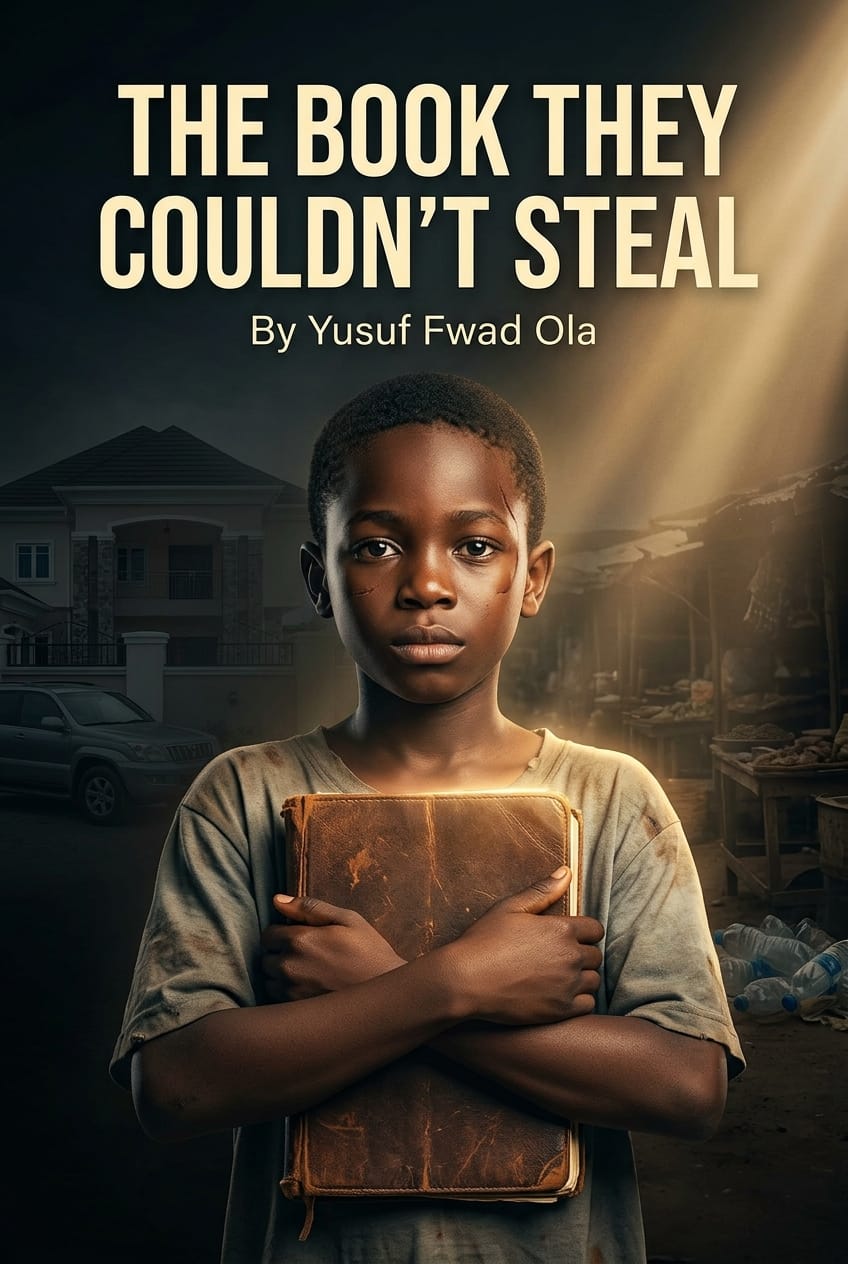
By the time Suleiman turned twelve, scavenging at Tanke market had become routine, exhausting routine, but a routine nonetheless. He knew which hours the market threw out the most waste, which traders wouldn't chase him off, and which corners of the rubbish heaps usually held the most bottles. He had become an expert in a life he never asked for.
He had also, along the way, made a few unlikely friends among the market traders the kind of small, warm relationships that even hardship couldn't fully choke out. There was Iya Bose, a plantain seller with a laugh so loud it startled pigeons off nearby roofs, who had taken to calling Suleiman "my Manager" for no reason she ever explained, and who occasionally "mistakenly" dropped an extra plantain into his bag when she thought he wasn't watching. When he tried to thank her, she would wave him off dramatically. "Ah ah, Manager, don't disturb my spirit early morning. Just carry your plantain and comot!"
There was also Baba Sikiru, the mechanic two stalls down, who insisted on teaching Suleiman useless but entertaining facts about engines every time their paths crossed, he would say: "You see this carburetor? If your carburetor vex, the whole car go vex" lessons Suleiman never asked for and never quite understood, but that made him laugh despite everything, mostly at how seriously Baba Sikiru delivered them, wrench in hand, sweat on his brow, as though lecturing at a university.
These small pockets of warmth were the only things that made the market bearable. But not everyone who noticed Suleiman there meant him any kindness.
He had also, without wanting to, become a target.
A group of boys, slightly older than him, ran a loose kind of territory around that part of the market, not quite a gang, but close enough. They didn't scavenge themselves; their parents had money, or at least more than Suleiman's mother did. They came to the market to loiter, to smoke where adults couldn't see them, and, increasingly, to entertain themselves by tormenting whoever seemed weakest.
Suleiman had learned to avoid them when he could. But avoidance isn't always possible when you need the same rubbish heap they've decided to stand near.
Their leader was a boy named Wasiu, tall for his age, with a reputation for cruelty that other boys both feared and, disturbingly, admired. Wasiu had noticed Suleiman weeks earlier and taken a particular interest in mocking him — perhaps because Suleiman, despite everything, still carried himself with a quiet dignity that irritated boys like Wasiu, who measured worth only in money and dominance.
"Look at this one," Wasiu would say to his friends whenever Suleiman appeared, loud enough for Suleiman to hear. "Digging in rubbish like an animal. I heard his father used to own buses. Big man's son, now searching for bottle in dustbin."
The other boys would laugh. Suleiman would say nothing, keep his head down, and continue working, because a coin earned mattered more to him than a boy's opinion. He had learned that lesson early that pride doesn't fill a stomach.
But on one particular Tuesday morning, something in Wasiu decided that mockery wasn't entertaining enough anymore.
Suleiman was bent over a large rubbish heap, focused on separating usable plastic bottles from waste, sweat already gathering on his back despite the early hour. He didn't notice Wasiu and his friends approaching until he heard the familiar, mocking laughter close behind him.
"Bottle boy," Wasiu called out. "Big man's son. How the mighty have fallen, eh?"
Suleiman straightened up slightly, said nothing, and tried to move toward another part of the heap, hoping to put distance between himself and the group without provoking anything further. He had learned, through painful experience, that silence and distance were usually his safest options.
But Wasiu wasn't finished.
"You think you can just ignore me?" he said, stepping closer, his voice sharpening with the particular cruelty of a boy who has never once faced real consequences for his actions. "You people think because your father had money before, you are better than us? Look at you now."
Suleiman kept walking, kept his eyes on the ground, kept telling himself just a few more minutes and he could leave with the bottles he needed.
He didn't see Wasiu bend down and pick up a discarded glass bottle from the very heap Suleiman had been searching through. He didn't see him raise his arm.
He only felt a sudden, violent impact against the side of his head, followed instantly by a flash of white light behind his eyes, then a strange, spreading warmth trickling down toward his ear.
The world tilted sideways.
Suleiman heard, distantly, as though from underwater, the sound of the other boys' laughter turning suddenly to alarm, someone shouting "Ah ah, Wasiu, see blood o!"and they ran away, then Suleiman's own knees giving way beneath him as the ground rushed up to meet his face.
The last thing he remembers clearly, before everything went dark, was the rough texture of the rubbish heap pressed against his cheek, and somewhere far away, the sound of his father's leather notebook falling from his bag onto the ground beside him — the one thing he had sworn never to let out of his sight, now lying abandoned in the dirt beside his unconscious body.
He woke up hours later in a small clinic three streets away, his head wrapped tightly in bandages, a stranger's worried face hovering above him, and a single, desperate thought cutting through the fog of pain before he even fully opened his eyes:
Where is the notebook? Did I lose it?
He did not get his answer until he was fully conscious — and when he did, what he learned about who had picked it up off that rubbish heap, and brought it safely to the clinic along with him, would mark the beginning of a friendship Suleiman never expected, with a stranger who was about to become the most important person in the next chapter of his life.