Writers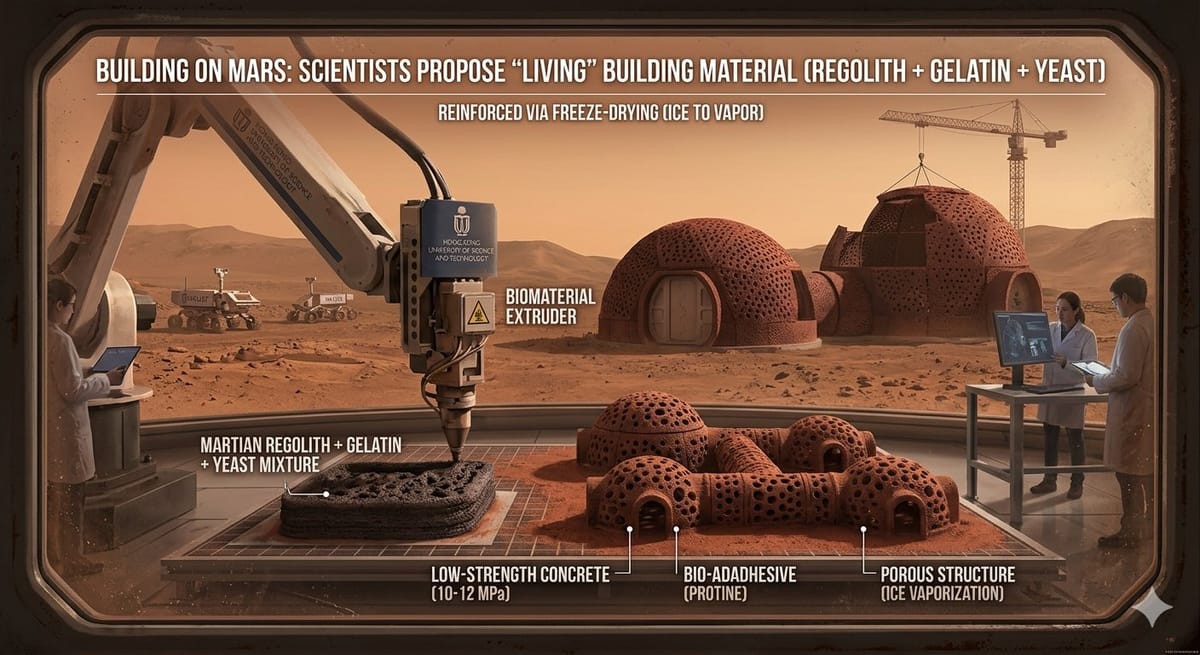
The innovative work of Associate Professor Jishen Qiu and his team at Hong Kong University of Science and Technology (HKUST) takes a different approach to adapting to the foreign climate of another planet.
By studying the process which makes store-bought, freeze-dried fruit hard, researchers found that they could use the harsh frigid and near-perfect vacuum of space to turn ubiquitous but useless space dust into a strong building material, without having to use large amounts of energy to melt and bake it first.
🧫 The Living Structural Recipe
The compound consists of a mixture of specially prepared biological and mineral ingredients which can be extruded from a 3D-printer nozzle:
• Martian Regolith (Sand): provides the bulk, weight, and foundational makeup.
• Gelatin: acts as an initial bonding agent, and also provides a nutritious medium for the yeast to feed on.
• Engineered Yeast: covered in a special cocktail of strongly-adhesive proteins, normally found in the "glue" mussels use to stick themselves to wet rocks.
How The Climate Of Mars Would Bind The Material Together
1. The mixture of wet bio-glue and sand is pushed out of a 3D-printer nozzle. A similar technique today is used to print prosthetic limbs and dental implants.
2. The low pressure and freezing temperatures cause the water in the mix to freeze-dry.
3. The escaping vapor leaves behind a sponge-like foam structure with a large amount of tiny, air pockets. This creates a very light, yet strong structural material.
🏗️ Structural Strength And Martian Gravity
The 3D-printed test versions, while still only the size of a wine cork (45 mm tall, 30 mm wide), already exhibit a compressive strength of 10 to 12 MPa.
That is a comparable strength to low-grade concrete, or enough to make a two-story building, if printed at full scale on Earth. But due to the low gravity on Mars, the same compound would be able to make structures many times larger, before needing additional support.
🔄 Circular, Multi-Planetary Economy
Using biology to form materials also allows for a sort of circular economy. Standard bricks or concrete buildings are permanent. If you wanted to move out of a city, you couldn't really take most of it's buildings and furniture with you. But using this new compound, you could dismantle the old structures, grind up the pieces, and culture a new mix of materials on the local planet to form new buildings. As long as there is living yeast, you could keep doing it over-and-over again.
⚠️ Challenges Before Launch
• The Living Experiment: While the recipe has been tested in a simulated Martian vacuum chamber, scientists are not sure yet how real interplanetary radiation would affect the yeast.
• Getting The Process Going: While the regolith can be mined on site, getting enough biological boosters, yeast, and gelatin to kick-start the process still requires dozens of tons of cargo to be shipped from Earth. We can expect further improvements in rocket technologies, to allow such high-value cargo to make it to another planet.
🔗 Sources / More Information
• Discover SWNS: https://swns.com
• Infobae: https://infobae.com
https://bilkisu-hub.blogspot.com