 Writers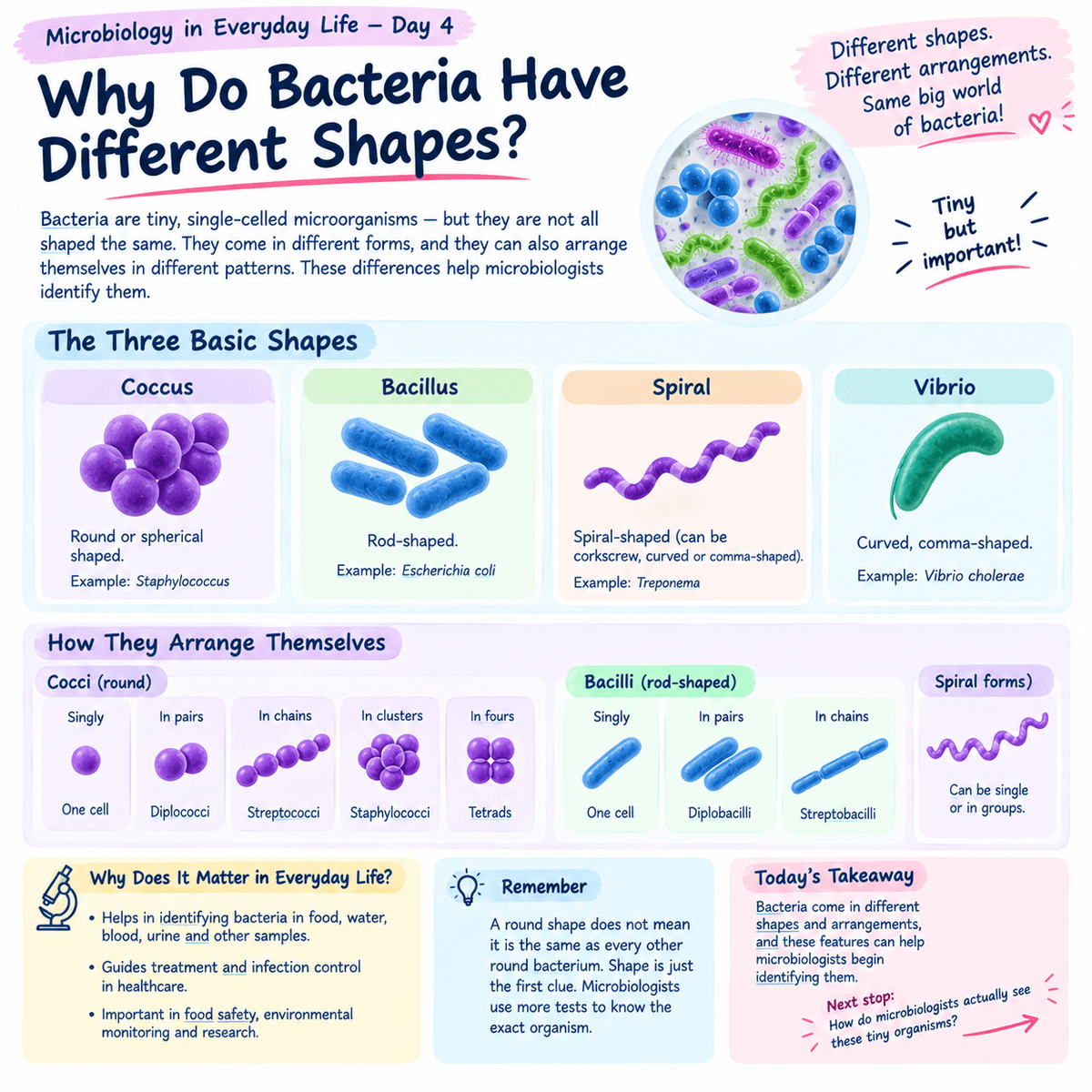
Microbiology in Everyday Life — Day 4
Why Do Bacteria Have Different Shapes?
If someone asked you to imagine a bacterium, what would you picture?
Maybe a tiny round cell. Or perhaps something that looks like a little rod.
The interesting thing is that bacteria do not all look the same. Under a microscope, they can have different shapes and can even arrange themselves in different patterns.
And for a microbiologist, that small difference can be very useful.
The three basic shapes
One of the simplest ways microbiologists begin describing bacteria is by looking at their cell shape.
The first is coccus (plural: cocci). These bacteria are generally round or spherical.
The second is bacillus (plural: bacilli). These are rod-shaped bacteria.
The third is spiral-shaped bacteria. Some are curved, some are corkscrew-like, while others have a shape that resembles a comma. CDC laboratory materials use these morphological differences when teaching bacterial identification.
There is also a shape called vibrio, which is characteristically curved, often described as comma-shaped. A familiar example is Vibrio cholerae, the bacterium associated with cholera.
But shape is only half of the story
Here is where microbiology becomes even more interesting.
Bacteria do not only differ in shape. Some bacteria also arrange themselves differently after they divide.
For example, cocci may occur:
- Singly — one cell
- In pairs — called diplococci
- In chains — called streptococci
- In clusters — called staphylococci
- In groups of four — called tetrads
Rod-shaped bacteria can also occur singly, in pairs, in chains, or in other arrangements.
So when a microbiologist looks through a microscope, they are not simply seeing “some bacteria.”
They are paying attention to details.
Is it round or rod-shaped?
Is it curved?
Is it arranged in chains or clusters?
What does it look like after staining?
These observations can help guide further laboratory identification. CDC laboratory training specifically teaches bacterial morphology as part of the process of identifying microorganisms.
Why should you care about bacterial shape?
You might be wondering, “Okay, but what does the shape have to do with my everyday life?”
Quite a lot.
When you hear that scientists are examining a sample of food, water, urine, blood, or another specimen for bacteria, they don't simply put it under a microscope and guess what they are seeing.
They combine different pieces of information.
Shape and arrangement can provide an early clue, but microbiologists usually need additional tests to identify a bacterium accurately.
This is why the laboratory is so important in microbiology.
A bacterium that looks round is not automatically the same organism as every other round bacterium. Two bacteria can have similar shapes but very different characteristics.
That is why microbiologists don't stop at:
“I see bacteria.”
They ask:
“What bacteria am I seeing?”
Think about it this way
Imagine walking into a room and seeing ten people.
You could describe them by their appearance, but that alone would not tell you their names, occupations, or personalities.
Bacterial shape works somewhat like that.
It gives the microbiologist an important first description, but more investigation is needed to know exactly what organism is present.
And this is one reason microbiology is much more than simply looking at “germs” under a microscope.
Today's takeaway
Bacteria come in different shapes and arrangements, and these features can help microbiologists begin identifying them.
So the next time you hear the word bacteria, don't imagine just one tiny shape.
Think cocci, bacilli, curved and spiral forms, chains, pairs and clusters.
There is an entire microscopic world hiding in plain sight.
Next stop: How do microbiologists actually see these tiny organisms when most bacteria are too small to see with our naked eyes?
