 Writers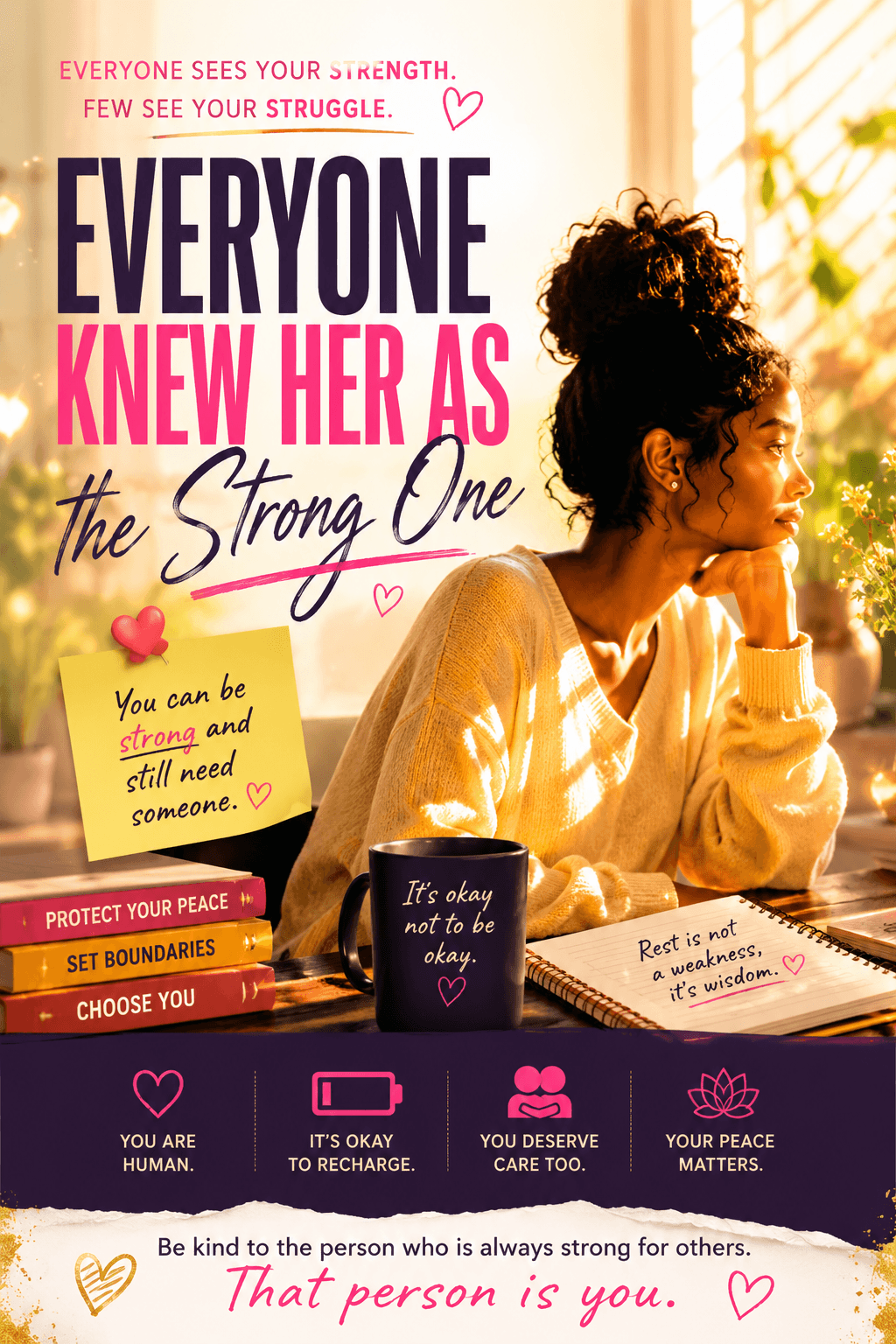
Sometimes the person everyone depends on is the one who needs someone too.
I hated being called strong.
Not because I wasn't strong, but because people started using it as an excuse not to notice when I was tired.
Whenever something happened, I heard the same words.
"You'll be fine."
"You can handle it."
"You're strong."
At first, I liked hearing it.
Who wouldn't?
There was something comforting about knowing that people believed you could handle difficult things. So, I became the person everyone called when things fell apart.
When my friend had a problem, she called me.
When my family needed someone to make a difficult decision, they called me.
When someone needed encouragement, advice, a listening ear, or simply someone to say, "Don't worry, we'll figure it out," somehow, that person was always me.
And I never complained.
I became very good at saying, "I'm fine."
Even when I wasn't.
I remember one particular evening.
I had spent the entire day solving everyone else's problems. By the time I got home, I was exhausted. I dropped my bag on the floor, sat on the edge of my bed, and stared at the wall for a while.
Then my phone rang.
It was a friend.
I answered.
She was crying.
So I listened.
For almost an hour, I listened to her talk about everything that was going wrong in her life.
I reassured her, I encouraged her, I told her things would get better.
When we finally ended the call, she said something that stayed with me.
"I honestly don't know what I'd do without you. You're so strong."
I smiled.
Then I put my phone down.
And for the first time, I wondered:
Who was I supposed to call when I didn't feel strong?
That question stayed with me for days.
I began to notice something.
People didn't really ask how I was doing.
They asked what I was doing.
"Have you handled this?"
"Can you help with that?"
"What do you think we should do?"
But rarely:
"How are you holding up?"
I don't blame them completely.
I had trained them.
Every time I said "I'm fine" when I wasn't, I taught them not to worry.
Every time I solved a problem without asking for help, I taught them that I didn't need any.
Every time I smiled through a difficult day, I made it easier for everyone to believe that everything was okay.
I had built the image of the strong woman so carefully that, eventually, everyone forgot there was a woman underneath it.
Then one day, someone asked me a very simple question.
"Do you need help?"
I almost said no.
The word was already sitting at the tip of my tongue.
But something stopped me.
Maybe I was tired.
Maybe I was finally learning.
So I said:
"Yes."
Just one word.
And strangely, nothing terrible happened.
The world didn't fall apart.
Nobody thought less of me.
Nobody suddenly decided I was weak.
Someone simply sat beside me and said, "Okay. Tell me what you need."
That moment changed something in me.
I realised that strength isn't always carrying everything alone.
Sometimes, strength is admitting that your hands are full.
Sometimes, strength is saying, "I don't know."
Sometimes, it is allowing someone else to help you.
And sometimes, the strongest thing you can do is stop pretending that you are okay just because everyone expects you to be.
I still get called strong.
I don't hate the word anymore.
I've just learned that being strong doesn't mean being available for everyone's problems while ignoring your own.
It doesn't mean you have to be the person who always has the answer.
It doesn't mean you aren't allowed to have difficult days.
You can be strong and still need someone.
You can be strong and still cry.
You can be strong and still say, "I can't do this alone."
And if you're reading this because everyone knows you as the strong one, I hope you remember something I had to learn the hard way:
You don't have to earn the right to be cared for by proving how much you can endure.
You are allowed to put the weight down.
You are allowed to rest.
You are allowed to be human.
Because perhaps the greatest misunderstanding about strong people is this:
Strength was never supposed to mean that you don't need anyone.
It simply means that even when life becomes heavy, you keep finding your way forward.
And sometimes, finding your way forward means letting someone walk beside you.