 Writers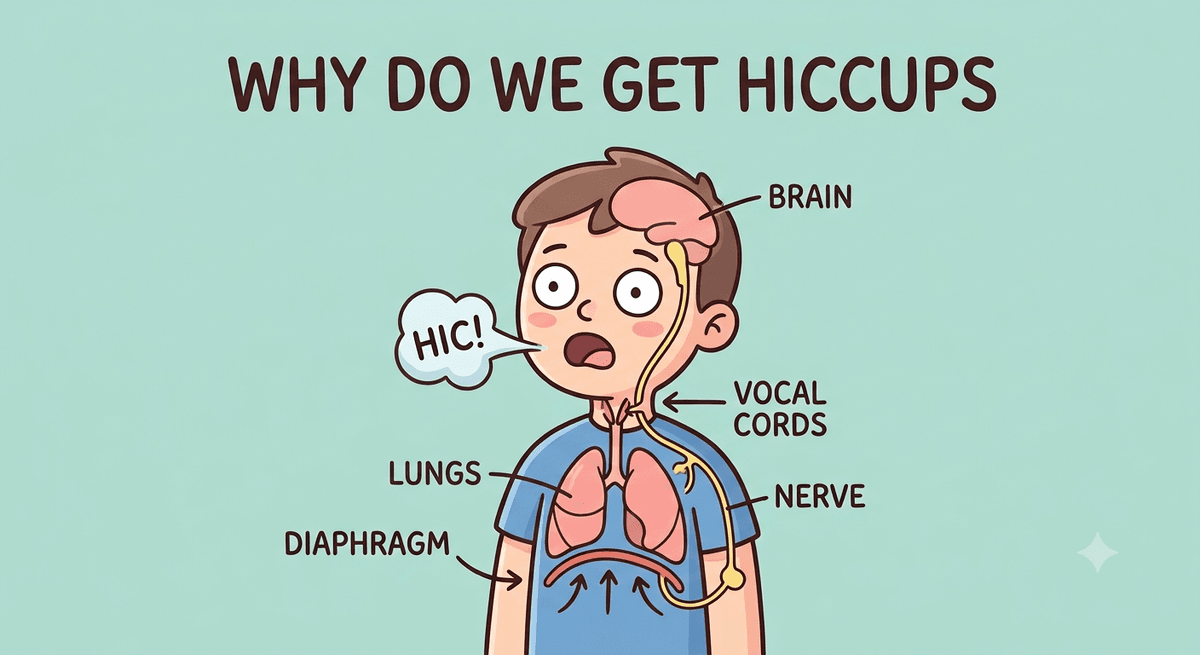
Why Do We Get Hiccups?
There are some things the human body does that are honestly very unnecessary. Like hiccups.
Almost everybody has had that annoying “hic” moment. You could be sitting quietly, eating your food or having a perfectly normal conversation, and suddenly,
Hic.
You ignore it.
Hic.
Okay.
Hic.
Now everybody around you is looking at you like something has entered your body. And the more you try to stop it, the more stubborn it becomes.
But what exactly is happening when we hiccup?
A hiccup starts with a sudden, involuntary contraction of the diaphragm. The diaphragm is a dome-shaped muscle located beneath the lungs. It plays a major role in breathing. When it contracts, it moves downward and helps create space for the lungs to expand, allowing air to enter. Normally, this happens smoothly without us having to think about it.
During a hiccup, however, the diaphragm suddenly contracts when it shouldn't. Immediately after that contraction, the opening between the vocal cords closes very quickly. That sudden closure produces the familiar “hic” sound.
So basically, your diaphragm suddenly goes: “Let me contract.”
And your vocal cords respond: “Absolutely not.”
Hic.
😂😂
Several things can trigger this reflex.
Eating too quickly, drinking carbonated drinks, eating a very large meal, sudden changes in temperature, laughing hard or swallowing air can sometimes irritate or stimulate the nerves involved in the hiccup reflex. Also Imbalances in some electrolyte levels can also stimulate hiccups.
The important nerves here include the phrenic nerve, which supplies the diaphragm, and the vagus nerve, which carries signals between the brain and several organs. There is also a part of the brainstem involved in coordinating the reflex.
So although a hiccup feels like a tiny random event, there is actually a whole reflex pathway behind it. And that explains why holding your breath sometimes helps.
The idea is that changing the level of carbon dioxide in your blood and altering your breathing pattern may interrupt the reflex.
Of course, the internet has produced approximately 47 different methods for stopping hiccups. Some like, Drink water upside down.
Hold your breath.
Get scared.
Eat sugar.
Have somebody surprise you.
At this point, people are basically conducting experiments on one another. 😂😂
Most hiccups are harmless and disappear on their own after a few minutes.
But there is one interesting exception. If hiccups persist for a very long time or keep coming back repeatedly, they may sometimes be associated with irritation of the nerves involved in the reflex, problems affecting the brain or chest, certain medications or other medical conditions.
That is when it stops being just an annoying little “hic” and becomes something worth discussing with a healthcare professional.
In persistent hiccups, doctors may also consider metabolic problems such as electrolyte disturbances, because normal nerve and muscle activity depends on properly balanced electrolytes.
So the next time you get hiccups, remember: Your body isn't malfunctioning completely.
Your diaphragm just decided to contract at the wrong time, your vocal cords slammed shut, and your brain gave you a tiny involuntary sound effect.
Hic.
Very sophisticated machinery. 😂😂