Writers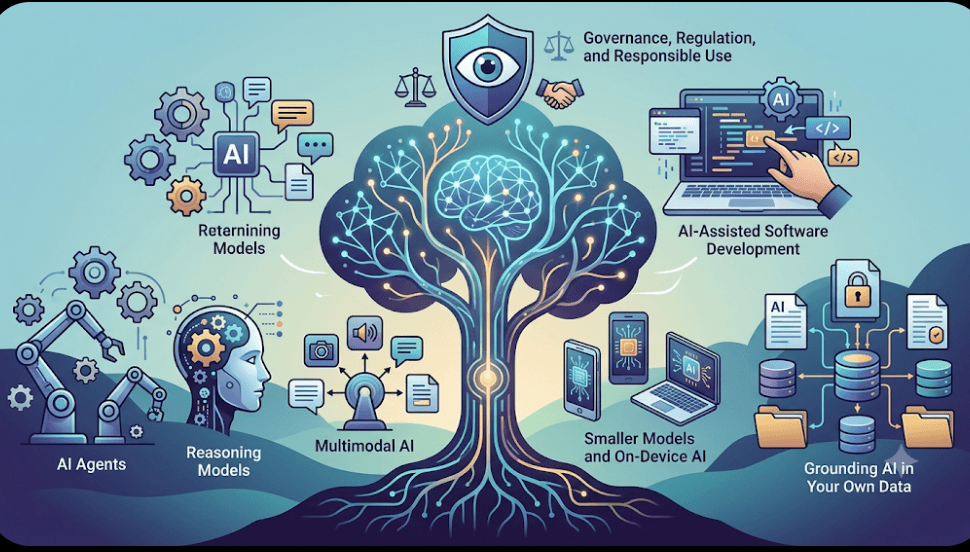
Not long ago, AI meant a chatbot that answered questions. Today, it books meetings, writes and tests code, reads documents, and runs on the phone in your pocket.
The pace can feel overwhelming, and not every headline deserves your attention. Below are seven trends that are reshaping how technology is built and used, along with practical examples of each.
1. AI Agents: From Answering to Doing
The biggest shift is from AI that responds to AI that acts. An AI agent takes a goal, breaks it into steps, uses tools, and works toward a result with limited supervision.
Practical example: Instead of asking a chatbot to draft a reply to a customer complaint, an agent can look up the order, check the refund policy, issue the refund within set limits, and send the response.
Agents still make mistakes, so the best deployments keep a human approving high-stakes actions. Start with low-risk, repetitive tasks and expand as trust builds.
2. Reasoning Models: AI That Thinks Before It Answers
Newer models are designed to work through problems step by step before responding, rather than producing the first plausible answer. This improves performance on tasks like math, planning, data analysis, and complex coding.
The trade-off is that deeper reasoning can mean slower responses and higher costs. Many teams now match the model to the task: a fast, cheap model for simple questions and a heavier reasoning model for difficult ones.
3. Multimodal AI: One System, Many Kinds of Input
Modern AI systems increasingly handle text, images, audio, video, and documents together. You can photograph a whiteboard and get organized notes, upload a spreadsheet and ask for a chart, or show a screenshot of an error and ask what went wrong.
Practical example: A field technician can snap a photo of faulty equipment, describe the symptom aloud, and get troubleshooting steps back. No typing or manual searching is required.
This lowers the barrier to using AI, because people can communicate in whatever format is natural to them.
4. Smaller Models and On-Device AI
Bigger isn't always better. There's growing momentum behind smaller, efficient models that run directly on laptops and smartphones instead of in distant data centers.
Running AI locally offers real advantages:
Privacy: Sensitive data can stay on the device.
Speed: No round trip to a server means faster responses.
Cost: Fewer cloud calls can reduce ongoing expenses.
Offline use: Features keep working without a connection.
Expect more everyday features, like transcription, summarization, and photo editing, to happen on your device.
5. AI-Assisted Software Development
Software development is one of the clearest examples of AI changing a profession. Coding assistants now suggest code, explain unfamiliar codebases, write tests, and help fix bugs. More advanced tools can take on multi-step tasks across a whole project.
This doesn't remove the need for skilled developers. Someone still has to define the problem, review the output, and take responsibility for quality and security. What changes is where developers spend their time: less on boilerplate, more on design, review, and decision-making.
For non-developers, the same shift means simple internal tools and automations can be built faster than before, often with little or no code.
6. Grounding AI in Your Own Data
General-purpose AI knows a lot, but it doesn't know your business. One of the most practical trends in enterprise tech is connecting AI to a company's own documents, databases, and policies so answers are relevant and traceable.
A common approach is retrieval-augmented generation (RAG). The system first searches trusted internal sources, then uses what it finds to craft a response, often with links back to the source material.
Practical example: An HR assistant that answers employee questions using your actual benefits handbook, instead of guessing from general knowledge, and shows which section it used.
This approach helps reduce made-up answers, though it doesn't eliminate them. Checking sources still matters.
7. Governance, Regulation, and Responsible Use
As AI moves into hiring, healthcare, finance, and customer service, oversight is catching up. Governments are introducing rules, with the European Union's AI Act among the most prominent examples, and organizations are building internal policies on how AI can be used.
Common priorities include:
Transparency about when AI is being used
Protection of personal and confidential data
Human review for decisions that significantly affect people
Testing for bias and accuracy
Clear accountability when something goes wrong
Regulations vary by region and keep evolving, so check current requirements for your industry and location. Companies that build responsible practices early will adapt more easily than those scrambling to comply later.
What These Trends Have in Common
Look across all seven and a pattern emerges. AI is becoming more capable (agents, reasoning), more accessible (multimodal, on-device), more useful to specific organizations (your own data, developer tools), and more closely watched (governance).
It's also becoming less of a standalone product and more of a layer built into the tools people already use.
How to Respond Without Getting Overwhelmed
You don't need to adopt everything at once. A sensible approach looks like this:
Pick one real problem. Choose a repetitive, time-consuming task rather than starting with a tool.
Run a small pilot. Test with a limited group and measure time saved or quality improved.
Keep humans in the loop. Review outputs, especially where errors are costly.
Protect your data. Understand what information you're sharing with any AI service and how it's handled.
Revisit regularly. The tools improve quickly, so a limitation today may not exist in six months.
The most important AI trends right now share a common thread: they move AI from a novelty to a working part of everyday technology. The businesses and professionals who benefit most won't be those chasing every new release. They'll be the ones who choose a clear problem, test carefully, and build good habits around accuracy and responsibility.
Pick one trend from this list, find one task it could improve, and try it this week. Small, well-chosen experiments are the fastest way to turn AI headlines into real results.