Writers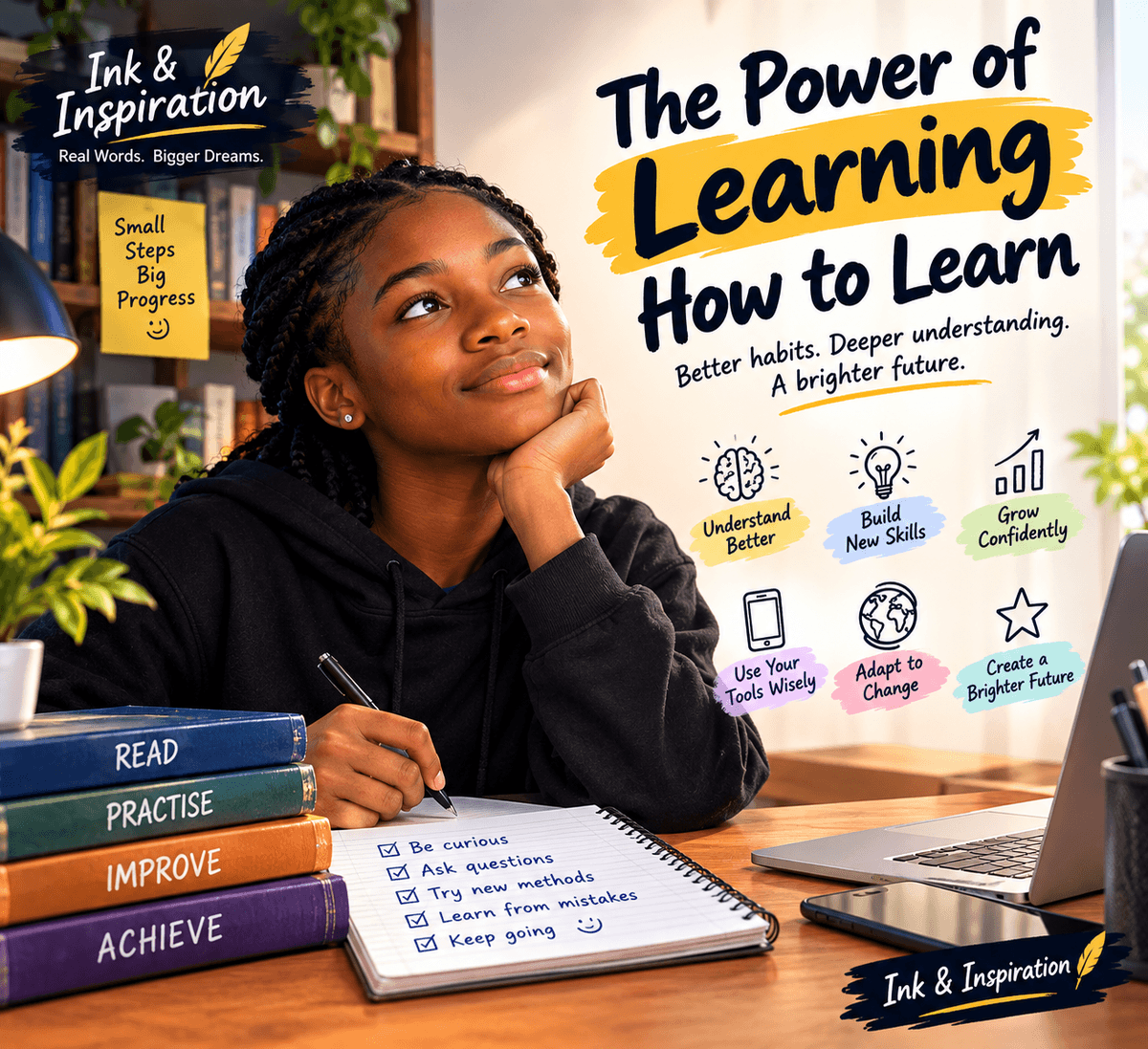
Many people believe that being good at school simply means having a good memory. They think successful students are the ones who can read a chapter once, remember everything and reproduce it during an examination.
But learning is much more than memorizing information.
One of the most valuable skills a person can develop is knowing how to learn effectively. This skill can help you understand difficult subjects, develop useful abilities and continue growing even after you leave school.
The world is constantly changing. New technologies appear, careers evolve and information becomes available faster than ever before. Because of this, the ability to learn independently can become one of the most useful skills a young person possesses.
Learning Is Not the Same as Memorizing
Memorizing information can be useful, especially when preparing for an examination. However, remembering something temporarily is different from truly understanding it.
Imagine someone memorizes a mathematical formula but does not understand when or why to use it. They may perform well when the examination question looks familiar, but struggle when the problem is presented differently.
Understanding allows you to use knowledge in new situations.
Instead of simply asking, "What is the answer?" try asking, "Why is this the answer?" and "How did we get here?"
Questions like these encourage deeper thinking.
Find the Learning Method That Works for You
Not everyone learns in exactly the same way.
Some people understand concepts better when they read. Others learn faster by watching demonstrations, listening to explanations or practising the skill themselves.
This does not mean you should avoid methods that feel difficult. Sometimes struggling with a subject is part of the learning process.
However, experimenting with different methods can help you discover what makes information easier to understand and remember.
For example, after reading a topic, you could close the book and explain what you remember without looking at your notes. You could create a simple diagram, write down questions or practise problems related to the subject.
The important thing is to become an active participant in your learning.
Do Not Be Afraid of Difficult Subjects
A difficult subject can make you feel as though you are not intelligent enough to understand it.
But difficulty does not automatically mean inability.
Sometimes a topic becomes difficult because you have not yet developed the background knowledge required to understand it. Breaking the subject into smaller parts can make it less overwhelming.
Instead of trying to understand an entire chapter in one sitting, focus on one concept at a time.
Learn it.
Practise it.
Test yourself.
Then move to the next concept.
Progress does not always happen quickly, but consistent effort can make a significant difference.
Mistakes Are Part of Learning
Many people are afraid of making mistakes because they associate mistakes with failure.
However, mistakes can provide useful information.
If you answer a question incorrectly, you have an opportunity to discover what you misunderstood. If you make an error while learning a new skill, you can examine what went wrong and try again.
The important thing is not to repeat mistakes without reflection.
Ask yourself:
What went wrong?
Why did it happen?
What can I do differently next time?
This simple habit can turn mistakes into lessons.
Your Phone Can Be More Than Entertainment
Smartphones are often associated with social media, games and entertainment. But the same device can also become a powerful learning tool.
You can use your phone to read educational articles, watch lessons, practise languages, research unfamiliar subjects, listen to educational podcasts and learn digital skills.
The challenge is not simply having access to information. There is more information available today than most people could ever consume.
The real skill is knowing what information is useful, checking whether it is trustworthy and applying what you learn.
Make Learning a Daily Habit
You do not need to study for ten hours every day to become a better learner.
Even a small amount of focused learning can become valuable when repeated consistently.
You could spend thirty minutes each day learning something useful. One day might be dedicated to writing. Another could be used to improve your communication skills. You might spend another day learning technology, business, mathematics or a subject connected to your future career.
Over time, these small efforts can accumulate.
A person who learns something useful every day may discover that they have developed an impressive amount of knowledge and skill after several months.
Never Stop Being Curious
Curiosity is one of the simplest ways to keep learning.
When you encounter something you do not understand, instead of immediately ignoring it, become curious about it.
Ask questions.
Look for explanations.
Read.
Experiment.
Discuss the subject with people who know more about it.
You do not need to know everything. Nobody does.
What matters is developing the confidence to say, "I don't understand this yet, but I can learn."
That mindset can open many doors.
The Real Advantage Is Becoming a Lifelong Learner
Education should not end when you leave a classroom.
The world will continue presenting you with situations you have never experienced before. You may need to learn a new technology, understand a new responsibility, develop a professional skill or adapt to an unexpected change.
If you know how to learn, you are better prepared to face those situations.
You do not need to become the smartest person in the room.
You simply need to remain willing to learn, improve and ask questions.
The ability to learn is not only useful for passing examinations. It is a skill that can continue serving you throughout your life.
Start with one subject. Learn one useful thing today. Practise it tomorrow.
Small lessons can eventually become powerful knowledge.
— Ink & Inspiration