Writers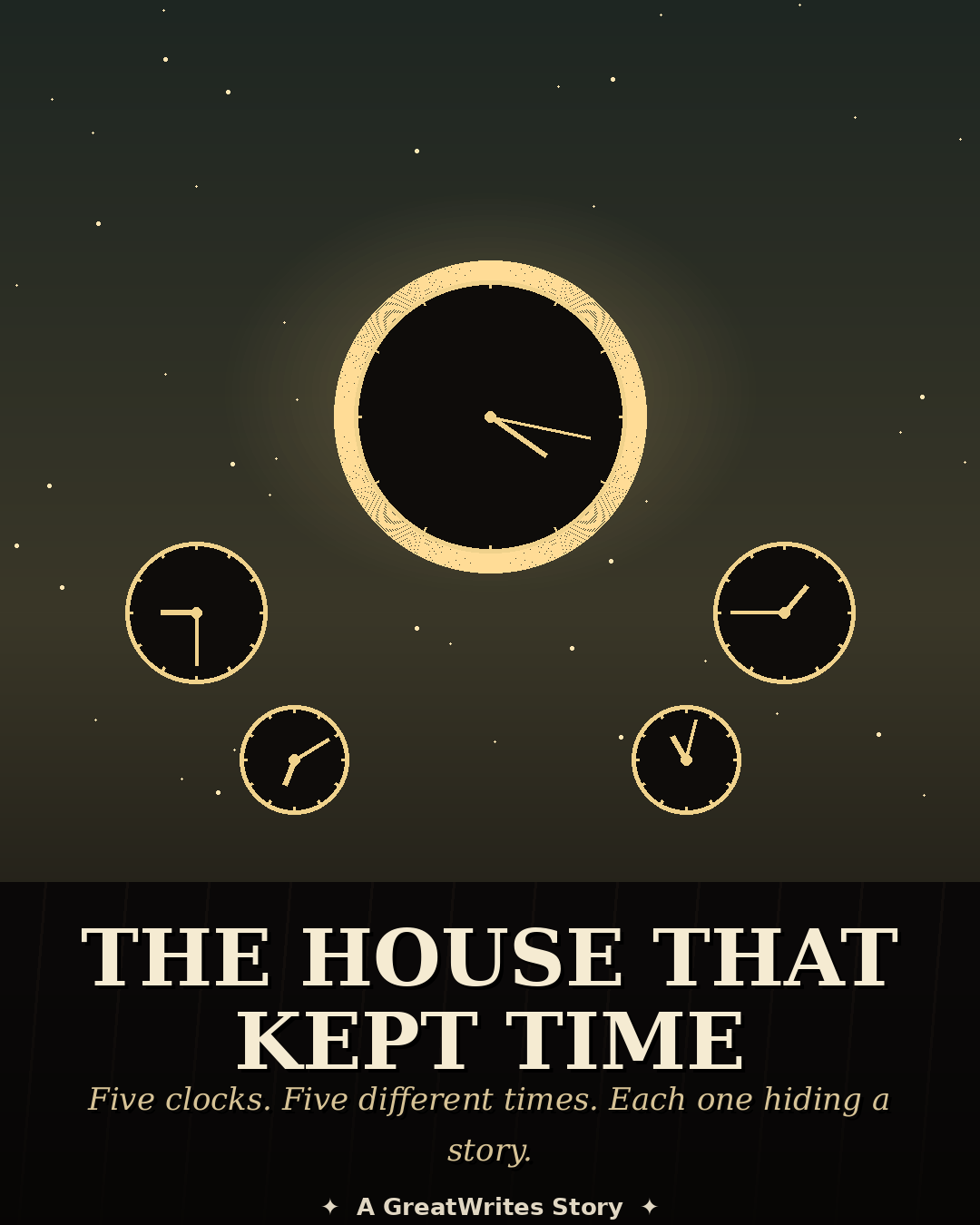
Chapter 1: The Clock That Never Matched 🕰️
When Funmi inherited her late grandmother's house in Ibadan, she noticed something odd on the very first night: every clock in the house — five of them, in five different rooms — showed a different time. Not by minutes. By hours. Sometimes by years, if you believed the strange antique one in the study that seemed stuck permanently on a date instead of a time. 🏚️
She assumed they were simply old, unwound, forgotten. She began resetting them one by one. 🔧
By morning, every single one had reset itself back to its original, mismatched time. 😳
Chapter 2: The Neighbor's Warning 🚪
"Your grandmother never touched those clocks," said Mama Ronke, the elderly woman next door, when Funmi mentioned it over the fence. "She used to say each clock was keeping time for someone who was no longer here to keep it themselves." 👵🏾
Funmi laughed nervously. "That sounds like something from a novel, not real life."
Mama Ronke didn't laugh back. "Your grandmother buried three children before you were born, my dear. And a husband. This house held a lot of years that never got to finish." ⏳🖤
Chapter 3: The Study Clock 📚
That night, unable to shake the conversation, Funmi went into the study and studied the antique clock more closely. Its hands were frozen at 4:17, but a small engraved plate beneath the face read a date: March 3, 1988. 🕓
She searched her grandmother's old documents in a nearby drawer and found a faded newspaper clipping from that same date — an obituary. Her grandmother's eldest son. Funmi's uncle she never knew existed. He had died at exactly 4:17pm, in a car accident on his way home from work. 📰💔
The clock hadn't stopped from neglect. Someone had stopped it, deliberately, thirty-six years ago.
Chapter 4: The Bedroom Clock ⏰
Encouraged now by unsettling curiosity, Funmi checked the bedroom clock — the one showing a time seven hours ahead of Nigeria's timezone. She found a small note taped behind it, yellowed and brittle: "For my daughter, wherever her time zone may be. I hope you are well, wherever you are, my Adaeze." 💌
Funmi's mother's name was Adaeze. Her mother, she now remembered vaguely from childhood whispers, had lived abroad for several years before returning home — in what timezone, Funmi had never actually confirmed. She called her mother immediately.
"Mama... when you lived in London all those years... what time difference was it from Nigeria?" 📞
Her mother went quiet. "Seven hours behind us in winter. How do you know about that?" 😳
Chapter 5: The Kitchen Clock 🍲
The kitchen clock ran fast — exactly forty minutes ahead of real time, every single day, no matter how often it was corrected. Funmi's grandmother had apparently kept it that way on purpose for over twenty years. 🕧
Her mother, once she visited and saw the clocks herself, finally explained through tears: "That was for your grandfather. He worked night shifts at the factory. Forty minutes ahead meant Mama always had his food ready hot, exactly when he walked through that door, never a minute late. He's been gone twelve years, and she never changed it." 🍛❤️
Chapter 6: The Living Room Clock 🛋️
The living room clock, Funmi discovered last, was the only one keeping perfectly accurate time. Beneath it was a simple note in her grandmother's handwriting, dated just weeks before she passed:
"This one is for whoever finds this house next. Real time. Moving forward. Because grief keeps its own clocks, but life — the living — must keep this one." ⏳➡️🕊️
Funmi sat on the floor of that living room and cried for a woman she thought she'd known completely, but had only ever seen the surface of. 😭
Chapter 7: What Funmi Chose ⏱️
Funmi kept every clock exactly as she found them — the frozen one for the uncle she never met, the shifted one for her mother's years abroad, the fast one for a husband who never returned home late, and the accurate one for herself, moving forward. 🏠
She added a sixth clock of her own to the hallway on her one-year anniversary in the house, set to the exact time she'd finally understood her grandmother, and by extension, herself. 🕰️✨
Visitors still find it strange — a house full of clocks, none of them agreeing. But Funmi always tells them the same thing her neighbor once told her:
"Grief doesn't run on the same clock as everyone else's world. Some hearts need a few extra timepieces just to keep up with all the people they've loved and lost." 🕯️❤️
The End.
Caption for posting: "Every clock in her late grandmother's house showed a different time. What she discovered behind each one left her in tears. 🕰️😢 Which clock story touched you the most?"