 Writers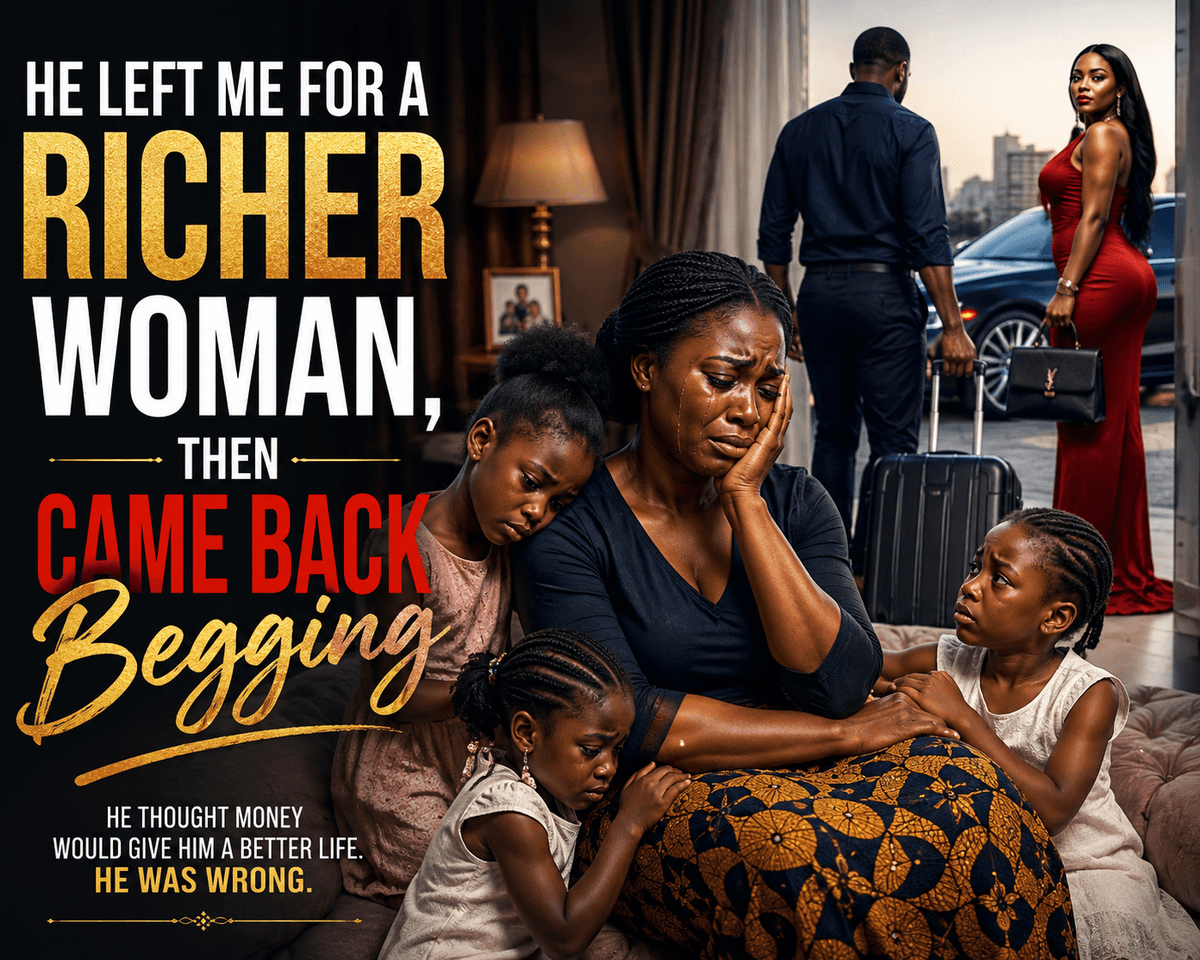
HE SAID I WAS THE REASON HE COULDN'T SUCCEED
The Years We Had Nothing
When I look back at the first few years of my marriage, I sometimes wonder how we survived them.
We were young, hopeful and full of dreams, but we had very little money. There were days when we would go to bed hungry or take food items on credit just to have something in our bellies.
My husband, Patrick, was a project manager who was trying to find his feet in project management. He was constantly looking for clients who needed his services. He was in no way a lazy man, and I used to draw a lot of strength from him because he was always ready to do any kind of job just to take care of the family.
The years of struggle took their toll on us, especially when the children started coming. We had four lovely children—three girls and a boy.
My parents and siblings were a huge support system to us. They sent money and food whenever they could and constantly encouraged us that things would definitely get better.
At some point, my younger sister was paying my children's school fees because things had become so bad.
The children were sent out of school so many times because we couldn't pay their fees on time. There were days when I would have to look my children in the eyes and tell them to be patient while I tried to sort things out.
Those moments were painful.
I remember one particular day when one of my daughters came home from school with tears in her eyes.
"Mummy, they said I shouldn't come back tomorrow if I don't bring my fees."
I collected the note from her and forced a smile.
"Don't worry, my darling. I'll take care of it."
She nodded and walked away.
I waited until she was out of sight before I allowed myself to cry.
Where was I going to get the money?
I didn't know.
But somehow, God always provided a way.
Unfortunately, we did not receive any form of support or encouragement from Patrick's family.
If anything, they spent most of their time mocking us and talking down to us.
Patrick was the first son in his family, but strangely, he was not accorded any respect.
They felt he had nothing meaningful to contribute, and they never missed an opportunity to remind him of it.
Sometimes, I would watch him come back from visiting his family looking completely defeated.
I knew what had happened without asking.
One evening, after one particularly difficult visit, he sat quietly on the edge of the bed.
I went and sat beside him.
"What happened?" I asked.
He shook his head.
"Nothing."
"Patrick."
He looked at me.
"They don't believe I'll ever amount to anything."
My heart broke for him.
I placed my hand on his shoulder.
"Don't listen to them. Your time will come."
He looked at me and smiled weakly.
"You really believe that?"
"Of course I do."
And I meant it.
I believed in that man more than he probably realised.
There were nights when I would lie awake beside him after he had fallen asleep and ask God the same question over and over again.
What have we done to deserve this kind of life?
I wasn't asking for a mansion.
I wasn't asking for a luxurious car.
I simply wanted my children to go to school without being sent home.
I wanted to open the kitchen cupboard and find enough food.
I wanted my husband to have a decent job and be respected for his efforts.
That was all.
Eventually, I decided that I couldn't sit at home and wait for things to change.
I got a job in a law firm.
My monthly salary was N25,000.
It wasn't much, but to me, it was something.
I remember the day I received my first salary.
I came home with the money and couldn't stop smiling.
Patrick looked at me and laughed.
"What are you smiling about?"
I told him.
He looked at the money and smiled too.
"So this is what we're celebrating?"
I laughed.
"Yes. Leave me alone. At least I'm contributing something."
He pulled me closer.
"Thank you."
Those two words meant so much to me.
I didn't see the N25,000 as insignificant.
To me, it was my contribution to our family.
It meant that if Patrick couldn't provide everything, I could at least take some of the burden off his shoulders.
My first salary went almost immediately.
School fees.
Food.
Transport.
One medical bill.
There was barely anything left.
But I was happy.
For the first time, I felt like I was doing something that could help us move forward.
Patrick also seemed proud of me.
"We will get there," he told me one evening.
I smiled.
"Together?"
He looked at me.
"Together."
I held onto that word.
Together.
I didn't know then that there would come a time when Patrick would look back at those same years and see them differently.
I saw a young couple fighting to survive.
He would eventually see a life that had held him back.
I saw the family that had stood by him when nobody else would.
He would eventually see the people who had failed to give him the life he wanted.
And I saw myself as his wife and partner.
He would eventually look at me and wonder why he had ever settled for the life we had.
But that was still years away.
For now, we were simply two young people trying to survive.
And despite everything we were going through, I still believed that one day, Patrick and I would look back at those difficult years and be proud that we never gave up on each other.
I was wrong.
Very wrong.
When Things started to Change
The change in Patrick did not happen suddenly. Looking back now, I realize that the crack in our marriage began quietly, almost imperceptibly. There was no single day I could point to and say, “This was when everything changed.” Instead, it was a gradual shift, made up of little things that I initially dismissed because I wanted to believe that the man I had married was simply going through a difficult season.
One evening, Patrick returned from a site he was managing. After dinner, we were supposed to relax together as we usually did, but instead, he looked at me and asked a question that caught me completely off guard.
“How would our lives have been if we didn't get married to each other?”
I was shocked.
I looked at him, wondering where such a question had suddenly come from.
“Why would you even think of something like that?” I asked.
He simply shrugged.
“It was just a thought that crossed my mind.”
I tried to dismiss it, but somehow, those words stayed with me.
After that evening, I began noticing subtle changes in Patrick. He started coming home very late. Whenever I called to find out where he was, he sometimes refused to answer. And when he eventually picked up, instead of calmly explaining where he was, he would become angry.
“Stop suffocating me. Why are you always monitoring me?”
At first, I did not think the worst of him. I told myself that perhaps he was under pressure. Maybe there were things he was dealing with that he did not want to burden me with. I had always known that life was not easy for him, and I thought perhaps he was simply struggling to cope.
But gradually, I began to discover things that were much harder to explain away.
Patrick started making calls to different women. He chatted with them and, to my shock, began asking some of them for nude pictures.
When I discovered what he was doing, I was devastated.
I confronted him, hoping perhaps he would be remorseful or at least understand why his actions were hurting me. Instead, his response broke something inside me.
He told me that if he had not married me, his life would have been much better.
Then he said something that I would never forget.
He told me that he should have listened to his mother, who had advised him not to marry me but to marry a girl who was based in the United Kingdom. According to him, that woman would have taken him abroad and given him a better life.
I could not understand how the same marriage we had entered together, the same home we had struggled to build, could suddenly be presented to me as the reason his life had not turned out the way he wanted.
What hurt even more was the timing.
Patrick was not the one carrying the financial burden of the family at that point. He had very little doing, while I was doing everything I could to keep our home going.
I was paying the children's school fees. I was feeding the family. I was borrowing money when there was no money. I was even shopping for Patrick and the children, trying to make sure that, despite everything we were going through, nobody lacked the basic things they needed.
There were times when I took loans simply to pay the children's school fees.
When my first daughter gained admission into secondary school, I had to borrow money from a friend to pay her acceptance fee because I needed to secure her place in the school. I did not want her admission to be lost simply because I could not immediately afford the money.
When it was time for my son to write his entrance examination for secondary school, I took him myself and bore all the expenses without disturbing Patrick.
I was carrying the family on my shoulders, yet somehow, I had become the person Patrick believed was responsible for his unhappiness.
His behaviour toward other women continued. He began making calls and having video conversations with them, sometimes right in front of me, as though my presence no longer mattered.
I remember sitting there and wondering what had happened to the man I married.
There were nights when I cried myself to sleep, asking God what I had done wrong.
Where had I gone wrong?
What had I done to deserve this?
How could the man I had struggled with, stood by and supported now look at me as though I was the obstacle standing between him and the life he wanted?
I had no answers.
And still, I kept trying.
Perhaps that was one of my biggest mistakes. I kept believing that if I remained patient enough, prayed hard enough and endured long enough, things would eventually return to normal.
But they did not.
Instead, Patrick began sleeping out.
At first, it happened occasionally. Then it became more frequent.
There were nights when I waited for him, listening for the sound of the gate opening or the key turning in the door. Sometimes I would call, but he would not answer. Other times, he would answer angrily and make me feel as though I was the problem for simply wanting to know where my husband was.
Eventually, coming home stopped being something I could expect.
And with every night he spent away from home, another little piece of our marriage seemed to disappear.
He Walked out Us
I tried speaking to Patrick's mother about the way he was behaving. I thought that, as his mother, she would speak to him and perhaps help him see how much his actions were hurting our family.
But to my greatest shock, all I got was a simple response:
“He's a man. He can do whatever he wants.”
Those words stayed with me.
At that point, I made a decision. I would no longer have conversations with his family about the problems in my marriage. If they had chosen to excuse his behaviour simply because he was a man, then there was nothing more I could say.
I turned my attention to my children and my job. I decided that, whatever happened, I would work as hard as I could to give my children the best life I was capable of providing.
But Patrick's words continued to hurt me.
He mocked my faith and called me a fake child of God. He would tell me that I had nothing to show for serving God and that going to church was a waste of my time.
There were days he called me a failure. He mocked my inability to make as much money as the women he had begun associating with.
At first, I tried to ignore him. But words repeated often enough can begin to find their way into your heart.
I started doubting myself.
Perhaps I was cursed.
Perhaps I was not destined to succeed.
Perhaps there was something fundamentally wrong with me that I could not see.
I remember one day calling my parents and asking them a question I had never imagined I would ask.
“Is there an evil curse in our family? Did you perhaps offer me to a strange god? Is that why it seems impossible for me to make it in life?”
My parents were shocked.
They immediately rebuked me for saying such things and asked where I had heard such an idea.
But at that point, I was desperate for an explanation.
I looked around me and saw people I went to school with moving forward with their lives. Some had master's degrees. Some were travelling in and out of Nigeria. Others were occupying important positions and building successful careers and businesses.
And I kept asking myself, Why isn't anything working for me?
I became ashamed of my circumstances.
I stopped attending gatherings with former schoolmates because I could not bear the thought of standing among people I once knew as equals and having them see how far behind I felt I had fallen.
There were times I reached out to some of them for help. Some were kind enough to help me. Others mocked me.
“We are no longer on the same level,” some would say.
Those words hurt, but I kept going.
Through all of this, my children became my greatest source of strength.
They encouraged me every day. They believed in me even when I had stopped believing in myself. They constantly told me that one day I would become so successful that I would be able to give them the kind of life they deserved.
Their faith in me kept me going.
Then came the day Patrick walked away.
It was an ordinary day. I was preparing to go to work when Patrick told me that he had gotten a project to handle and would be travelling out of town.
“When will you be back?” I asked.
“I'll let you know,” he replied.
And then he left.
Four days passed.
I called him to ask when he would be returning. I expected an ordinary answer. Instead, the words I heard on the other end of that phone call changed the dynamics of my family forever.
“I'm never coming back. In fact, I've moved on with someone who can give me a better life. I never achieved anything while I was with you.”
For a moment, I thought I had not heard him correctly.
“What did you say?”
He repeated the same words.
And something inside me died that day.
I didn't argue.
I didn't plead.
I simply said, “Okay.”
I put down the phone and sat there, trying to process what had just happened.
My mind began racing.
How will I cope with four children?
How will I take care of them with a job that doesn't bring in very much?
What am I going to do?
I cried.
I replayed his words over and over again in my mind, searching for answers and wondering where I had gone wrong.
Was I angry?
Yes, I was.
I was angry at the betrayal. I was angry that after all the years we had spent together, he could simply walk away and tell me he had found someone who could give him a better life. I was angry at myself for the years I felt I had lost. And I was angry that I had not achieved enough to put myself and my children in a more secure position.
But eventually, I knew I had to face reality.
I had four children looking up to me.
I could not afford to fall apart.
I sat my children down and told them that their father had left to be with another woman and that, from that point, it was just the five of us.
My first daughter, Ann, was devastated. She had been very close to her father and felt deeply betrayed by his decision.
My son, who was about thirteen at the time, simply listened and then said,
“Good riddance. We can finally have some peace in this house.”
His words surprised me, but they also told me something about what the children had been experiencing behind closed doors.
You would think that after Patrick left, he would simply focus on his new life and leave us alone.
But he didn't.
He would call just to gloat.
He would tell me how well he was doing, how he would never be poor again, and how he had left me “in the trenches.”
Sometimes his words pushed me beyond my limit. I would respond out of anger and hurt, and we would exchange words over the phone.
But eventually, I became tired of fighting.
I made a decision that I would no longer engage him.
I had spent too many years trying to prove myself to someone who had already decided that I was not enough.
I had children to raise.
And I had a life to rebuild.
That became my turning point.
I made up my mind that I was going to move forward and build a life for my children, whether Patrick was part of it or not.
I opened my law firm and began sending my profile to friends, colleagues and some members of my church. At first, I did not know what to expect.
Then the jobs began to come.
One client referred me to another. Friends recommended me to their families. Gradually, the work increased.
For the first time in a long time, I began to see possibilities where I had previously seen only limitations.
Things started changing.
I was able to get better accommodation for myself and the children.
And then, almost as if God was reminding me that the years of struggle had not been wasted, my children's achievements began to speak for themselves.
My first daughter graduated from secondary school as the third-best student in science.
My youngest daughter passed her Common Entrance examination and gained admission into secondary school.
My second daughter was on a winning streak at school, coming second overall in her JSS 1 class.
The following year, my son graduated from secondary school.
Then came one of the moments that filled my heart with indescribable joy: my first daughter gained admission into the University of Lagos to study Medicine and Surgery.
I looked at my children and realized that despite everything we had been through, they were moving forward.
The life I had feared I could not provide for them was slowly becoming a reality.
We were not where I wanted us to be yet, but we were no longer where we had started.
And throughout all of this, not a single member of Patrick's family reached out to ask how the children and I were coping.
Not once did anyone call to ask how we were surviving.
Not once did anyone ask about their grandchildren's welfare.
But by then, I had stopped waiting for anyone to rescue us.
I had learned that sometimes, the people you expect to stand beside you may walk away, and sometimes, the person you thought would break you becomes the very reason you discover how strong you can be.
Patrick had walked away from our family believing he was leaving behind a woman who would never amount to much.
He did not know that, in walking away, he had unknowingly pushed me toward the woman I was always meant to become.
His Regret and News to come Back
Then, just one ordinary day, completely out of the blue, I received a call from a strange number.
I answered, thinking it was probably a client calling.
“Hello?”
The voice on the other end said, “Amanda, how are you?”
Everything around me seemed to stand still.
For a moment, I wasn't sure I had heard correctly.
“Who is this?” I asked.
There was a brief silence.
“It's me, Patrick,” he whispered.
My heart skipped, but I quickly composed myself.
“How are you doing?” I asked. “And to what do I owe this call?”
I wasn't prepared for his answer.
“I made a mistake.”
I said nothing.
I waited for him to explain what he meant, but when the silence continued, I finally asked, “What did you just say?”
“I made a mistake,” he repeated.
“What kind of mistake did you make?”
His voice became quieter.
“I made a mistake leaving you. I thought you were the reason I wasn't succeeding. I thought my life would be better if I left you and went to be with someone who could give me the kind of life I wanted.”
I listened.
Then, for the first time, I heard the story from his side.
The woman he had left me for did have money. She gave him access to a life that looked, from the outside, like everything he had wanted. But there was a price.
She put him in charge of running her food business while also expecting him to cook for her and her children at home.
Yes, the money was there.
But so was the humiliation.
She belittled him at every opportunity and made him feel small.
Perhaps he had imagined that having money would automatically give him happiness and respect. Perhaps he had also believed that he could treat her the way he had treated me and still have everything he wanted.
So he did what he had done before.
He began having affairs with other women.
Only this time, he had money to spend on them.
He spent her money entertaining other women, repeating the same pattern that had contributed to the destruction of our marriage.
And while all this was happening, he was sending money home to his family and not to his children.
Suddenly, the same man who had once struggled financially was being celebrated by his family.
They started calling him “Chairman.”
He finally had money to play the role expected of him as the first son.
His mother even went as far as travelling to spend time with him and his new “family.”
There was a painful irony in all of this.
To get to Patrick's new home, she would have passed my house.
The house where her grandchildren lived.
Yet she had never once stopped to ask how we were doing.
She had never come to check on the children she had left behind.
Eventually, however, the life Patrick had imagined would save him began to collapse.
The woman could no longer tolerate his lies, betrayal and constant affairs.
She threw him out.
And this time, he had nothing.
When Patrick finished telling me everything, he said the words I had once longed to hear.
“I'm sorry. I shouldn't have left you.”
Then he told me that he had nowhere else to go. He said he couldn't return to his father's house because his family would laugh at him.
I listened quietly.
Then came the statement that almost made me laugh—not because it was funny, but because of the sheer audacity of it.
“I want to come back so we can be a complete family again.”
A humourless laugh escaped me.
Come back?
After everything?
After leaving me with four children?
After telling me that another woman could give him a better life?
After watching me struggle?
After calling me a failure?
After telling me I had been the reason he had achieved nothing?
After walking away from the family he had helped create?
Now he wanted to come back and make us a complete family again.
I did not argue with him.
I simply told him, “I'll get back to you.”
But I already knew that something had changed.
Not Patrick.
Me.
When my children were all around, I sat them down and told them what their father had said.
The reaction was immediate.
They did not want him back.
They reminded me of everything we had endured after he left. They told me they did not want him coming back into our home or disrupting the peace we had finally found.
My children had watched me struggle.
They had seen me cry.
They had seen me borrow money, work, worry and fight to keep our family together.
They had watched me rebuild my life from almost nothing.
And now that we had found peace, they were afraid of losing it.
I understood them.
I also understood something else.
Forgiveness does not mean restoration.
Forgiveness does not mean giving someone access to you again.
Forgiveness does not erase consequences.
And forgiveness certainly does not require you to return to a place that nearly destroyed you.
I do not know where Patrick is today.
I do not know what he is doing or how he is faring.
Perhaps one day, my children may decide that they want a relationship with their father. If they do, that will be their decision to make. I will never force them either to forgive him or to reject him.
As for me, I forgave him a long time ago.
I had to.
Not for Patrick, but for myself.
I could not continue carrying the weight of anger and resentment while trying to build a future for my children.
But forgiveness did not mean I wanted him back.
There was simply no space for him anymore.
The space he had occupied in my heart had been filled with something else—peace, purpose, self-respect and the knowledge that I could survive without him.
Today, my children and I are doing well.
We are not extraordinarily wealthy, but we are comfortable. We have a home. We have peace. My children are growing, achieving their dreams and becoming the people I prayed they would become.
And when I look at them, I realize that the years I once thought I had wasted were not entirely wasted after all.
They produced these beautiful human beings.
They taught me resilience.
They taught me that sometimes, you can give everything you have to a person and still be told that you are not enough.
And most importantly, they taught me that someone else's decision to abandon you does not determine your worth.
Patrick thought leaving me for another woman would destroy me.
He thought he was walking away from a woman who had failed to give him the life he wanted.
But he was wrong.
His leaving broke me for a while.
It made me question myself. It made me question my faith. It made me wonder whether I was cursed or destined never to succeed.
But I eventually discovered that I was not cursed.
I was simply in a season of my life that I had mistaken for the end of my story.
The woman he walked away from is not the woman I am today.
I built myself again.
I built my career.
I built a home.
I raised my children.
I found my confidence again.
And I learned to stop measuring my worth by what someone else thought of me.
Patrick eventually came back looking for the family he had once abandoned.
But by then, we had become a family without him.
Perhaps that was the greatest irony of all.
He left because he believed another woman could give him a better life.
He came back when he discovered that the life he thought he wanted was not what he imagined.
But while he was busy searching for a better life somewhere else, I was quietly building one right where he left me.
I don't know what the future holds for Patrick.
That is no longer my burden to carry.
I have chosen to leave the past where it belongs.
Have I forgiven him?
Yes.
Do I hate him?
No.
Do I want him back?
No.
Some doors can be forgiven for being closed without ever needing to be opened again.
And perhaps that is the greatest lesson my journey has taught me:
Sometimes, what feels like the end of your life is actually the beginning of the life you were meant to live.
Patrick thought he was leaving me behind.
He never realized that, in walking away, he was also walking away from the woman I would eventually become.
And when he finally came back looking for her, she was no longer there.
She had moved on.
She had found herself.
She had found her strength.
And she had built a life that no longer had room for the man who once convinced her that she could never make it without him.
I didn't get the life I thought I would have.
I got something different.
Something stronger.
Something I built with my own hands, with God's help, and with the love and faith of the four children who never stopped believing in me.
And today, when I look back at the woman who once cried herself to sleep asking God what she had done wrong, I wish I could reach through time and tell her:
You did not fail.
You were not cursed.
You were not forgotten.
Your story was simply not over yet.
And it wasn't.
It was only beginning.