Writers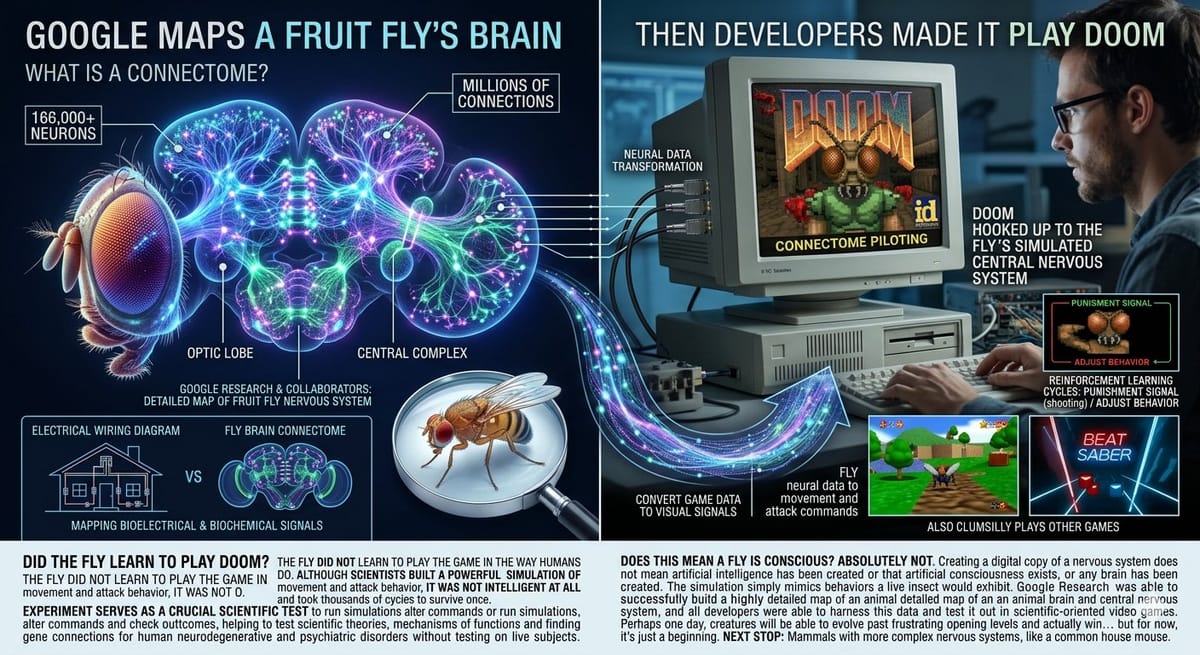
Imagine taking the brain of a small insect, mapping how its neurons are connected to each other, and then inserting this information into a computer.
While still an extraordinary scientific enterprise, researchers have been successfully working toward making this concept a reality.
Google Research and collaborators recently developed an extremely detailed map of an adult male fruit fly's nervous system, providing information about how thousands of its neurons are connected to each other.
Researchers discovered more than 166,000 neurons and millions of connections throughout the insect's brain and central nervous system.
The project is incredibly important and valuable to researchers, as it tackles one of the greatest conundrums in biology — how does the physical structure of a nervous system produce behaviors?
What is a Connectome?
You can think of a connectome as something similar to an electrical wiring diagram.
In an electrical system, having a complete map of where each wire is going to and coming from can provide insight into how the electricity in a house or commercial building will be distributed.
Now imagine a scientist having the ability to view the connections between neurons in a nervous system.
Scientists are essentially doing the same thing with a connectome, except instead of electricity, they're studying neurons sending bioelectrical and biochemical signals to other neurons.
The fruit fly makes this type of research possible, as the insect's nervous system is many times smaller and simpler than that of a human being, allowing researchers to study every single connection between neurons.
Google's research creates a realistic way for researchers to conduct experiments and determine how each part of a nervous system works together to produce specific behaviors that an organism showcases.
What is the Point of Doom?
Once scientists obtained this new and valuable data, computer programmers discovered an unusually creative application for it.
A group of individuals connected the simulated nervous system to a video game called Doom, which was first released in 1993 by id Software.
The game is well-known and loved among PC gamers as it is compatible with almost all kinds of PC components and software.
In the experiment, Doom was hooked up to the fly's simulated central nervous system.
Video game data could then be converted into signals that almost mimicked the visual information taken in by a fly's compound eyes.
Finally, the fly's neural data could be transformed into movement and attack commands so that the insect could, theoretically, move around and shoot at enemies.
The setup included a reinforcement-type learning model, so whenever the computer-controlled or simulated fly had been shot at by an enemy, signals associated with punishment would tell its nervous system to adjust behaviors so that the virtual fly would make different decisions.
Did the Fly Learn to Play Video Games?
The fly actually did not learn how to play the game, at least not in the way humans do.
This is where the experiment gets even more interesting.
While scientists had essentially built a powerful enough simulation to show a biologically plausible example of movement and attack behavior, it was not intelligent at all and took thousands of reinforcement-type learning cycles to even survive once after being shot at.
Other computer programmers and scientists have even used the fly's simulated nervous system to show how it can clumsily maul through Super Mario 64 and a rhythm-based game called Beat Saber, making it a great research platform that just cannot seem to play well.
Why even Continue With this Experiment?
It might seem odd for researchers to continue with this type of experiment where the simulated nervous system of a fruit fly cannot play a video game adequately, but that is the point.
The experiment serves as a type of scientific test; the scientists can essentially try out new ideas.
By running the simulation again and altering some commands, researchers can see if the outcomes change; these outcomes can then help a researcher to test the results of other scientific theories.
This type of experimentation is crucial to finding out the mechanisms for various types of nervous system functions, as it creates a biologically accurate model without requiring the testing on live test subjects that would take much longer.
With further experimentation, scientists can continue with connectomics and eventually find out how various nervous systems work on a more comprehensive scale.
While it is a common way to conduct research, using other organisms still remains an excellent option, as other species have genes and biochemistry similar to humans.
Fruit flies, despite the small size and different appearance, are one of the most researched animals in the world right now.
As stated before, their small and less-complex nervous system makes them ideal candidates for research, and scientists have even discovered that many human genes have similar versions in fruit flies.
These genes can even be linked to many neurodegenerative and psychiatric disorders in humans.
Does This Experiment Mean a Fly Is Conscious?
Absolutely not.
Creating a digital copy of the nervous system does not mean researchers have found the key to artificial intelligence inside an adult insect.
It does not prove consciousness, nor does it confirm the creation of an artificial brain of any kind.
At best, the experiment is a way to test some of the basic biology behind neurons and their connections.
The virtual insect simply mimics the behaviors a live insect would normally exhibit.
Researchers have essentially built a type of science experiment and control system, and with any project of this size, there will be more questions asked than answers.
What Will Happen Next?
As previously mentioned, fruit flies only constitute a starting point.
Researchers really want to build upon this discovery, and scientists know that the next step will be to further study mammals that have even more complex nervous systems, like the common house mouse.
Moving research from invertebrates to mammals will be quite a jump, but the jump will serve as an important leap toward understanding higher life forms and complex behaviors.
However, this initial step was incredibly important; the fruit fly is a beginning to an entirely new world of biological and neuroscience research.
For now, the concept of how one scientific joke became an experiment with profound implications, in spite of its lack of success seems a bit surreal.
The idea that computer science researchers and computer game developers could collaborate and build what essentially became an AI simulation of a fly that had trouble firing at enemies in a 3-D sci-fi first-person shooter may seem amusing; however, the experiment truly showed that the science is there.
Google was able to successfully build a highly detailed and complex map of an animal brain, as well as its central nervous system, and developers were even able to harness this information and test it out in different science-oriented video games. Perhaps one day, not only will science better understand and categorize how nervous systems work, but maybe the simulated nervous systems of creatures will be able to evolve past that frustrating opening level of a video game and actually win instead of dying at the first tower.
Source
- "Google Research — Fruit fly brain and connectome research" (https://research.google/blog/ai-generated-synthetic-neurons-speed-up-brain-mapping/?utm_source=chatgpt.com)
- "HHMI Janelia — Male fruit fly central nervous system connectome" (https://www.janelia.org/news/researchers-reveal-connectome-of-the-male-fruit-fly-central-nervous-system?utm_source=chatgpt.com