 Writers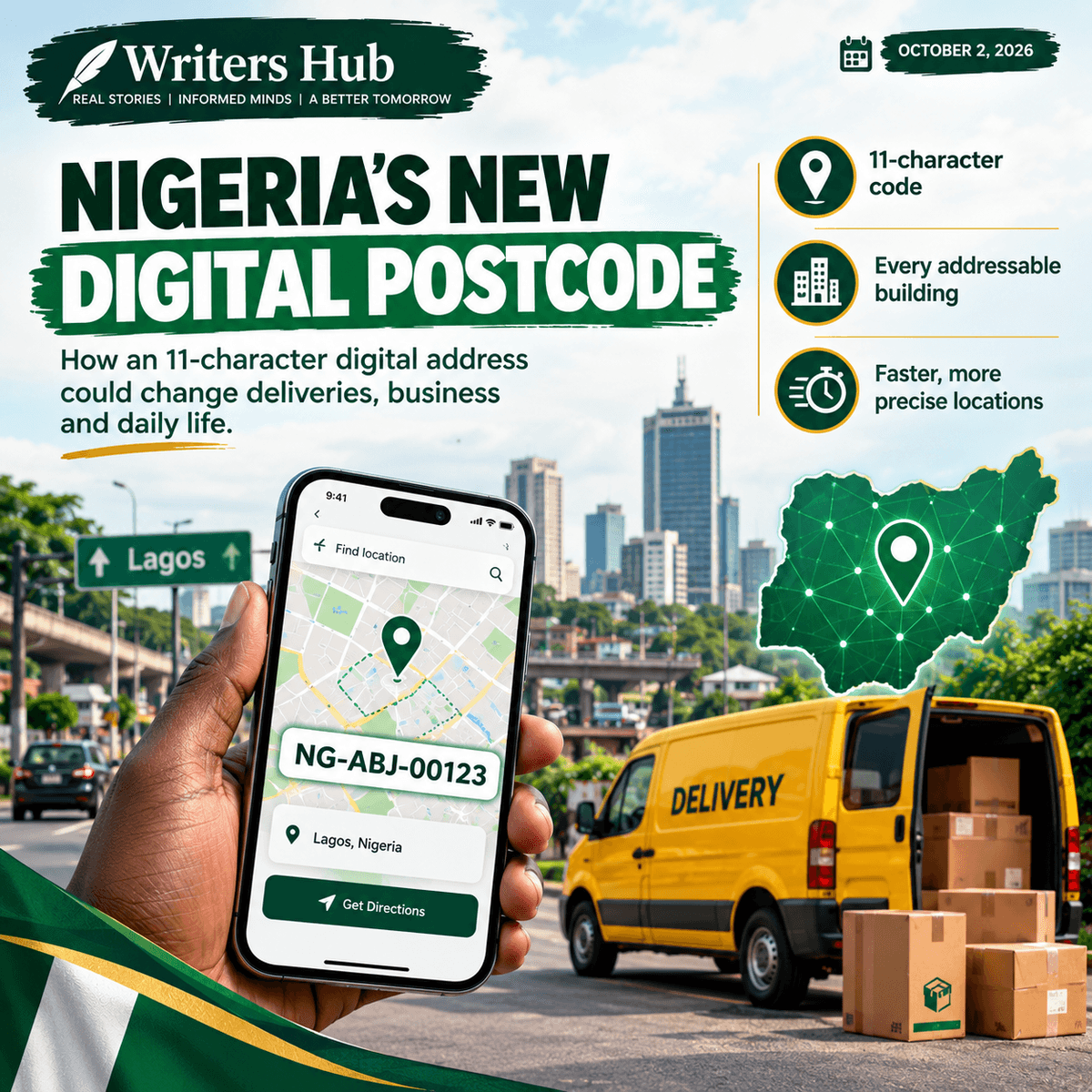
NIGERIA’S NEW DIGITAL POSTCODE: HOW AN 11-CHARACTER CODE COULD CHANGE DELIVERIES, BUSINESS AND DAILY LIFE
Nigeria has officially entered a new phase of digital addressing with the launch of the National Digital Alphanumeric Postcode System, a new nationwide system designed to give every addressable building a unique digital location identity.
The system was launched through the Nigerian Postal Service (NIPOST) on October 1, 2026, and uses Geographic Information System (GIS) technology to identify locations more precisely. Unlike the traditional postcode system, the new system assigns an 11-character alphanumeric code to individual buildings, including homes, shops, offices, schools and other addressable locations.
WHY NIGERIA NEEDS A NEW ADDRESS SYSTEM
For many Nigerians, giving directions still involves landmarks.
“After the mosque.”
“Opposite the big tree.”
“Behind the filling station.”
“Close to the transformer.”
While these descriptions may make sense to people who live in an area, they can create difficulties for delivery companies, emergency responders, businesses and people visiting an unfamiliar location.
The new digital postcode is designed to provide a standard location reference that can be used across different digital services.
According to the Federal Government, the system can help improve logistics, e-commerce, emergency response, financial services and public-service delivery.
HOW DOES THE NEW POSTCODE WORK?
The new postcode is built around five levels of location identification:
STATE → LOCAL GOVERNMENT AREA → DISTRICT → AREA → BUILDING
This means the code is connected to a specific geographical location rather than simply identifying a broad postal region.
NIPOST’s official platform demonstrates the system using codes made up of letters and numbers. Each part of the code contributes to identifying the location.
The postcode belongs to the building rather than the person living or operating there. This means that if someone moves out of a property, the digital postcode remains associated with the location.
WHAT COULD IT MEAN FOR DELIVERIES?
One of the biggest potential uses is logistics.
Online shopping has grown significantly in Nigeria, but locating customers can sometimes be difficult, particularly where streets are poorly mapped or addresses are inconsistent.
A digital postcode could give delivery companies another reliable reference for finding a customer’s exact building.
The Federal Government has said poor addressing contributes to missed and failed deliveries, with officials citing an estimated ₦50 billion to ₦80 billion in annual losses associated with the problem.
If businesses, customers and logistics companies adopt the system widely, the postcode could become another important part of online shopping and delivery transactions.
OPPORTUNITIES FOR SMALL BUSINESSES
The system could also be useful for Nigerian entrepreneurs.
A small business operating from a residential area, for example, can potentially give customers a precise digital location instead of relying entirely on landmarks.
This could be useful for laundry businesses, restaurants, fashion vendors, online stores, pharmacies, repair services and many other businesses that depend on customers finding them or receiving deliveries.
The government is also encouraging developers and technology companies to build services around the new postcode system.
That could create opportunities for Nigerian technology companies to develop new delivery, mapping, address-verification and location-based services.
BEYOND DELIVERIES
The importance of the system goes beyond parcels.
Imagine an emergency where someone needs an ambulance but struggles to describe their exact location. A standard digital location code could provide emergency responders with another way to identify the building.
Government agencies could also use accurate location information for planning infrastructure and delivering public services.
Banks, fintech companies, insurance firms and other organisations may also find applications for reliable address verification.
The official government announcement describes the system as part of Nigeria’s wider digital public infrastructure, with potential applications across logistics, e-commerce, emergency response, financial services and public administration.
NIGERIANS CAN FIND THEIR DIGITAL POSTCODES
The official NIPOST platform allows Nigerians to search for their digital postcodes, save them and share them when necessary.
The system is also available through a mobile application, while organisations can explore integration options for their businesses and digital platforms.
For Nigerians, the real impact of the system will ultimately depend on how widely it is adopted by individuals, businesses, government agencies and technology platforms.
A digital postcode alone cannot solve every addressing problem. But it provides a common digital reference that different services can potentially use.
A NEW DIGITAL IDENTITY FOR NIGERIAN LOCATIONS
Nigeria has spent years dealing with the challenges created by inconsistent addressing. The new postcode system represents an attempt to make location information more precise, standardised and usable in the digital economy.
For a country where people often describe their homes using landmarks, the idea is simple: instead of explaining where you are, you can give a code that identifies the location.
If widely adopted, that small change could have implications for deliveries, businesses, emergency services, e-commerce and public administration.
Nigeria’s streets and communities are not changing overnight. But the way the country identifies them is entering a new digital era.
SOURCE: Nigerian Federal Ministry of Communications, Innovation & Digital Economy; NIPOST; Channels Television and reports published October 1–2, 2026.