Writers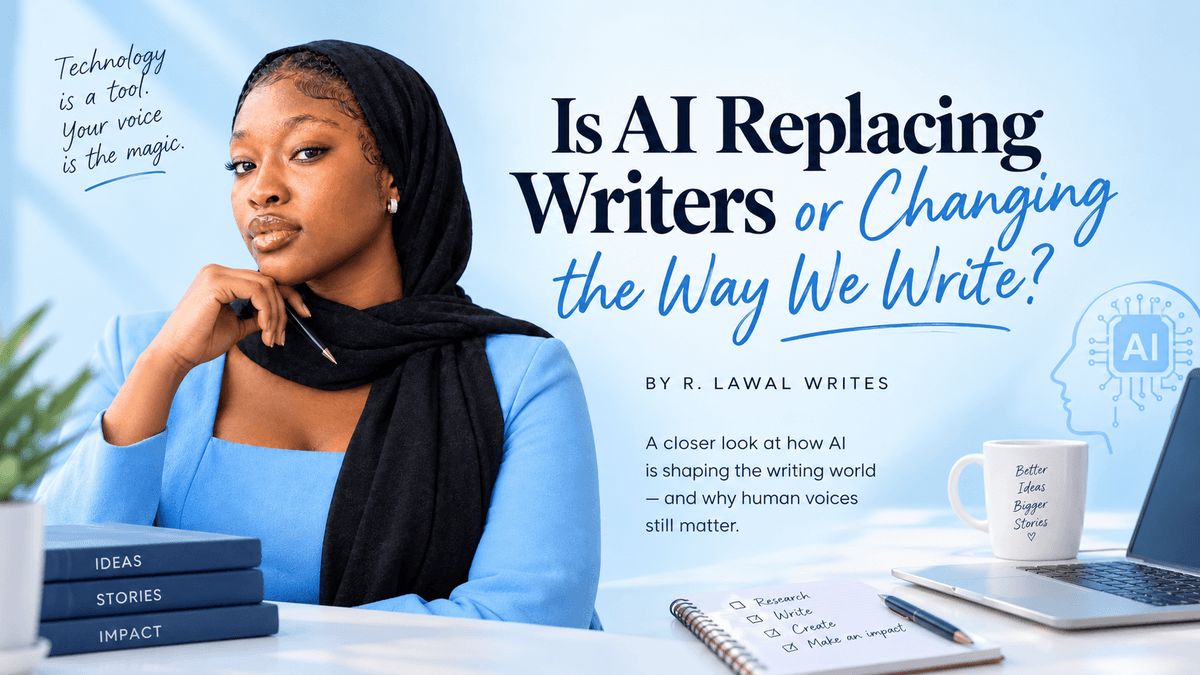
Is AI Replacing Writers or Changing the Way We Write?
By R. Lawal Writes
A few years ago, if someone told me that artificial intelligence would become part of everyday writing, I probably would have imagined something far more complicated.
Today, AI can write emails, create social media captions, summarize long documents, generate ideas, and even help people write entire articles in minutes.
Naturally, this has left many writers asking one uncomfortable question:
Is AI going to replace us?
I don't think the answer is that simple.
AI is changing writing, but I don't believe it means writers are becoming useless. Instead, it is changing what it means to be a writer.
AI Is Already Changing the Writing Process
Writing has never been just about putting words on a page.
Before writing even begins, there is usually research, brainstorming, outlining, editing, rewriting, and trying to understand what the audience actually wants.
AI can now assist with several of these tasks.
For example, a writer can use AI to:
- Brainstorm possible topics and angles.
- Create an initial outline.
- Simplify complicated information.
- Suggest different ways to phrase an idea.
- Identify grammatical errors.
- Generate questions an audience might have.
- Help overcome writer's block.
For a writer staring at a blank page, that kind of assistance can be incredibly useful.
But assistance is not the same thing as authorship.
The Human Part of Writing Still Matters
AI can generate a sentence.
But a sentence is not automatically a story.
Good writing often comes from experience, emotion, observation, personality, and understanding.
Think about a personal story.
Two people can experience the same event and describe it completely differently. Their memories, emotions, personalities, and perspectives will shape the way they tell it.
That human perspective is difficult to replace.
A writer doesn't simply ask, “What words should I use?”
A good writer also asks:
- Who am I speaking to?
- Why does this matter?
- What should the reader feel or understand?
- Does this sound authentic?
- What makes this perspective different?
Those questions are part of what gives writing a voice.
But Writers Also Need to Adapt
At the same time, pretending AI does not exist would be a mistake.
The writing industry is changing, and writers who understand new tools may have an advantage.
The future may not belong to writers who refuse to use AI completely or writers who allow AI to do everything for them.
It may belong to writers who know when to use it and when not to use it.
For example, a writer could use AI to brainstorm ten possible headlines but choose the final one themselves.
They could use it to organize research but verify the information independently.
They could use it to improve clarity while making sure the final piece still sounds like their own voice.
The tool can assist the writer without becoming the writer.
The Real Danger Isn't AI
Perhaps the bigger problem isn't that AI can write.
The problem is what happens when people stop thinking about what they are writing.
If someone simply generates an article, copies the output, and publishes it without checking the facts, adding personality, or considering the reader, the result can feel empty.
And readers notice.
We have all read content that is technically correct but somehow feels lifeless.
It has words.
It has paragraphs.
It may even have perfect grammar.
But there is nothing behind it.
That's where human writers still have an important role.
AI May Actually Make Good Writers Better
There is another side to this conversation that doesn't get enough attention.
AI can remove some of the tedious parts of writing.
Instead of spending a long time trying to create ten possible ideas, a writer can generate possibilities quickly and spend more time developing the strongest one.
Instead of struggling with a rough outline, they can use AI to organize their thoughts and then improve the structure themselves.
That means writers can potentially spend more time on what really matters:
- Research
- Original ideas
- Storytelling
- Strategy
- Creativity
- Editing
- Connecting with readers
Used properly, AI doesn't have to make writing less human.
It can give writers more room to be human.
So, Is AI Replacing Writers?
Some writing tasks are certainly becoming more automated.
AI can already produce a lot of basic and repetitive content.
That reality shouldn't be ignored.
But writing is much bigger than producing sentences.
A writer's value can come from their ideas, judgment, voice, creativity, research, storytelling ability, and understanding of people.
Those things still matter.
Perhaps the better question isn't:
“Will AI replace writers?”
Maybe we should be asking:
“What kind of writer will remain valuable in a world where AI can generate words?”
My answer is simple.
The writer who can think deeply, communicate clearly, tell meaningful stories, understand their audience, and use technology wisely will still have something valuable to offer.
AI may change the way we write.
But what we choose to say and why we choose to say it still matters.